
High SEER AC vs Standard SEER in Mild Climates: Which Is Right for San Diego Homeowners?
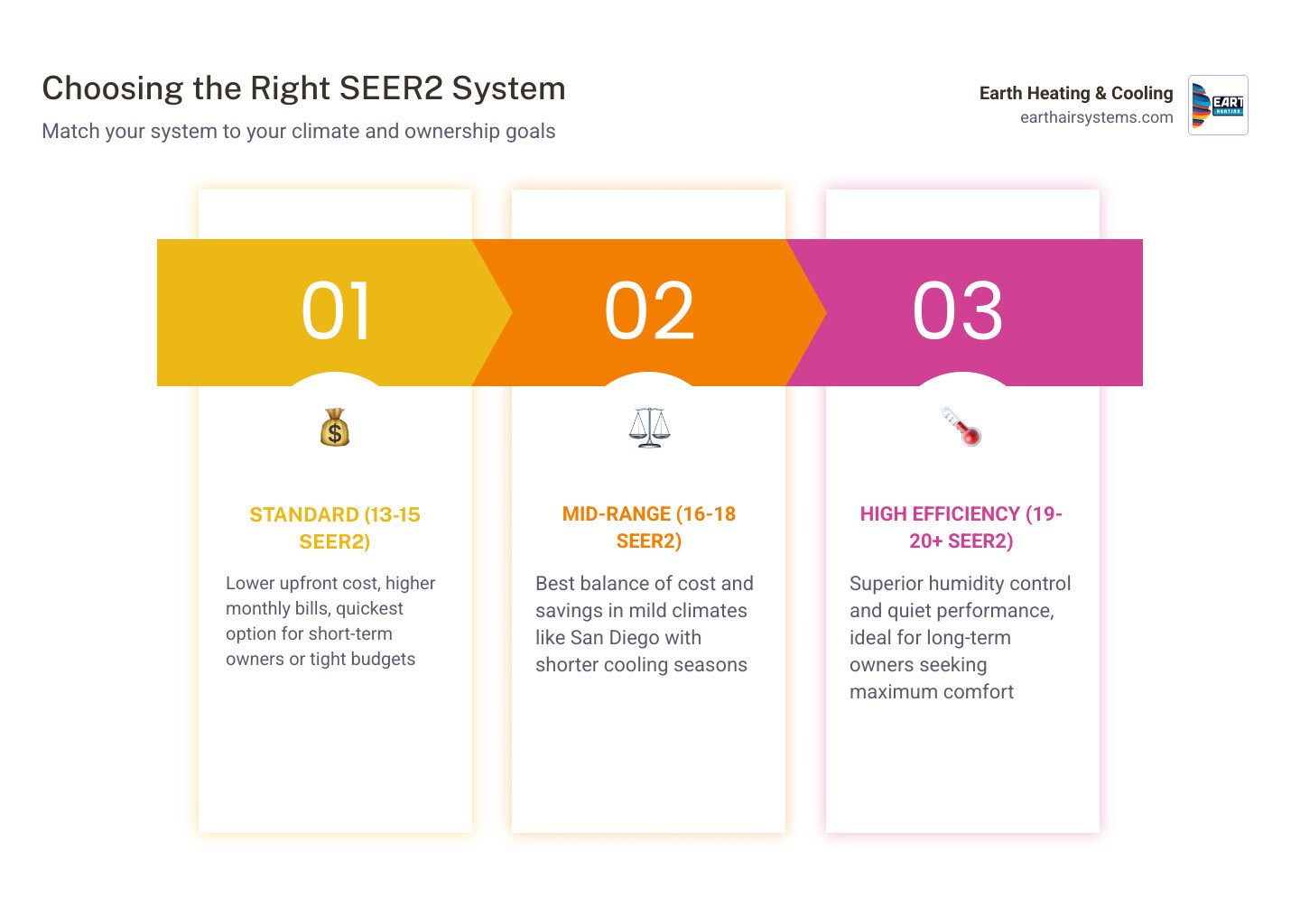
When comparing high SEER AC vs standard SEER in mild climates, the short answer is: a mid-range SEER2 system (around 16–18) typically offers the best balance of upfront cost and long-term savings for most San Diego homeowners. Ultra-high SEER units can stretch payback periods beyond 10 years in mild climates where the AC simply doesn’t run as hard or as often.
Here’s a quick comparison to help you decide:
| Factor | Standard SEER2 (13–15) | High SEER2 (16–20+) |
|---|---|---|
| Upfront cost | Lower | Higher |
| Monthly energy bills | Higher | Lower |
| Payback period (mild climate) | N/A (baseline) | 4–10 years typical |
| Humidity control | Basic | Significantly better |
| Noise level | Louder startup | Quieter, gradual operation |
| Best for | Short-term owners, tight budgets | Long-term owners, comfort-focused |
| Compressor type | Single-stage | Variable-speed or two-stage |
San Diego’s Mediterranean climate means mild summers, cool ocean breezes, and relatively short peak cooling seasons — especially near the coast. That changes the math compared to Phoenix or Houston, where air conditioners run hard for six or more months a year. Here, the efficiency premium of a 20+ SEER2 system may take longer to pay back than it would in a hotter region.
That said, SEER ratings are only part of the story. Since January 1, 2023, the Department of Energy replaced the old SEER standard with SEER2, a more rigorous testing method that better reflects how equipment performs in real homes with real ductwork. Understanding the difference — and knowing what rating makes sense for your specific neighborhood, usage patterns, and ownership timeline — can save you from either overspending on equipment you don’t need or underspending on a system that leaves you uncomfortable.
This guide breaks it all down clearly, so you can make a confident, informed decision for your home.
Basic high seer ac vs standard seer in mild climates terms:
- how much does a high efficiency system save
- is a high efficiency system worth the extra cost
- standard efficiency vs high efficiency hvac comparison
Understanding the Technology: High SEER vs. Standard SEER
To make an informed choice, we first need to look under the hood of these systems. SEER stands for Seasonal Energy Efficiency Ratio. It is essentially the “miles per gallon” rating for your cooling system, calculated by dividing the total cooling output over a typical season by the total electric energy input.
But what about SEER2? Transitioning as the mandatory industry standard, SEER2 uses a newer testing protocol known as the M1 blower test. This updated testing procedure raises the external static pressure from 0.1″ w.g. to 0.5″ w.g.—which is up to five times higher than the old testing parameters. This change is crucial because it accounts for the real-world resistance of home ductwork, giving us a far more realistic look at actual home performance. You can read more about this shift in The Homeowner’s Guide to Understanding SEER2 Efficiency.
The physical differences between standard and high-efficiency systems come down to the compressor and fan motor technology:
- Standard SEER2 Systems (13–15 SEER2): These units typically feature single-stage compressors and basic PSC (Permanent Split Capacitor) blower motors. A single-stage compressor is either 100% on or 100% off. It works like a car with only two speeds: parked and floor-it. When your home warms up, the system kicks on with a loud clunk, blasts cold air until the thermostat is satisfied, and then shuts off.
- High SEER2 Systems (16–20+ SEER2): These systems utilize two-stage or variable-speed compressors paired with advanced ECM (Electronically Commutated) blower motors. Variable-speed compressors can adjust their output in increments as small as 1%, running anywhere from 30% to 100% capacity. Instead of cycling on and off constantly, they run at a low, continuous sip, keeping your home at a perfectly steady temperature. Furthermore, ECM motors use roughly 60% less electricity than standard PSC motors when running at lower speeds.
| Feature | Standard SEER2 (13–15) | High SEER2 (16–20+) |
|---|---|---|
| Compressor Type | Single-stage | Two-stage or Variable-speed |
| Blower Motor | PSC (Standard) | ECM (High-efficiency, variable) |
| Operational Speed | 100% capacity only | Modulating (adjusts in small increments) |
| Energy Consumption | Baseline | Up to 30% to 50% lower energy use |
| Temperature Swings | 2–4 degrees | Virtually none |
High SEER AC vs Standard SEER in Mild Climates: Does Climate Matter?

Geography is the single most important factor when weighing the benefits of high seer ac vs standard seer in mild climates. If you live in an area with extreme summer heat, upgrading to the highest possible SEER rating is a no-brainer. But here in San Diego County, our Mediterranean climate changes the financial equation entirely.
Our weather is heavily influenced by microclimates. If you reside in coastal communities like La Jolla, Coronado, Oceanside, or Solana Beach, your cooling demand is exceptionally low. The marine layer keeps afternoon temperatures mild, meaning you might only run your air conditioner for a few weeks out of the year. In these coastal zones, the extra upfront equipment cost of a 20+ SEER2 system may never be recovered through utility bill savings. A standard-efficiency or mid-range system is often the most practical choice.
However, as you move inland toward Escondido, El Cajon, or San Marcos, summer temperatures regularly climb into the 90s, and cooling seasons stretch much longer. Additionally, seasonal Santa Ana wind events can bring sudden, extreme temperature spikes and dry heat. In these inland neighborhoods, a higher SEER2 system starts to make a lot more sense.
To help you navigate these microclimates and choose the perfect system configuration for your specific neighborhood, check out our Best HVAC Setup for San Diego County Weather: A Complete Guide.
Real-World Energy Savings and Financial Payback
How much can you actually expect to save on your utility bills by upgrading? The mathematical differences between SEER tiers are significant:
- Upgrading from a legacy 9 SEER to a 14 SEER system can reduce your cooling energy consumption by more than 35%.
- Upgrading from 14 SEER to 16 SEER provides a moderate efficiency boost of approximately 14%.
- An 18 SEER system is generally about 10–12% more efficient than a 16 SEER system under similar conditions.
- Moving from a standard 14 SEER rating to a high-efficiency 20 SEER2 rating can result in energy savings of up to 30% or more. In fact, a 20 SEER system is roughly 43% more efficient than a 14 SEER unit overall, and upgrading from a 14 SEER unit to a 20 SEER2 system can reduce energy consumption by up to 50% under optimal conditions.
To run the numbers for your specific household, you can use our SEER Calculator and learn How to Calculate Energy Bill Savings.
While those percentage drops sound fantastic, your actual return on investment (ROI) depends on how many hours your system runs and local utility rates. San Diego has some of the highest electricity rates in the country, and our time-of-use (TOU) billing means running your AC during peak afternoon and evening hours is incredibly expensive.
Because of these high rates, even a modest reduction in energy use can translate to noticeable dollar savings on your monthly bill. However, because our overall cooling season is relatively short compared to desert regions, the typical payback period for a high-efficiency system in San Diego ranges from 4 to 10 years.
If you plan to stay in your home for more than 5 to 10 years, investing in a high-efficiency system is highly beneficial, as it will eventually pay for itself and continue to save you money. On the other hand, if you plan to downsize or relocate within the next 2 to 3 years, a standard-efficiency system is likely the more practical and economical choice. For a deeper look at this financial balance, read through our High Efficiency System Savings vs Cost Guide and The Ultimate Guide to HVAC ROI and Home Value. You can also weigh the overall pros and cons in our guide on the Pros and Cons of Upgrading to High Efficiency HVAC Equipment.
Comfort, Humidity, and Crucial Installation Factors
While energy savings get all the headlines, daily indoor comfort is where high-efficiency systems truly shine. However, achieving those rated efficiencies and comfort levels depends heavily on proper installation and system sizing.
We cannot stress this enough: proper sizing and installation quality matter just as much as the SEER rating itself. A poor installation can reduce your system’s real-world efficiency by up to 30%. Before installing any system, a professional HVAC contractor must perform a Manual J load calculation. This calculation looks at your home’s square footage, ceiling heights, insulation levels, window types, and sun exposure to determine the exact cooling capacity (tonnage) your home requires.
- Oversized systems will short-cycle, turning on and off rapidly. This leads to uneven room temperatures, high energy bills, and premature wear and tear.
- Undersized systems will run continuously without ever reaching your desired thermostat setting, wasting energy and stressing the compressor.
Your ductwork is another critical piece of the puzzle. The average home loses 20% to 30% of its conditioned air through duct leakage. If you connect a brand-new, ultra-high SEER2 system to leaky, uninsulated ducts, you are essentially throwing your energy savings right out of the attic.
Finally, to keep your chosen system running at peak efficiency for its entire 15-to-20-year lifespan, regular maintenance is essential. Learn more about protecting your investment in Mild Climates and Maintenance: How Often Should You Service Your System?.
Dehumidification Benefits of High SEER AC vs Standard SEER in Mild Climates
In coastal San Diego communities like Pacifica, Point Loma, or Carlsbad, humidity is often a bigger comfort challenge than actual heat. The morning marine layer can leave indoor air feeling damp and clammy, even when the thermometer only reads 72 degrees.
Standard single-stage air conditioners are terrible at managing humidity in mild weather. Because they cool the air very quickly, they satisfy the thermostat and shut off before they have run long enough to pull moisture out of the air. This leaves you with cold, sticky indoor air.
High SEER2 systems with variable-speed compressors are the ultimate weapon against humidity. Because they can run continuously at a low, gentle speed, they act like giant, whole-home dehumidifiers. They keep the air circulating across the cold evaporator coil for longer periods, extracting maximum moisture without over-cooling your home. Removing this excess humidity allows you to set your thermostat a few degrees higher while remaining perfectly comfortable, saving you even more on your utility bills.
Noise Levels and Variable-Speed Performance of High SEER AC vs Standard SEER in Mild Climates
If you enjoy spending time in your backyard or have an AC condenser located right outside a bedroom window, noise level is a major consideration.
Standard-efficiency systems are notoriously loud. They often start up with a loud mechanical clunk and run with a constant, high-decibel hum. High-efficiency systems, by contrast, are engineered for quiet operation. Many premium variable-speed models operate as quietly as 58 decibels—which is about the volume of a normal, quiet conversation.
Because variable-speed systems ramp up and down gradually rather than blasting on at full capacity, you won’t experience that sudden “jet engine taking off” sound in the middle of the night. Sound-dampening compressor blankets and aerodynamic fan blades ensure that these units run whisper-quiet, keeping both you and your neighbors happy.
Frequently Asked Questions About AC Efficiency
What are the minimum SEER2 requirements in California?
The U.S. Department of Energy enforces regional minimum efficiency standards. As of the current standards in 2026, California has some of the strictest energy regulations in the country. For split-system air conditioners under 45,000 BTU, the minimum allowable rating for new installations is 14.3 SEER2. Split-system heat pumps must also meet a minimum of 14.3 SEER2 in all regions. Any new equipment installed in your home must comply with these regional baselines and state Title 24 building standards.
Are there tax credits or rebates available for high SEER ACs in 2026?
Yes! Under Section 25C of the Internal Revenue Code, homeowners can claim federal tax credits of up to $2,000 for qualifying high-efficiency heat pumps and central air systems that meet specific ENERGY STAR efficiency tiers. Additionally, local utility companies frequently offer rebates for upgrading to high-efficiency systems, and ENERGY STAR-certified air conditioners consume about 8% less energy than conventional new models, making them highly eligible for these incentives. Be sure to ask us for documentation to help you claim these savings.
How long do high-efficiency AC systems typically last?
A professionally installed central air conditioner or heat pump typically has an equipment lifespan of 15 to 20 years. High-efficiency systems often experience less wear and tear over their lifespan because their variable-speed compressors avoid the frequent, harsh “hard starts” that stress standard single-stage motors. Regular annual maintenance is the best way to ensure your system reaches its maximum lifespan.
Conclusion
Choosing between a high SEER and standard SEER air conditioner in San Diego’s mild climate isn’t about finding a single “correct” number. It’s about finding the sweet spot where your upfront investment matches your long-term comfort, neighborhood microclimate, and financial goals. For many local families, a mid-range system in the 16 to 18 SEER2 range hits that perfect balance, providing excellent energy savings and superior comfort without the premium price tag of ultra-high-efficiency units.
At Earth Air Heating & Cooling, we bring over 40 years of hands-on experience to every home. We are dedicated to helping you find the perfect heating and cooling setup for your unique space. We offer transparent service, professional load calculations, and a 100% satisfaction guarantee across San Diego, Carlsbad, Encinitas, Chula Vista, and beyond.
Ready to find the perfect fit for your home? Explore our Air Conditioning Services in San Diego today to schedule your personalized comfort consultation!
