
Why SEER2 Ratings Matter for Every Homeowner
SEER2 rating explained for homeowners in plain terms: it’s the updated federal standard that measures how efficiently your air conditioner or heat pump cools your home over an entire season — and as of January 1, 2023, it replaced the old SEER rating on all new HVAC equipment.
Here’s a quick breakdown of what that means for you:
- SEER2 stands for Seasonal Energy Efficiency Ratio 2 — a revised efficiency score set by the U.S. Department of Energy
- Higher numbers = greater efficiency — and lower monthly energy bills
- The minimum in Southern states (including California) is now 14.3 SEER2 for split-system air conditioners
- The old SEER and new SEER2 are not the same scale — a 14 SEER unit from before 2023 is roughly equivalent to 13.4 SEER2
- SEER2 reflects real-world performance more accurately than the old standard, thanks to stricter lab testing that simulates actual ductwork conditions in your home
If you’ve been shopping for a new AC or heat pump, or if your system is aging and you’re wondering what all these new numbers mean, you’re in the right place. Air conditioning accounts for about 6% of all electricity used in the U.S., and the switch to SEER2 is one of the most significant changes to hit the HVAC industry in decades. Understanding it helps you make smarter decisions about your home comfort and energy costs.
What is a SEER2 Rating Explained for Homeowners?
When we talk about the seer2 rating explained for homeowners, we are looking at a mathematical ratio. Specifically, SEER2 measures the total cooling output of an air conditioner or heat pump over a typical cooling season, divided by the total electric energy input (in watt-hours) it uses during that same period.
Think of it like the “Miles Per Gallon” (MPG) for your home’s cooling system. Just as a car that gets 40 MPG is more efficient than one that gets 20 MPG, an AC unit with a 20 SEER2 rating is significantly more efficient than one with a 14.3 SEER2 rating.
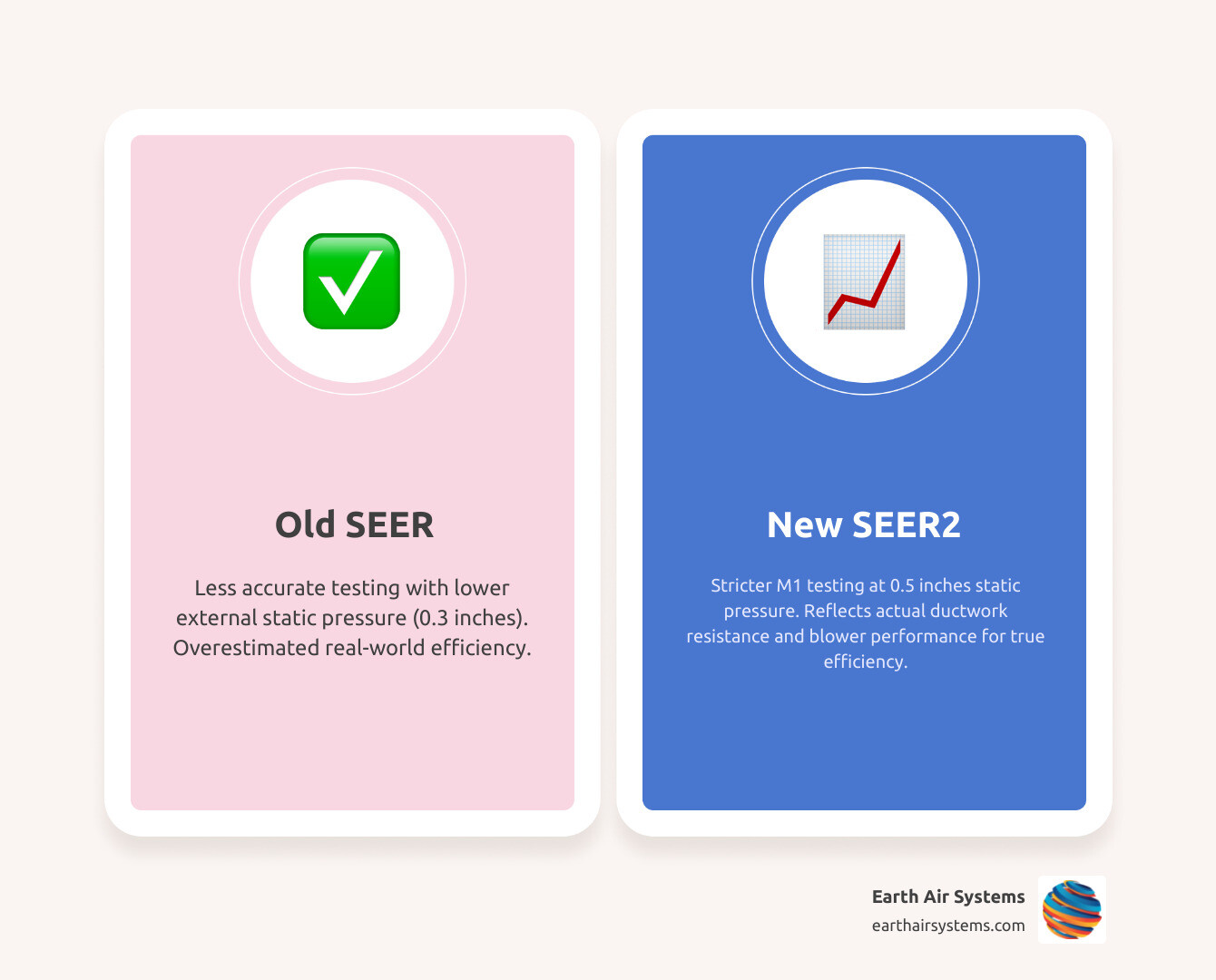
The “2” in SEER2 comes from the Department of Energy’s (DOE) updated “M1” testing procedure. In the past, the original SEER tests were conducted in a laboratory environment that didn’t quite match the reality of a home. The new M1 testing procedure increases the external static pressure—the resistance the air faces as it moves through your ducts—by a factor of five. It moved from 0.1 inches of water to 0.5 inches of water. This change makes the rating much more accurate because it accounts for the actual push-back your blower motor experiences once the unit is hooked up to your home’s ductwork.
SEER vs. SEER2: Testing Protocol Comparison
| Feature | Original SEER (Pre-2023) | SEER2 (2023 and Beyond) |
|---|---|---|
| Testing Procedure | M Testing | M1 Testing |
| Static Pressure | 0.1 in. of water | 0.5 in. of water |
| Accuracy | Theoretical/Lab-based | Real-world simulation |
| Blower Performance | Not fully represented | Includes blower motor load |
| Rating Value | Higher numerical value | ~4.7% lower numerical value |
Why the Shift from SEER to SEER2 Matters
The transition to SEER2 wasn’t just a bureaucratic update; it was a necessary move toward honesty in energy reporting. For years, HVAC systems were tested under conditions that were “too perfect.” In a lab, there are no leaky ducts, no narrow vents, and no long runs of piping. In your San Diego home, all those factors exist.
By requiring manufacturers to test systems under 0.5 inches of static pressure, the DOE ensures that the efficiency number you see on the box is closer to what you’ll actually experience. This matters for energy conservation across the country. Air conditioning contributes roughly 117 million metric tons of CO2 emissions annually in the U.S. By improving the accuracy of these ratings, we can better manage our environmental footprint and help homeowners save money on Air Conditioning Services in San Diego.
How SEER2 Rating Explained for Homeowners Differs from Original SEER
Because the new testing is much more difficult, the numerical ratings for the same piece of equipment actually dropped. This can be confusing! If you had a unit that was rated 15 SEER under the old rules, that same unit might only be rated 14.3 SEER2 today.
The math shows that SEER2 ratings are approximately 4.7% to 5% lower than original SEER ratings. To get a rough estimate of how your old system compares to new standards, you can use a SEER Calculator or simply divide an old SEER rating by 1.05 to see what its SEER2 equivalent would be. For example, a 14 SEER unit is roughly equal to a 13.4 SEER2 unit.
Regional Minimums and Compliance Standards
The Department of Energy doesn’t apply the same rules to every state. Since the cooling needs in San Diego are much higher than those in Maine, the requirements are stricter here. The U.S. is divided into three regions: North, Southeast, and Southwest.
California falls into the Southwest region, which has some of the highest standards in the nation. Not only must we follow federal SEER2 minimums, but we also have to comply with California’s Title 24 Building Energy Efficiency Standards. These standards emphasize proper AC Installation in San Diego to ensure that the equipment isn’t just efficient on paper, but also installed in a way that prevents energy waste.
Understanding the SEER2 Rating Explained for Homeowners in 2026
As of April 2026, the rules are very clear for our local area. For any new split-system central air conditioner installed in San Diego, the minimum requirement is 14.3 SEER2. If you are installing a heat pump, the national minimum is also 14.3 SEER2 (equivalent to about 15 SEER under the old system).
In California, compliance often involves HERS (Home Energy Rating System) testing. This is a third-party verification where a rater checks the duct leakage and airflow of your new system to ensure it meets state codes. When you are planning an AC Replacement in San Diego, it is vital to work with a licensed contractor who understands these specific regional mandates.
Benefits of Choosing High-Efficiency HVAC Systems
While 14.3 SEER2 is the legal minimum, many homeowners choose to go much higher. Modern units can reach ratings of 20 SEER2 or even 22+ SEER2. But is the extra investment worth it? Usually, the answer is a resounding yes, especially in our climate.
- Lower Utility Bills: An 18 SEER2 unit is about 20% more energy efficient than a 14.3 SEER2 unit. A 20 SEER2 unit can be up to 43% more efficient. Over the 15-to-20-year lifespan of a system, those monthly savings add up to thousands of dollars.
- Better Comfort and Humidity Control: High-efficiency units often use variable-speed technology. Instead of being 100% “on” or 100% “off,” they can run at lower speeds for longer periods. This allows for much better dehumidification. As we often say, 74°F with high humidity feels much warmer than 76°F with low humidity.
- Quieter Operation: Systems with higher SEER2 ratings typically feature advanced sound-dampening insulation and variable-speed compressors that don’t make the loud “clunk” when they kick on.
- Environmental Impact: Reducing your electricity usage directly lowers your carbon footprint. If you are looking into a Heat Pump Replacement in San Diego, you are already choosing a more sustainable path by moving away from gas-fired heating.
Incentives and Tax Credits
The upfront cost of a high-efficiency system is often offset by the Inflation Reduction Act (IRA). Under this federal law, homeowners can qualify for significant tax credits for installing energy-efficient equipment.
To qualify for these federal incentives, split-system heat pumps generally need to meet a 16 SEER2 threshold. There are also rebates available through various local utility programs and ENERGY STAR® certifications. If you have questions about which units qualify, checking our HVAC FAQs can provide more clarity on the current requirements.
Frequently Asked Questions about SEER2
Is my current HVAC system SEER2 compliant?
If your system was installed before January 1, 2023, it was likely rated under the old SEER standards. Does this mean you have to replace it? No. The SEER2 regulations apply to the manufacture and installation of new equipment. Your current system is “grandfathered” in.
However, if your system is more than 10–12 years old, it likely has a SEER rating of 10 or 13. Upgrading to a modern SEER2-compliant unit could cut your cooling costs by 30% or more. In the meantime, the best way to keep an older system running efficiently is through regular Heating Services in San Diego and AC maintenance to ensure coils are clean and refrigerant levels are correct.
What is the difference between SEER2, EER2, and HSPF2?
While SEER2 is the most common term, you might see these other acronyms on an EnergyGuide label:
- EER2 (Energy Efficiency Ratio 2): This measures efficiency at a specific, peak temperature (usually 95°F). While SEER2 tells you how the unit performs over a whole season, EER2 tells you how it performs on the hottest day of the year.
- HSPF2 (Heating Seasonal Performance Factor 2): This is the heating equivalent of SEER2. It measures the efficiency of a heat pump during the heating season. For homeowners looking into How to Find the Best AC Replacement in La Jolla, CA, understanding HSPF2 is crucial if you plan to use your system for year-round comfort.
Is a higher SEER2 unit worth the investment?
The “sweet spot” for most homeowners is usually between 16 and 18 SEER2. These units offer a great balance of upfront cost and long-term savings. If you plan to stay in your home for more than five years, the energy savings usually pay for the price difference between a base model and a high-efficiency model.
If you are Finding AC Installation in National City, CA, consider your specific microclimate. Coastal homes might prioritize humidity control, while inland homes in Escondido or El Cajon will see a much faster return on investment from a high SEER2 unit due to the intense summer heat.
Conclusion
Navigating HVAC efficiency can feel like learning a second language, but it all boils down to one goal: keeping your home comfortable without breaking the bank. At Earth Air Systems, we’ve spent over 40 years helping San Diego families find the perfect balance of performance and value.
Whether you need a simple repair or a full system upgrade, our team is here to provide flat-rate pricing and expert guidance on the latest SEER2 standards. Don’t settle for a “one-size-fits-all” approach—ensure your system is sized correctly and optimized for our unique Southern California climate.
Ready to see how much you could save by switching to a more efficient system? Calculate your potential savings with our SEER Calculator and take the first step toward a more comfortable, energy-efficient home today.
