
Why San Diego County’s Climate Is Harder on Your HVAC Than You Think
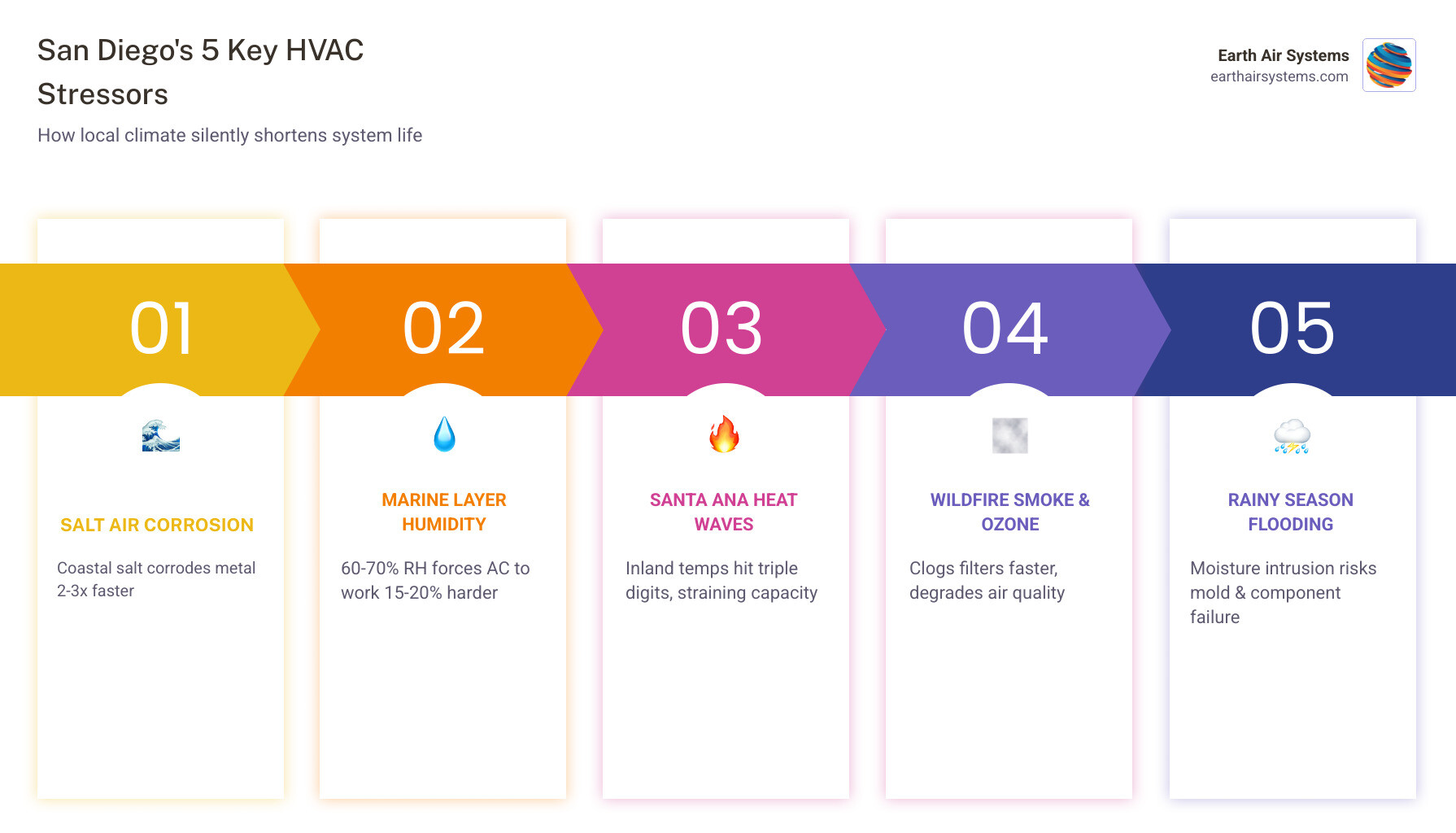
How San Diego County climate affects your HVAC comes down to five key forces working against your system year-round:
- Salt air and coastal humidity corrode metal components 2-3x faster than dry inland climates
- Marine layer moisture pushes relative humidity to 60-70%, forcing your AC to work 15-20% harder
- Santa Ana winds and heat waves spike inland temperatures into triple digits, straining cooling capacity
- Wildfire smoke, ozone, and seasonal pollen clog filters faster and degrade indoor air quality
- Rainy season moisture creates flood risk, condensate overflow, and mold conditions around your equipment
San Diego has a reputation for perfect weather. And honestly, it mostly deserves it. But that mild, coastal paradise hides a set of climate conditions that quietly push HVAC systems harder than most homeowners expect. The same marine layer that keeps summer temperatures comfortable also carries salt particles and moisture deep into your outdoor unit. The same dry Santa Ana winds that bring warm fall days also dump wildfire ash straight into your air filters. Even the short, concentrated rainy season creates flash flooding risks around outdoor condenser units that most people never think about until water is already pooling.
The result? HVAC systems in San Diego face a unique combination of stressors that don’t show up clearly until something breaks — or until your energy bill starts climbing without explanation.
This guide breaks down exactly what’s happening, why it matters for your specific location in the county, and what you can do to protect your system before small problems become expensive ones.
Understanding How San Diego County Climate Affects Your HVAC System
In San Diego, we often joke that we live in “two climates in a trench coat.” If you are in La Jolla or Coronado, you are dealing with the cool, damp marine layer and salty breezes. Drive just 15 to 20 miles inland to Escondido or El Cajon, and you are suddenly in a semi-arid environment where triple-digit heat waves are the norm in late summer. This geographic split is the primary reason why there is no “one-size-fits-all” solution for home comfort here.
The way how san diego county climate affects your hvac depends heavily on these microclimates. Coastal residents might rarely turn on their heaters, but their air conditioners are constantly fighting high humidity. Meanwhile, inland residents face massive temperature swings — chilly winter nights that dip toward freezing and blistering summer afternoons that force the AC to run for ten hours straight.
When extreme weather hits, such as the “July Fry” or the fierce Santa Ana winds of autumn, your system isn’t just cooling the air; it’s acting as a frontline defense against outdoor pollutants and moisture. If your system was sized for a “standard” climate, it might struggle to keep up with San Diego’s specific demands. This is why professional Air Conditioning Services in San Diego focus so heavily on load calculations that account for your specific neighborhood’s sun exposure and elevation.
| Feature | Coastal San Diego (0-5 miles inland) | Inland San Diego (15+ miles inland) |
|---|---|---|
| Primary Stressor | Salt Air & Humidity | Extreme Heat & Dust |
| Avg. Relative Humidity | 60% – 70% | 20% – 40% |
| Corrosion Risk | High (2-3x faster) | Low |
| Filtration Needs | High (Mold/Pollen) | High (Dust/Smoke/Ash) |
| System Load | Dehumidification heavy | Cooling capacity heavy |
The Impact of Salt Air and Coastal Humidity on System Longevity
If you live within five miles of the Pacific, your HVAC system is essentially living in a giant, slow-motion battery. The combination of salt particles from the ocean and the consistent moisture of the marine layer creates an electrolytic reaction. This chemical process eats away at the copper and aluminum in your outdoor unit.
Research shows that salt in coastal air accelerates corrosion on metal components at rates 2 to 3 times faster than in dry inland climates. You might notice the thin aluminum “fins” on your outdoor unit beginning to crumble or turn into a white powder. This is coil degradation. Once those fins disappear, your system loses its ability to release heat, forcing the compressor to work harder and hotter until it eventually fails.
Because of this, systems near the San Diego coast often need replacement parts 40% more frequently than those in protected inland valleys. To fight this, we recommend The Ultimate Guide to AC Maintenance Services in San Diego which includes specialized coil cleaning to rinse away salt deposits before they can bond to the metal.
How San Diego County Climate Affects Your HVAC Efficiency in Coastal Zones
Efficiency isn’t just about how cold the air is; it’s about how dry it is. Coastal San Diego’s average relative humidity levels hover between 60-70% year-round. For your AC to make a room feel comfortable, it must first remove that moisture.
This dehumidification load can increase AC operating costs by 15-20% compared to drier climates. If your system is poorly maintained, it has to run longer cycles to wring the water out of the air. These longer run times don’t just spike your electric bill; they lead to “short-cycling” and increased wear on the blower motor and electrical contacts.
Seasonal Challenges: Wildfires, Ozone, and Indoor Air Quality
San Diego’s air quality typically ranges between the mid-20s to the mid-60s on the US AQI scale. While that sounds “good,” the main culprit hurting our scores is ozone pollution, which thrives in our sunny, subtropical climate. Ozone is a corrosive gas that can irritate the lungs, and your HVAC system is the primary filter standing between that gas and your family.
Then there’s the “Fire Season.” During Santa Ana wind events, wildfire smoke and fine ash can travel for miles. This ash is incredibly abrasive and can clog a standard air filter in a matter of days. When filters clog, airflow drops, and your system can actually “freeze up,” leading to a total cooling failure right when the outdoor temperatures are at their highest.
Furthermore, indoor air quality can be up to five times worse than outdoor air quality in San Diego homes. This is often exacerbated by the fact that we keep our homes sealed tight during heat waves, trapping allergens, pet dander, and smog inside. To combat this, many homeowners are turning to professional Air Quality Services in San Diego to install advanced purification systems.
Managing Indoor Air Quality and How San Diego County Climate Affects Your HVAC Filtration
To keep your air breathable, you need more than just a 99-cent fiberglass filter. We recommend:
- HEPA-Grade Filtration: To capture the fine particulate matter (PM2.5) found in wildfire smoke.
- Air Scrubbers: These use UV light and specialized technology to neutralize ozone and biological contaminants.
- Professional Duct Sealing: In coastal homes, leaky ducts don’t just lose cold air; they pull in humid, salty air from attics and crawlspaces. Professional duct sealing can improve overall HVAC system performance by 20-30% by preventing this infiltration.
If you have more questions about which filter is right for your home, our HVAC FAQs provide a deep dive into MERV ratings and filtration types.
Protecting Your System During the Rainy Season and Heat Waves
San Diego doesn’t get a lot of rain, but when it does, it usually comes in “concentrated bursts.” This Mediterranean rain pattern often leads to flash flooding. If your outdoor unit is sitting in a low-spot in your yard, standing water can damage the electrical “guts” of the machine. We often suggest elevating units by 4 to 6 inches on a sturdy pad to prevent this.
Humidity spikes during the rainy season (November through March) also place a heavy burden on your condensate management system. Your AC or heat pump creates water as it runs, and that water has to go somewhere.
Crucial Regulatory Note: In San Diego, you cannot just let that water run into the street. Discharging air conditioning condensate into San Diego’s storm sewer system without controls violates Municipal Code §43.0305(e)(1). Penalties for this can reach up to $10,000 per day per incident because the water can carry copper and other pollutants into our oceans. Proper drainage should be directed toward landscaping or a sanitary sewer line.
While we focus a lot on cooling, don’t forget that inland areas still need reliable Heating Services in San Diego for those winter nights when the desert air turns cold.
Choosing the Best HVAC Setup for Local Microclimates
If you are installing a new system in April 2026, you have more options than ever. But the “best” setup depends on your zip code:
- Coastal Areas (La Jolla, Carlsbad, Coronado): Look for “Coastal-Rated” equipment. These units come with factory-applied e-coatings or copper fins that resist salt corrosion. Mini-split systems are also excellent here, as they allow for zoned cooling in homes that might not have traditional ductwork.
- Inland Areas (Escondido, San Marcos, Chula Vista): High SEER2 ratings (16+) are essential to keep energy costs down during 100-degree weeks. Heat pumps are incredibly efficient in our climate because they handle both the mild winters and the hot summers using electricity rather than gas.
- Variable-Speed Compressors: Unlike older “on/off” systems, these can run at lower speeds to provide constant dehumidification, which is a game-changer for San Diego’s morning marine layers.
No matter where you live, check our Service Areas to see how we tailor our installations to your specific neighborhood’s weather patterns.
Frequently Asked Questions about San Diego HVAC
Why does my AC unit rust faster in coastal San Diego?
It’s all about the salt. The Pacific Ocean releases salt spray into the air, which the marine layer then carries inland. When this salt settles on your AC’s metal coils and meets moisture, it triggers oxidation and an electrolytic reaction. This “eats” the metal. To prevent this, we use protective coatings and sometimes install “sacrificial anodes”—the same technology used on boat hulls—to attract the corrosion away from your expensive HVAC components.
Is it illegal to drain AC condensate into the storm drain?
Yes, according to San Diego Municipal Code §43.0305(e)(1), it is illegal to discharge untreated AC condensate into the storm drain system. Storm drains lead directly to our creeks and the ocean without being treated. The best practice is to drain the water into your landscaping (where the plants will love it!) or have it professionally tied into your home’s sanitary sewer system.
How often should I service my HVAC in San Diego’s climate?
We recommend bi-annual maintenance. A pre-summer check ensures your system can handle the “July Fry” and Santa Ana heat waves without the compressor overheating. A pre-winter inspection ensures your furnace or heat pump is ready for the chilly inland nights. In coastal zones, we specifically focus on cleaning the coils to remove salt buildup during these visits.
Conclusion
At Earth Air Systems, we have seen how san diego county climate affects your hvac over our 40+ years of experience. From the rusted units of Ocean Beach to the overworked systems of Escondido, we know that proactive maintenance is the only way to ensure your system lives its full 12-to-15-year lifespan.
Living in San Diego is a dream, but your HVAC system needs a little extra help to survive the salt, smoke, and heat that come with the territory. Whether you need a quick repair, a seasonal tune-up, or a full system replacement with coastal-rated equipment, our team is committed to your 100% satisfaction.
Don’t wait for the next heat wave to find out if your system is up to the task. Contact us today for expert Air Conditioning Services in San Diego and let us help you stay comfortable, no matter what the microclimate throws your way.
