How Much Does a High Efficiency System Save San Diego Homeowners?
How much does a high efficiency system save depends on what you’re replacing and how often you run it — but the numbers are significant enough to pay close attention to before your next upgrade.
Here’s a quick snapshot of typical annual savings by upgrade type:
| Upgrade | Estimated Annual Savings | 10-Year Savings |
|---|---|---|
| 80% to 96% AFUE furnace | $200–$260/year | $2,000–$2,600 |
| 10 SEER to 18 SEER2 AC | 40%+ reduction in cooling costs | ~$5,000 over 5 years |
| 14 SEER2 to 18 SEER2 AC | $120–$300/year | $1,200–$3,000 |
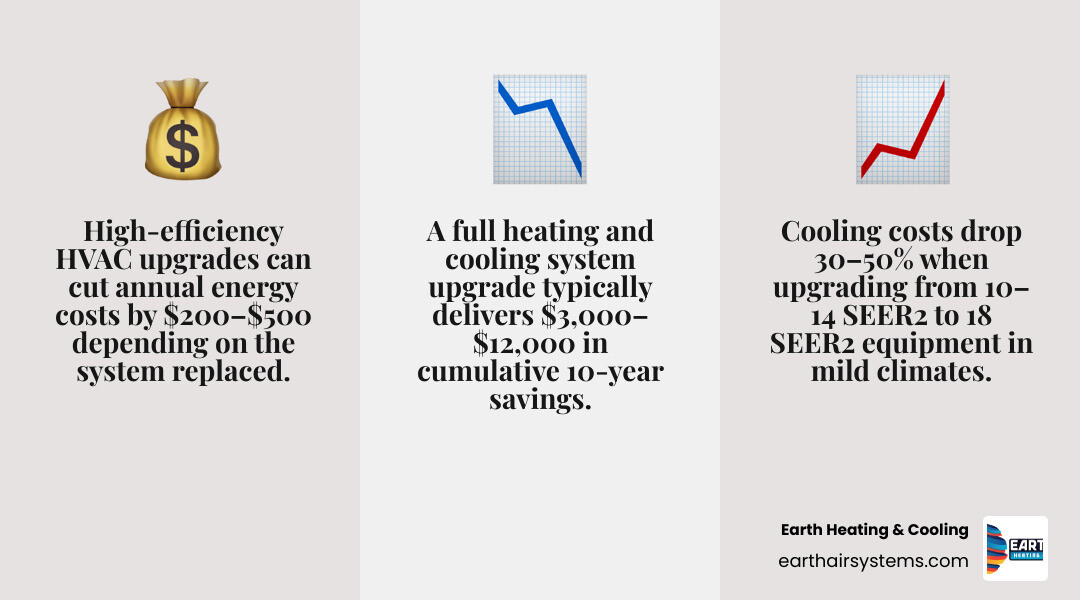
| Full system upgrade (heating + cooling) | 30–50% total HVAC energy reduction | $3,000–$12,000 |
| Adding a smart thermostat | ~$100–$180/year | $1,000–$1,800 |
Nearly half of the energy used in a typical home goes toward heating and cooling. That makes your HVAC system the single biggest driver of your monthly utility bill — and the biggest opportunity for savings when it’s time to upgrade.
For San Diego homeowners, the equation looks a little different than it does in colder parts of the country. Mild winters mean heating costs are lower, but summers still push AC systems to work hard. Knowing exactly where your savings will come from — cooling, heating, or both — helps you make a smarter investment decision.
In this guide, Earth Air Heating & Cooling walks you through the real math: what efficiency ratings mean, how much you can realistically expect to save, and which factors will determine whether a high-efficiency upgrade pays off for your home.
For more ways to cut energy costs year-round, check out our guide on how to beat the heat and the bill with San Diego energy tips.
Easy how much does a high efficiency system save word list:
- is a high efficiency system worth the extra cost
- standard efficiency vs high efficiency hvac comparison
Decoding HVAC Efficiency Ratings: SEER2, AFUE, and HSPF2
Before we look at the potential savings, it helps to understand the language of HVAC efficiency. When shopping for a new system, you will see three main ratings: SEER2, AFUE, and HSPF2. These ratings tell you exactly how much heating or cooling you get for every dollar you spend on electricity or gas.
SEER2 (Seasonal Energy Efficiency Ratio 2)
SEER2 measures the cooling efficiency of central air conditioners and heat pumps over an entire cooling season. The higher the number, the more efficient the unit.
The industry transitioned to SEER2 testing protocols to better reflect real-world installation conditions. Unlike the old SEER standards, SEER2 testing accounts for the actual static pressure found in typical home ductwork. This makes the rating much more accurate for modern homes. A system rated at 18 SEER2 uses significantly less electricity than an older 10 or 14 SEER system. To dive deeper into these cooling metrics, check out The Homeowner’s Guide to Understanding SEER2 Efficiency.
AFUE (Annual Fuel Utilization Efficiency)
AFUE is the standard rating system for gas furnaces. It is displayed as a percentage that represents how much of the fuel burned is converted into usable heat for your home.
For example, a standard 80% AFUE furnace converts 80% of the gas it burns into warmth, while the remaining 20% is lost as flue gas up the chimney. A high-efficiency condensing furnace boasts an AFUE rating of 90% to 98%. These systems utilize a secondary heat exchanger to capture latent heat from water vapor that standard furnaces simply vent away. This means only 2% to 10% of your fuel is wasted.
HSPF2 (Heating Seasonal Performance Factor 2)
HSPF2 measures the heating efficiency of heat pumps over the course of a typical heating season. Like SEER2, HSPF2 was updated to reflect more rigorous testing standards. Modern high-efficiency heat pumps can reach HSPF2 ratings of 10 to 13, meaning they provide highly efficient electric heating even when outdoor temperatures drop.
How Much Does a High Efficiency System Save on Utility Bills?
When you replace an aging, lower-efficiency system with a modern high-efficiency model, the impact on your monthly utility bills is immediate. According to the U.S. Department of Energy, replacing old HVAC equipment with an ENERGY STAR certified system can cut your annual energy bill by nearly $140 on average, with many homeowners saving much more depending on their usage.
To help you visualize the potential return on your investment, let’s explore how a standard efficiency vs high efficiency hvac comparison translates to real-world utility reductions. If you are wondering is a high efficiency system worth the extra cost, comparing these operational savings over time is the best place to start.
Real-World Math: How Much Does a High Efficiency System Save Annually?
Let’s break down the actual savings based on realistic operational math:
- Furnace Upgrades: Upgrading from an older 80% AFUE furnace to a high-efficiency 96% AFUE model reduces your gas consumption for heating by roughly 16% to 20%. This upgrade typically saves homeowners between $200 and $260 per year. Over a 10-year period, those savings add up to $2,000 to $2,600.
- Air Conditioner Upgrades: Upgrading from an older 10 SEER air conditioner to a modern 18 SEER2 unit reduces cooling electricity consumption by 40% or more. In a standard home, this transition can save roughly $5,000 in electricity costs over a five-year period. Even upgrading from a standard 14 SEER2 unit to an 18 SEER2 model can yield $120 to $300 in annual savings.
- Full System Upgrades: When you replace both your heating and cooling systems with high-efficiency units, the combined effect can reduce your total HVAC energy costs by 30% to 50%.
Climate Factors: How Much Does a High Efficiency System Save in San Diego?
Climate is the single most important factor in determining your actual utility savings. In San Diego County, our weather varies dramatically depending on where you live.
If you live in coastal communities like Carlsbad, Oceanside, Coronado, or La Jolla, your cooling hours are relatively low. The ocean breeze keeps temperatures mild, meaning you may only run your air conditioner during the hottest weeks of late summer. In these coastal areas, a ultra-high-efficiency cooling system will take longer to pay for itself through utility savings alone.
However, if you live further inland in San Marcos, Escondido, Vista, or Chula Vista, your summer temperatures are significantly higher. Your air conditioner runs much longer and harder to keep your home comfortable. In these inland microclimates, upgrading to an 18+ SEER2 air conditioner or a high-efficiency heat pump delivers a much faster return on investment because your baseline energy usage is higher.
Calculating the Payback Period and Return on Investment
When evaluating a high-efficiency upgrade, it is helpful to look at the “payback period”—the amount of time it takes for your monthly energy savings to equal the initial premium of the high-efficiency equipment.
For most homeowners, the typical payback period for a high-efficiency HVAC upgrade is between 5 and 12 years. Because high-efficiency air conditioners and heat pumps have an average lifespan of 15 to 20 years (and high-efficiency furnaces can last 25 to 30 years), your system will continue to generate pure savings long after it has paid for itself.
Beyond monthly utility bills, upgrading to a high-efficiency system offers several long-term financial benefits:
- Increased Home Value: Modern, energy-efficient HVAC systems are a major selling point for buyers. Having a certified high-efficiency system on a home inspection report adds documented resale value and can help your home sell faster in competitive markets like North County and Downtown San Diego. Read more about this in The Ultimate Guide to HVAC ROI and Home Value.
- Reduced Wear and Tear: High-efficiency systems utilize variable-speed technology, which allows them to run at lower, more consistent speeds rather than constantly cycling on and off. This reduces “hard starts,” which lowers mechanical wear and extends the overall lifespan of your equipment.
- Environmental Impact: Upgrading from a 10 SEER system to an 18 SEER2 system can eliminate 1.5 to 3 tons of CO2 emissions per year, helping you reduce your home’s carbon footprint.
Key Factors That Maximize Your Real-World Energy Savings
Simply buying a high-efficiency system does not guarantee maximum savings. Your HVAC equipment is part of a larger home ecosystem. To ensure you get the full efficiency promised by your system’s ratings, several key factors must be addressed:
- Ductwork Integrity: According to the U.S. Department of Energy, sealing and insulating your ducts can improve your HVAC system’s efficiency by as much as 20%. Leaky ductwork allows conditioned air to escape into your attic or crawlspace, forcing your new system to work harder and wasting 20% to 30% of your energy.
- Home Insulation: Proper attic insulation and air sealing prevent heat from entering your home in the summer and escaping in the winter. Addressing major air leaks before installing new equipment ensures your system is not oversized and runs at peak efficiency.
- Proper Sizing: An oversized system will cycle on and off constantly (short-cycling), which wastes energy and prevents proper dehumidification. An undersized system will run continuously without ever reaching your desired temperature. Professional HVAC installers use Manual J load calculations to size your system perfectly for your home’s unique square footage and layout.
- Smart Thermostats: Pairing your high-efficiency system with an ENERGY STAR certified smart thermostat can save you an additional $100 to $180 per year. These devices learn your schedule and automatically adjust temperatures when you are away. Learn more about this technology in our guide on how a smart thermostat reduces energy bills and your stress levels.
- Regular Maintenance: Neglecting annual maintenance can cause your system’s efficiency to drop by about 5% every year. Keeping filters clean and coils clear of debris is essential to sustaining your savings. Discover how regular maintenance protects your wallet in our article, stop venting your cash and learn if HVAC plans save money.
Frequently Asked Questions About High-Efficiency HVAC Upgrades
When is a high-efficiency system the best choice versus a standard model?
A high-efficiency system is almost always the best financial move if you plan to stay in your home for at least five to seven years. It is also highly recommended if your current system is over 12 years old and facing expensive repairs, or if you live in warmer inland areas of San Diego County where utility rates are high and AC usage is frequent.
On the other hand, if you plan to sell your home in the next year or two, or if you live in a coastal microclimate where you rarely run your heating or air conditioning, a standard-efficiency system may make more financial sense.
Do high-efficiency systems improve indoor air quality and comfort?
Yes, significantly. Standard HVAC systems operate on an “all-on or all-off” basis, which can lead to temperature swings of up to 8°F and uneven hot or cold spots throughout your home.
High-efficiency systems utilize variable-speed blower motors and modulating compressors. They run for longer cycles at lower, quieter speeds. This continuous, gentle airflow keeps indoor temperatures incredibly consistent (often within 1 to 2 degrees of your thermostat setting). Because the air runs continuously through your filtration system, it removes more dust, pollen, and allergens, greatly improving your home’s indoor air quality. Longer run times also allow the system to remove excess humidity from the air much more effectively than standard units.
Are there utility rebates or incentives available for upgrading in 2026?
Yes. While federal tax credit programs are subject to change, local utility companies like San Diego Gas & Electric (SDG&E) and various state-level energy efficiency programs frequently offer rebates for homeowners who upgrade to high-efficiency air conditioners, heat pumps, and smart thermostats. Additionally, manufacturers often run promotional rebates that can be stacked with local utility incentives to help reduce the upfront premium of high-efficiency equipment.
Conclusion
Upgrading to a high-efficiency HVAC system is one of the most effective ways to lower your monthly utility bills, reduce your environmental impact, and transform the overall comfort of your home. While the exact savings depend on your local microclimate and your home’s insulation, the long-term financial return of a high-efficiency upgrade is clear.
At Earth Air Heating & Cooling, we have over 40 years of combined experience helping homeowners across San Diego, Carlsbad, Chula Vista, and Escondido find the perfect heating and cooling solutions for their homes. Our licensed, background-checked technicians are committed to providing transparent, flat-rate pricing and high-quality workmanship to ensure your new system runs at peak efficiency for decades to come.
Ready to stop overpaying on your energy bills? Contact Earth Air Heating & Cooling today to schedule your home energy efficiency consultation, or visit our air conditioning services in San Diego page to learn more about our energy-saving installation options.
