
Is a High Efficiency System Worth the Extra Cost? Here’s What San Diego Homeowners Need to Know
Is a high efficiency system worth the extra cost? For most San Diego homeowners planning to stay in their home for five or more years, the answer is yes — but the details matter.
Here’s a quick breakdown to help you decide at a glance:
| Your Situation | Worth the Upgrade? |
|---|---|
| Staying in your home 5+ years | Yes, typically |
| Replacing an older system (70–80% AFUE or below 14 SEER2) | Yes, strong payback |
| Hot or humid coastal climate with heavy AC use | Yes, faster payback |
| Planning to sell within 1–3 years | Probably not |
| Mild climate with low annual usage | Closer call — run the numbers |
| Poor ductwork or under-insulated home | Fix those first |
The core trade-off is straightforward: high-efficiency HVAC systems cost more upfront, but they use significantly less energy to deliver the same heating and cooling. Depending on your climate, usage patterns, and how long you stay in your home, that difference can translate to hundreds of dollars saved every year.
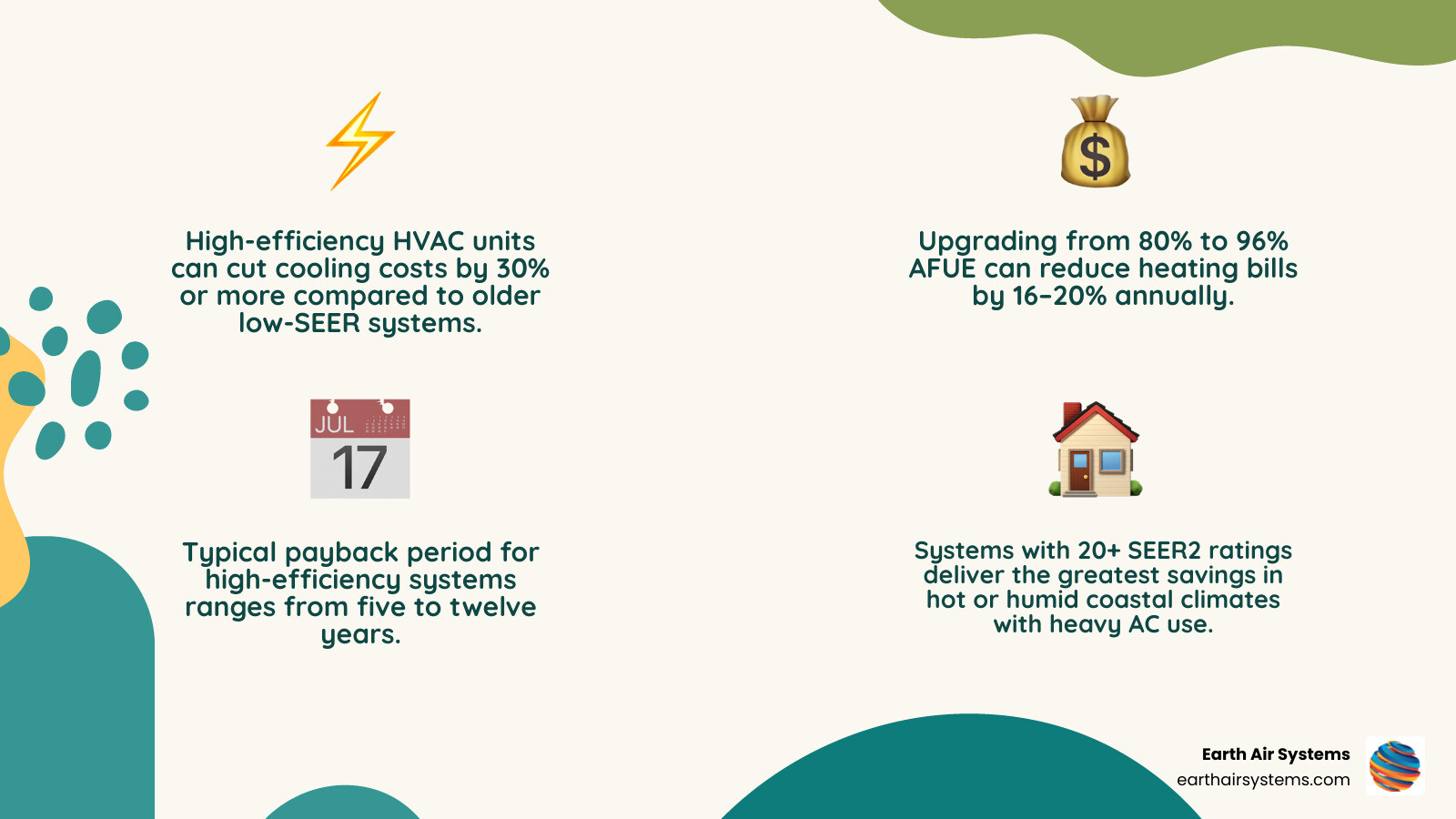
In San Diego, where coastal humidity, salt air, and year-round moderate temperatures create a unique set of demands on HVAC equipment, the case for efficiency is real — but it isn’t one-size-fits-all. Upgrading from an older 80% AFUE furnace to a modern 96% AFUE model, for example, can cut heating bills by 16–20%. Similarly, moving from a dated low-SEER air conditioner to a current high-efficiency unit can reduce cooling costs by 30% or more. Payback periods typically run five to twelve years, depending on how hard your system works and what utility incentives are available to you.
This guide cuts through the contractor sales pitch and gives you the actual numbers, the comfort benefits beyond the bill savings, and a clear framework for deciding whether a premium system makes sense for your home specifically.
Understanding HVAC Efficiency Ratings in 2026
When we talk about whether a high efficiency system is worth the extra cost, we first have to understand the language of the labels. In May 2026, the industry uses three primary metrics to measure how much “bang” you get for your utility buck.
- SEER2 (Seasonal Energy Efficiency Ratio 2): This measures cooling efficiency. The higher the number, the less electricity the unit uses to cool your home. In San Diego, we typically look for 16 to 18 SEER2 for mid-range efficiency, while premium systems can soar to 20+ SEER2.
- AFUE (Annual Fuel Utilization Efficiency): This is for your furnace. It’s expressed as a percentage. An 80% AFUE furnace wastes 20 cents of every dollar on exhaust, while a 96% AFUE model wastes only 4 cents.
- HSPF2 (Heating Seasonal Performance Factor 2): This measures the heating efficiency of heat pumps. Given San Diego’s push toward electrification, this is becoming a vital number for local homeowners.
For a deeper dive into these metrics, check out The Homeowner’s Guide to Understanding SEER2 Efficiency.
Deciphering the new DOE testing standards
You might notice that “SEER2” looks a bit different than the “SEER” rating on your neighbor’s five-year-old unit. The Department of Energy updated these standards because the old tests didn’t account for the “real world.”
In the past, systems were tested in lab conditions with very little air resistance. The new SEER2 and HSPF2 protocols use much higher static pressure—mimicking the resistance of actual ductwork in a San Diego home. This means a 14.3 SEER2 unit today is actually more efficient than an old 15 SEER unit. It’s a more “honest” rating that helps us ensure the equipment performs as promised once it’s installed in your attic or closet.

Is a high efficiency system worth the extra cost for San Diego homeowners?
In our local service areas—from the coastal breezes of Carlsbad and Oceanside to the inland heat of Escondido and San Marcos—the “worth” of a system depends heavily on your microclimate.
If you live in North Park or Downtown San Diego, your cooling needs might be moderate. However, if you are inland where summer temperatures regularly spike, a high-efficiency system becomes an investment that pays for itself much faster. You can explore more about these trade-offs in our guide on the Pros and Cons of Upgrading to High Efficiency HVAC Equipment.
Why a high efficiency system is worth the extra cost in humid coastal areas
For our friends in Solana Beach, Encinitas, and La Jolla, efficiency isn’t just about the temperature; it’s about the “sticky” factor. High-efficiency systems almost always utilize variable-speed technology.
Standard systems are either “on” or “off.” They blast cold air at 100% capacity and then shut down. This often doesn’t leave the system running long enough to remove moisture from the air. Variable-speed systems, however, can run at lower speeds for longer periods. This constant, gentle airflow is a master at dehumidification. It makes 75 degrees feel like 72 because the air is crisp and dry, rather than damp. Furthermore, premium units often feature specialized coatings to protect against the salt air corrosion common in coastal San Diego.
Calculating if a high efficiency system is worth the extra cost for your home
To decide if the math works for you, we look at three factors:
- Home Tenure: If you plan to live in your San Diego home for 10+ years, the high-efficiency system is almost always a “win.” The energy savings will eventually eclipse the higher upfront investment.
- Usage Patterns: Do you work from home in Chula Vista and run the AC all day? Or are you a “weekend warrior” who only turns it on during heatwaves? High usage equals faster ROI.
- The “Sweet Spot”: For many, moving from a 14 SEER2 to a 17 SEER2 offers a massive jump in savings. Moving from 18 to 22 SEER2 offers smaller incremental savings and may take much longer to pay back.
For a full breakdown of how these systems impact your property’s bottom line, see The Ultimate Guide to HVAC ROI and Home Value.
Performance Advantages of Premium HVAC Technology
Beyond the utility bill, there is a “lifestyle” upgrade that comes with high-efficiency equipment. We often tell our clients that efficiency is what you save, but technology is what you feel.
- Temperature Consistency: High-efficiency systems eliminate the “hot and cold spots” common in older San Diego homes. Instead of a 3- to 5-degree swing between cycles, variable-speed units maintain your set temperature within half a degree.
- Whisper-Quiet Operation: Standard units can sound like a jet engine taking off in your side yard. Premium systems often operate at decibel levels comparable to a quiet conversation (55–60 dB), making your patio or backyard much more enjoyable.
- Advanced Air Filtration: Because high-efficiency fans run more often at lower speeds, your air is constantly being pushed through your filters. This is a game-changer for San Diego families dealing with seasonal allergies or dust.
| Feature | Standard (Single-Stage) | High-Efficiency (Variable-Speed) |
|---|---|---|
| Temperature Control | ± 3-5°F | ± 0.5°F |
| Humidity Removal | Moderate | Exceptional |
| Noise Level | 70+ dB | 55-65 dB |
| Energy Consumption | Baseline | 30-50% Lower |
Enhanced indoor air quality and comfort
When we install a high-efficiency system in a home in Hillcrest or Old Town, one of the first things owners notice is the air quality. Modern systems allow for thicker, high-MERV filters without straining the motor. This removes more dander, pollen, and pollutants. When paired with a smart thermostat, you gain total control over your home’s environment, even when you’re at the beach.
Factors That Influence Your Total Return on Investment
The “sticker price” of a high-efficiency system is rarely what you actually pay. In 2026, there are several ways to bridge the gap:
- Utility Rebates: Local San Diego utility providers often offer rebates ranging from $200 to $1,000 for installing ENERGY STAR-certified equipment.
- Federal Tax Credits: Under current regulations, qualifying heat pumps and high-efficiency central AC units can net you significant credits on your federal tax return, sometimes up to $2,000.
- Reduced Maintenance: While the parts are more complex, new systems are under warranty and generally require fewer emergency repairs than an aging 80% AFUE furnace.
To learn more about protecting your investment, read Stop Venting Your Cash and Learn if HVAC Plans Save Money.
The importance of professional sizing and installation
A high-efficiency system is only as good as the technician who installs it. If you put a 20 SEER2 unit on leaky, undersized ductwork, it will never reach its rated efficiency.
At Earth Air Heating & Cooling, we perform Manual J load calculations. This isn’t a “rule of thumb” guess based on square footage; it’s a scientific calculation of how much heat your home gains and loses. Proper sizing prevents “short-cycling”—where a system turns on and off too quickly—which is the number one killer of HVAC efficiency and equipment lifespan.
When Standard Efficiency Might Be the Better Path
We pride ourselves on transparency, and the truth is that a high-efficiency system isn’t always the right choice.
- Short-Term Ownership: If you’re “flipping” a house in North County or planning to move in two years, you likely won’t see the energy savings return.
- Mild Climates: If you live in a part of San Diego where you only run your AC three weeks out of the year, a standard 14.3 SEER2 unit is perfectly fine.
- Budget Constraints: If a total system failure happens unexpectedly and the premium cost isn’t in the cards, a modern standard system is still a massive upgrade over a 20-year-old unit.
If you’re debating whether to keep patching up your old unit or finally bite the bullet, our guide To Fix or to Flip: When Replacing Your HVAC Makes More Sense can help.
Frequently Asked Questions
How long is the typical payback period for a high-efficiency upgrade?
In San Diego, the payback period typically ranges from 5 to 10 years. This depends on your local utility rates, how often you use the system, and whether you take advantage of federal tax credits and local rebates.
Does a high-efficiency system actually increase home resale value?
Yes. Modern buyers are extremely energy-conscious. Having a documented high-efficiency system with low utility bills can make your home more attractive and potentially increase its value by up to 10% compared to homes with aging, inefficient equipment.
Do high-efficiency units require more frequent maintenance?
Not necessarily more frequent, but they do require more precise maintenance. Because they use sensitive electronics and variable-speed motors, it’s vital to have a certified technician perform annual tune-ups to ensure the sensors and condensate lines are clear and functioning.
Conclusion
So, is a high efficiency system worth the extra cost? In the diverse climates of San Diego County—from the humidity of Coronado to the heat of San Marcos—the answer is usually a resounding yes for long-term comfort and savings.
At Earth Air Heating & Cooling, we don’t believe in high-pressure sales. We believe in “math-based” comfort. With over 40 years of experience, our family-owned team is here to help you weigh the upfront costs against the long-term benefits for your specific home and lifestyle. Whether you need a simple repair or a full system transformation, we provide flat-rate pricing and a 100% satisfaction guarantee.
Ready to see how much you could save? Schedule your high-efficiency system evaluation in San Diego with Earth Air Heating & Cooling today. Let’s make your home the most comfortable place on the block.
