
Should You Repair or Replace Your HVAC System? Here’s How to Decide
Knowing when to repair vs replace your HVAC system is one of the most stressful decisions a San Diego homeowner can face — especially when the AC quits during a summer heatwave or the heater stops working on a cold January night. The stakes are real: make the wrong call and you could spend thousands on a repair that only delays the inevitable, or replace a system that had years of good service left.
Before diving into the full guide, here is a quick-reference framework to help you decide:
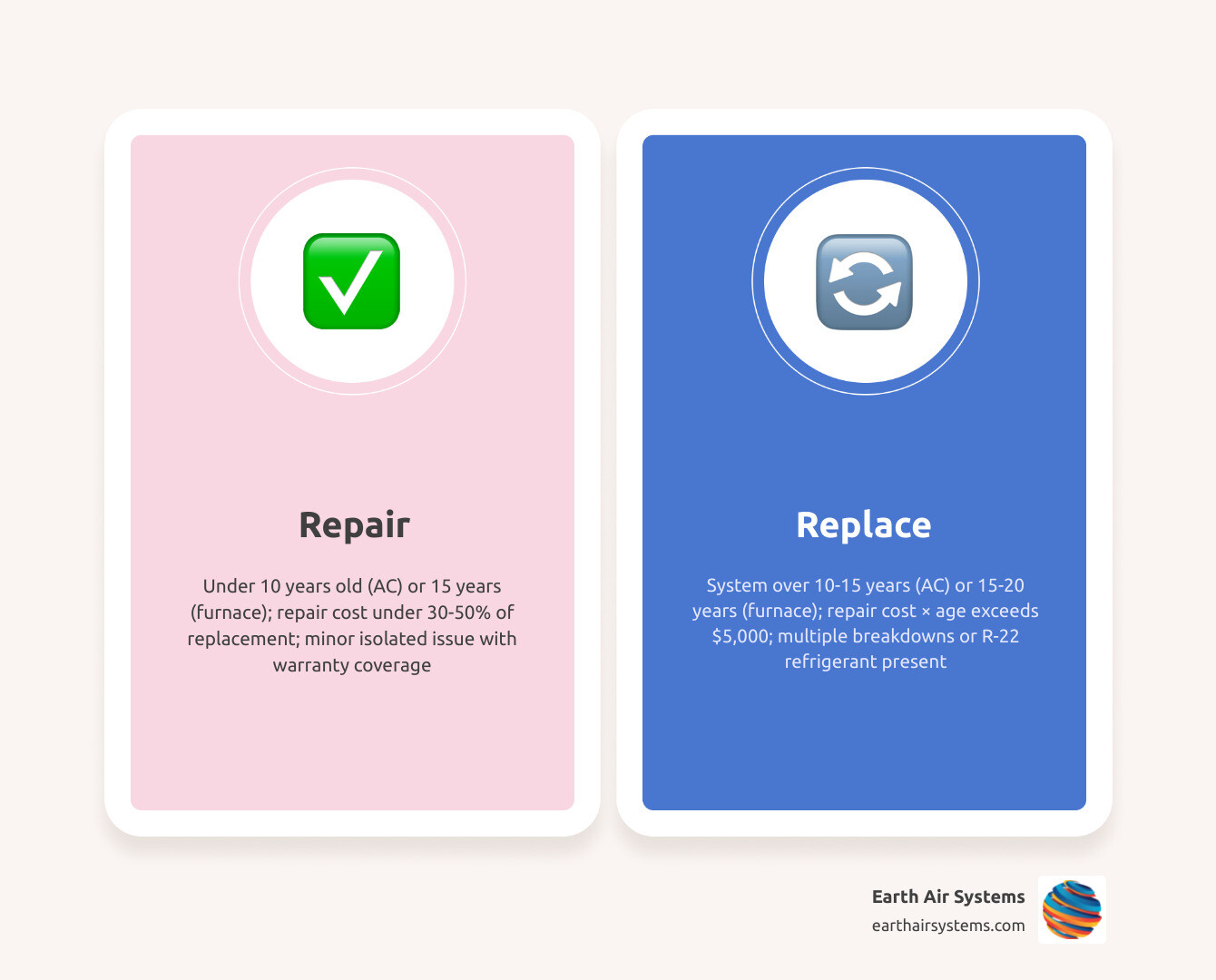
Repair your HVAC system if:
- The system is under 10 years old (AC/heat pump) or under 15 years (furnace)
- The repair cost is less than 30-50% of a new system’s price
- It is a minor, isolated issue with no pattern of repeated breakdowns
- The system is still under warranty
Replace your HVAC system if:
- Your AC or heat pump is 10-15+ years old, or your furnace is 15-20+ years old
- The repair cost multiplied by the system’s age exceeds $5,000 (the $5,000 Rule)
- You have had multiple significant repairs within the past 2-3 years
- The system uses R-22 refrigerant (phased out by the EPA)
- There are safety concerns such as a cracked heat exchanger or carbon monoxide risk
- Energy bills have been climbing steadily with no other explanation
For most San Diego homeowners, the decision comes down to a few core factors: system age, repair history, refrigerant type, energy efficiency, and cost thresholds. The sections below walk through each one in detail so you can make a confident, informed choice.
Key Factors in Deciding When to Repair vs Replace Your HVAC System
When we visit homes in areas like North Park or Chula Vista, we see homeowners grappling with the same question: “Is it worth fixing one more time?” To answer that, we look at several key pillars. First is the system age. In our coastal environment, salt air can sometimes accelerate wear on outdoor units, making age a critical metric. Second is the frequency of repairs. If you feel like your HVAC technician is on your holiday card list because they visit so often, you’re likely in a “repair spiral.”
Efficiency is another major player. In May 2026, the technology available in new units far outpaces what was standard even a decade ago. If your energy bills are rising while your comfort is declining, your system is likely working harder than it should. We often discuss the concept of To Fix or To Flip: When Replacing Your HVAC Makes More Sense with our clients to help them see the long-term financial picture.
Applying the $5,000 Rule to Your Decision
One of the most effective ways to remove emotion from the decision is to use the $5,000 Rule. This is a simple mathematical formula used by industry professionals to determine if a repair is a sound investment.
Here is how it works: Multiply the age of the unit by the cost of the repair.
- If the result is less than $5,000, repair it.
- If the result is more than $5,000, replace it.
For example, if you have a 12-year-old AC unit in Oceanside that needs a $500 repair, the math is 12 x 500 = 6,000. Since 6,000 exceeds the 5,000 threshold, the logic suggests that your money is better spent toward a new, efficient system rather than patching up an aging one.
Understanding the 50% Rule for Major Repairs
Another guideline we use at Earth Air Systems is the 50% Rule. This rule states that if the cost of a single repair exceeds 50% of the value of a brand-new system, replacement is almost always the better choice.
Major component failures, such as a seized compressor or a cracked heat exchanger, often come with high labor and parts costs. Investing that much into a system that is already past its prime—and likely out of warranty—is a high-risk move. When you choose replacement in these scenarios, you aren’t just getting a working unit; you’re getting a fresh warranty and the peace of mind that comes with modern reliability.
How Age and Technology Influence the Replacement Timeline
The typical lifespan of HVAC equipment varies by type. In San Diego, we generally see central air conditioners and heat pumps last between 12 and 15 years. Furnaces, which don’t have to work quite as hard in our moderate climate, can often reach 15 to 20 years.
However, “running” and “running well” are two different things. A system that is 15 years old might still kick on, but it is likely costing you significantly more in monthly utilities than a modern unit would. If you are wondering if your equipment has reached its sunset years, check out our guide: Is Your AC a Senior Citizen and Ready to Retire?. For our neighbors specifically in the San Diego area, we’ve also put together a San Diego Homeowner Alert: Is Your AC Giving Up the Ghost? to help identify local warning signs.
The Impact of R-22 Refrigerant on Older Systems
If your air conditioner was installed before 2010, there is a high probability it uses R-22 refrigerant (often called Freon). The EPA has completely phased out the production and import of R-22 because of its ozone-depleting properties.
As of 2026, R-22 is extremely scarce and expensive. If your older system develops a refrigerant leak, the cost to “top it off” can be astronomical—sometimes costing as much as a major part replacement. In these cases, we strongly recommend a transition to a modern system using R-410A or newer, more environmentally friendly refrigerants. Understanding these shifts is part of staying informed, and you can learn more in The Homeowner’s Guide to Understanding SEER2 Efficiency.
Energy Efficiency and SEER2 Standards in 2026
Efficiency standards have changed significantly. Today, we measure units using SEER2 (Seasonal Energy Efficiency Ratio 2). Older units often have SEER ratings as low as 8 or 10. Upgrading to a modern SEER2-compliant unit can reduce cooling energy consumption by over 35%.
According to ENERGY STAR, high-efficiency units can save homeowners up to 20% on total heating and cooling costs. For those with a standard furnace, moving to an ENERGY STAR-certified model (which is 15% more efficient than conventional models) can lead to annual savings of hundreds of dollars. We weigh these benefits carefully in our discussion of The Pros and Cons of Upgrading to High Efficiency HVAC Equipment.
Safety Red Flags and Performance Warning Signs
While financial math is important, safety is non-negotiable. There are certain “red flags” that should lead to immediate replacement regardless of the $5,000 rule.
- Cracked Heat Exchanger: In a gas furnace, a crack here can allow carbon monoxide to leak into your home’s air supply. This is a lethal risk and cannot be safely patched.
- Persistent Gas Leaks: If your older unit has recurring issues with gas connections or valves, it is a fire and health hazard.
- Electrical Hazards: Frequent tripped breakers or burning smells from the unit indicate a serious internal failure.
| Symptom | Minor Repair (Fix It) | Major Indicator (Replace It) |
|---|---|---|
| Noises | Squealing belt or loose panel | Grinding compressor or banging motor |
| Airflow | Dirty filter or blocked vent | Failing blower motor or collapsed ducts |
| Cycling | Thermostat calibration issue | System is incorrectly sized for the home |
| Bills | Seasonal fluctuation | Consistent 20%+ increase year-over-year |
| Safety | Blown fuse | Cracked heat exchanger or gas leak |
When to Repair vs Replace Your HVAC System for Better Comfort
Comfort isn’t just about the temperature on the thermostat; it’s about how the air feels. If you have rooms that are always too hot while others are freezing, or if your home feels like a swamp because of high humidity, your system is failing its primary mission.
Modern variable-speed technology allows systems to run at lower, more consistent speeds, which does a much better job of dehumidifying the air and eliminating hot spots. We often find that comfort issues stem from improper installation or sizing. You can read more about Why Correct System Sizing Is the Secret to Home Comfort to see if your current system was ever truly right for your San Diego home.
Identifying the “Repair Spiral” in Aging Equipment
The “Repair Spiral” is what we call the game of HVAC Whack-A-Mole. You fix a capacitor in June, a fan motor in August, and then the contactor fails in October. Individually, these repairs might seem affordable, but cumulatively, they are a sign of systemic decline.
If you have had two or more major repairs in the last 24 months, your system is telling you it’s tired. Emergency failures always happen at the worst time—usually on the hottest day of the year when every HVAC company in San Diego is booked out for days. Replacing a declining system on your schedule, rather than in an emergency, gives you the power to choose the best equipment and take advantage of seasonal rebates.
Long-Term Benefits of Upgrading Your San Diego Home
Upgrading your HVAC system is an investment in your property. A new, high-efficiency system is a major selling point in the San Diego real estate market, often providing a high return on investment. Beyond the resale value, the daily benefits include whisper-quiet operation, significantly better indoor air quality, and the ability to control your home from your smartphone.
For a deeper dive into how this affects your home’s equity, see The Ultimate Guide to HVAC ROI and Home Value.
Maximizing ROI with Modern Heat Pumps and Furnaces
In 2026, the financial incentives for upgrading are stronger than ever. The Inflation Reduction Act provides federal tax credits that can cover a significant portion of the cost for qualifying high-efficiency heat pumps and furnaces. When you combine these federal credits with local San Diego utility rebates and the monthly energy savings (which can range from $600 to $1,800 annually), a new system often pays for itself over its lifespan.
Frequently Asked Questions about HVAC Decisions
We know you have questions, and we are here to provide clear, honest answers. You can always visit our HVAC FAQs for more information.
When is repairing the more cost-effective choice?
Repairing is usually the best move if your system is relatively young (under 10 years), the issue is a simple fix like a capacitor or a clogged drain line, and the unit has been well-maintained. If your system is still under a manufacturer’s parts warranty, repairing is almost always the smarter financial path.
Should I replace my furnace and AC at the same time?
Generally, yes. Your furnace and AC share the same blower motor and ductwork. Replacing them together—known as a matched system—ensures they are designed to work together at peak efficiency. It also saves you money on labor costs, as our technicians only need to set up the job site once. Plus, it “resets the clock” for your entire home comfort system.
What questions should I ask a professional before deciding when to repair vs replace your hvac system?
Before you sign off on a major repair or a new installation, ask your technician:
- “What is the expected remaining lifespan of this unit if we perform this repair?”
- “How much will my monthly energy bills likely drop with a new SEER2-rated system?”
- “Is my existing ductwork compatible with a high-efficiency variable-speed blower?”
- “Can you perform a Manual J load calculation to ensure the new system is sized correctly for my home’s square footage?”
Conclusion
Deciding when to repair vs replace your HVAC system doesn’t have to be a guessing game. By using frameworks like the $5,000 Rule and the 50% Rule, and by considering the age and safety of your equipment, you can make a choice that protects both your comfort and your wallet.
At Earth Air Systems, we’ve spent over 40 years helping our neighbors in San Diego, Carlsbad, El Cajon, and beyond stay comfortable year-round. Whether you need a expert diagnosis to see if your current unit can be saved or a transparent, flat-rate proposal for a new energy-efficient upgrade, our team is ready to help. We stand behind our work with a 100% satisfaction guarantee.
Don’t wait for a total system failure to leave you in the heat. Contact us today for a professional evaluation of your home’s heating and cooling needs.
