
Should I Repair or Replace My HVAC System? Here’s How to Decide
Should I repair or replace my hvac system is one of the most common — and stressful — questions homeowners face. Your system stops working on a hot San Diego afternoon, a technician gives you a repair quote, and suddenly you’re trying to make a big financial decision on the spot.
Here’s a quick answer to help you decide:
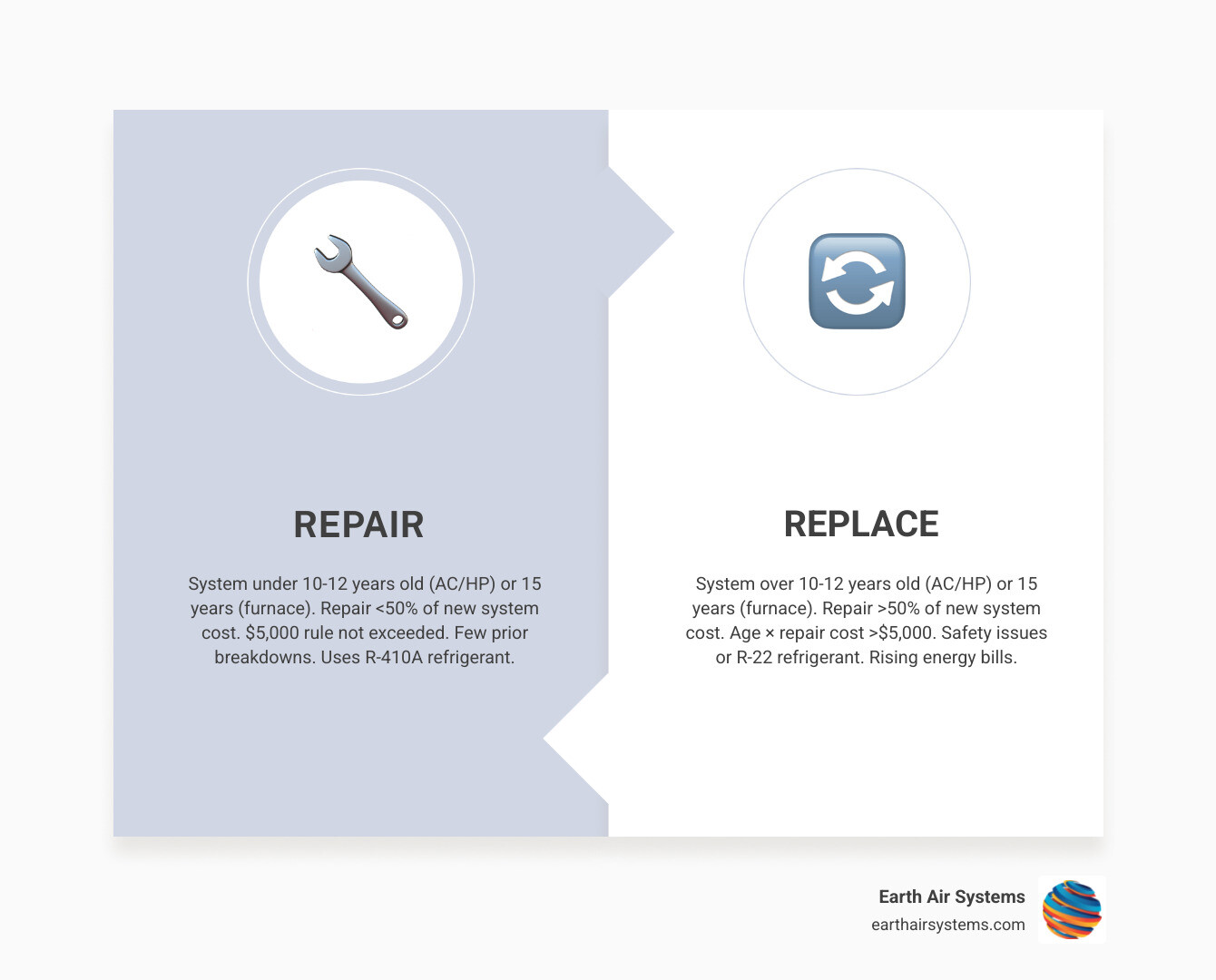
Repair your HVAC system if:
- The system is under 10 years old (AC/heat pump) or under 15 years (furnace)
- The repair cost is less than 15-30% of what a new system would cost
- You’ve had no more than one or two breakdowns in the past three years
- The system uses R-410A refrigerant (not the phased-out R-22)
Replace your HVAC system if:
- Your AC or heat pump is over 10-12 years old, or your furnace is over 15 years old
- Repair costs exceed 50% of a new system’s cost
- When you multiply the system’s age by the repair cost, the result is over $5,000
- You’re dealing with safety issues like carbon monoxide risk or a cracked heat exchanger
- Your energy bills keep climbing despite regular repairs
- The system uses R-22 refrigerant, which is now phased out and expensive to source
The decision comes down to a few key factors: how old your system is, what repairs are going to cost you now and over time, how efficient your current system is, and how long you plan to stay in your home. The good news? There’s a clear framework for working through all of it — and that’s exactly what this guide covers.
HVAC equipment accounts for roughly 50% of a home’s total energy use, so getting this decision right matters — not just for your comfort, but for your wallet and your home’s long-term value.
Evaluating the Age and Lifespan of Your Heating and Cooling Units
When we walk into a home in North County or Downtown San Diego, the first thing we look at is the manufacturing date. Just like a car, every HVAC unit has a “mileage” limit. While regular AC Maintenance in San Diego can certainly stretch these years, physics eventually catches up with the machinery.
In our experience, the typical lifespan of these systems varies by type:
- Air Conditioners and Heat Pumps: These usually last between 10 and 12 years. In coastal areas like La Jolla or Carlsbad, salt air can lead to faster corrosion, sometimes shortening that window.
- Furnaces: These are the marathon runners of the HVAC world, typically lasting 15 to 20 years. However, an old furnace is often significantly less efficient than modern models, even if it is still “running.”
As units age, component degradation becomes a major factor. Motors wear out, coils develop microscopic leaks, and electrical connections become brittle. Even if you haven’t needed Heating Maintenance in San Diego recently, a system nearing the end of its life is likely working much harder than it should to keep you comfortable.
Should I repair or replace my hvac system based on its age?
If your system is hitting the 10-year mark for an AC or the 15-year threshold for a furnace, you are officially in the “Decision Zone.” Technology moves fast. A system installed in 2011 is prehistoric compared to the smart, variable-speed units available in April 2026.
As efficiency declines, your utility bills naturally rise. If you find yourself calling for repairs once or twice every season, you aren’t just paying for parts; you’re paying for a system that is fundamentally failing to meet modern standards of reliability.
Applying the $5,000 Rule and the 50% Formula
We know that “gut feelings” aren’t great for your bank account. That’s why we use a mathematical framework to help our neighbors in Chula Vista and Oceanside make logical choices. There are two primary “rules of thumb” in the industry:
- The $5,000 Rule: Multiply the age of your unit by the repair quote. If the result is more than $5,000, it’s time to flip the system. For example, if your 12-year-old AC needs a $500 repair, that equals $6,000—a clear signal to replace.
- The 50% Formula: If the cost of a single repair is more than 50% of what a brand-new system would cost, repairing it is usually a poor investment.
Calculating the value: Should I repair or replace my hvac system?
Beyond a single repair, you must look at your cumulative repair history. If your HVAC company is on speed dial because you’ve had three or more repairs in the last three years, that’s a reliability red flag.
| Decision Tool | How to Apply | When to Replace |
|---|---|---|
| $5,000 Rule | Age of Unit x Repair Cost | If total > $5,000 |
| 50% Rule | Repair Cost / New System Cost | If > 50% |
| Frequency Rule | Number of repairs in 3 years | If 3 or more |
Financial logic suggests that sinking money into a 14-year-old system is a “short-term fix” that often leads to “long-term regret.” A professional evaluation from our team can give you an honest look at the remaining useful life of your equipment so you aren’t just guessing.
Critical Signs That It’s Time for an Upgrade
Sometimes, your system talks to you before it completely dies. If you’ve noticed your thermostat showing high energy usage or your home feels like a collection of different microclimates, your HVAC system is struggling.
Watch out for these telltale signs:
- Uneven Temperatures: Is the upstairs in your Hillcrest home a sauna while the downstairs is an icebox? This often means the system can no longer push air effectively.
- Excessive Dust and Humidity: If your home feels “sticky” or you’re dusting every other day, your system has lost its ability to dehumidify and filter air properly. This is often a sign of leaky ductwork; in fact, the average home leaks 30% of its air before it ever reaches a room.
- Strange Noises: Rattling, groaning, or banging (what we call “the airplane in the garage” sound) usually indicates a major mechanical failure is imminent.
- Frequent Cycling: If the unit turns on and off every few minutes, it’s “short-cycling,” which wastes energy and puts massive strain on the compressor.
If you’re experiencing these, you might start by searching for AC Repair in San Diego or Furnace Repair in San Diego, but keep the replacement option in the back of your mind.
Safety hazards and the R-22 refrigerant phase-out
There are some situations where we don’t even recommend a repair because the risks are too high. Safety issues like carbon monoxide leaks or cracked heat exchangers in a furnace are immediate grounds for replacement. These aren’t just comfort issues—they are life-safety issues.
Environmental regulations also play a huge role. If your system was manufactured before 2010, it likely uses R-22 refrigerant (Freon). The EPA officially banned the production and import of R-22 in 2020. Because the supply is now extremely limited, the cost to recharge an old system has skyrocketed. If your old unit has a leak, you’re often better off looking into a Heat Pump Repair in San Diego or, more likely, a full transition to a modern R-410A or R-32 system.
Efficiency Gains and Financial Incentives for Modern Systems
One of the best parts about living in April 2026 is the incredible efficiency of modern equipment. Replacing a SEER 9 AC with a SEER 14 model can reduce your energy consumption by more than 35%. If you opt for an ENERGY STAR certified system, you could save up to 20% on your annual heating and cooling costs.
When we handle an AC Installation in San Diego or a Heating Installation in San Diego, we always look for ways to put money back in your pocket through:
- Federal Tax Credits: Under the Inflation Reduction Act, you may be eligible for a tax credit of up to $2,000 (30% of the cost) for new heat pumps.
- Utility Rebates: Local programs often offer significant rebates for switching to high-efficiency electric or gas systems.
- Monthly Savings: New standard models save 20-40% on monthly bills compared to units from 15 years ago.
Long-term benefits of a new HVAC installation
Replacement isn’t just about avoiding a breakdown; it’s about upgrading your lifestyle. A new Furnace Replacement in San Diego offers:
- Improved Indoor Air Quality: Modern systems have better filtration and humidity control, which is vital for San Diego’s allergy seasons.
- Quieter Operation: You shouldn’t have to turn up the TV just because the AC kicked on. New units are designed to be whisper-quiet.
- Smart Home Integration: Control your comfort from your phone, whether you’re at the beach in Encinitas or working in Downtown San Diego.
- Warranty Protection: A new system comes with a fresh warranty, giving you 10+ years of “sleep-well-at-night” protection.
Should I repair or replace my hvac system: Final Decision Factors
Before you sign on the dotted line, we encourage you to look at your personal “big picture.”
- How long do you plan to stay? If you’re moving to a new home in six months, a repair might be the practical choice. But if you plan to stay for five years or more, the energy savings of a new unit will often pay for a significant chunk of the installation cost.
- Ductwork Integrity: If your ducts are old and leaky, even the most efficient AC won’t perform. We often recommend a full system evaluation to ensure your new unit isn’t being held back by “clogged arteries.”
- System Sizing: If you’ve added a room or finished a basement since your last HVAC was installed, your old system is likely undersized. This is the perfect time to “right-size” your comfort.
Whether you need an AC Replacement in San Diego or a Heat Pump Replacement in San Diego, a professional consultation is the only way to get a custom ROI analysis for your specific home.
Frequently Asked Questions about HVAC Replacement
How do I know if my system is sized correctly for my home?
A system that is too big will “short-cycle,” turning on and off quickly without removing humidity. A system that is too small will run constantly and never reach the target temperature. We perform a “Manual J” load calculation, which looks at your square footage, insulation levels, and window types to find the perfect fit.
Can I replace just the outdoor unit or just the furnace?
We almost always recommend replacing both the indoor and outdoor components together. HVAC systems are designed as “matched pairs.” If you put a new, high-efficiency outdoor unit with an old indoor coil, you’ll lose efficiency, likely void your warranty, and face a premature failure of the new part.
What should I ask a technician during an evaluation?
When we visit your home, grill us! We recommend asking:
- Can I have an itemized breakdown of the repair vs. the replacement?
- What was the root cause of this failure?
- What efficiency ratings (SEER2/AFUE) do you recommend for my specific neighborhood?
- Which current rebates or tax credits do I qualify for?
- How long will the installation take?
Conclusion
At Earth Air Systems, we’ve spent over 40 years helping our neighbors across San Diego—from Solana Beach to Coronado and everywhere in between—navigate the “fix or flip” dilemma. We don’t just sell equipment; we provide honest, flat-rate solutions tailored to your home and your budget.
Whether you need a quick tune-up to get through the summer or a complete system overhaul for maximum efficiency, our commitment to 100% customer satisfaction remains the same. Don’t spend another night in a drafty or sweltering home.
Schedule a consultation for air conditioning services in San Diego today, and let’s find the most reliable, cost-effective path to your comfort.
