
Why Correct HVAC Sizing Is the Secret to Home Comfort and Efficiency
How proper HVAC sizing affects comfort and efficiency comes down to one simple idea: your system needs to match your home’s actual heating and cooling demands — not too big, not too small.
Here’s how correct sizing directly impacts your home:
- Even temperatures – A properly sized system maintains consistent temps in every room
- Humidity control – Right-sized units run long enough to pull moisture from the air (keeping indoor humidity between 30–50%)
- Lower energy bills – A well-matched system can use up to 30% less energy than an oversized one
- Longer system life – Correct sizing prevents short cycling and constant running, both of which wear out equipment fast
- Better air quality – Adequate run times mean more air passes through your filters
More than half of U.S. homes have HVAC systems that are either too big or too small. That means wasted energy, uncomfortable rooms, and systems that break down sooner than they should.
Whether your San Diego home runs hot in the inland valleys or deals with coastal humidity, getting the size right from the start makes everything else work better.
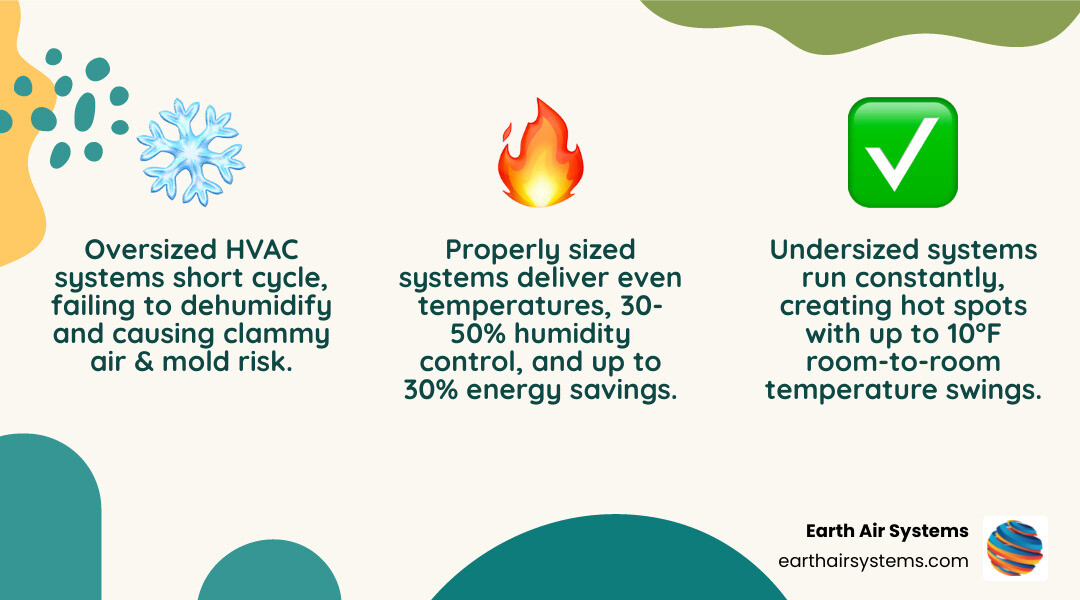
Understanding How Proper HVAC Sizing Affects Comfort and Efficiency
When we talk about “sizing” in the HVAC world, we aren’t talking about the physical dimensions of the unit (though a bigger capacity unit often takes up more space). Instead, we are talking about the system’s capacity to move heat. In the cooling season, your AC removes heat from your home; in the winter, your furnace or heat pump adds it.
This capacity is measured in British Thermal Units (BTUs). In the industry, we often simplify this into “tonnage.” One ton of air conditioning capacity is equal to 12,000 BTUs per hour. As a very loose rule of thumb, one ton can cool about 500 to 600 square feet, but as we’ll see, relying on that alone is what we call “HVAC Sin #1.”
The goal is “Load Matching.” This is the sweet spot where the system’s output perfectly matches the heat gain or loss of your home. When we achieve this, the system runs in long, steady cycles. This is where the magic happens for both your wallet and your comfort.
Comparing the Symptoms of Incorrect Sizing
To help you identify if your current system is struggling, we’ve put together this comparison:
| Symptom | Oversized System (“The Brute”) | Undersized System (“The Struggler”) |
|---|---|---|
| Cycle Length | Short, frequent bursts (Short cycling) | Runs almost constantly |
| Humidity | Air feels “clammy” or sticky | Usually okay, but air feels warm |
| Energy Bills | High due to “startup” power spikes | High due to non-stop operation |
| Temperature | 3-5°F swings between cycles | 10°F swings between rooms |
| Noise | Loud “whoosh” of air frequently | Constant background hum |
| Lifespan | Shortened by compressor wear | Shortened by overworking components |
If you suspect your system is costing you too much, you can use our SEER Calculator to see how much an efficient, correctly sized unit could save you over time.
The Pitfalls of Incorrect Sizing: Oversized vs. Undersized Systems
It is a common myth that “bigger is always better.” We see it all the time in San Diego—homeowners think that by installing a 5-ton unit in a 3-ton house, they’ll be “extra cool” during a Santa Ana heatwave. In reality, they are just buying a ticket to discomfort and high repair bills.
Conversely, an undersized system is like trying to cool a stadium with a desk fan. It will work itself to death and still leave you sweating. Beyond just the temperature, incorrect sizing wreaks havoc on your Air Quality Services in San Diego. If the air isn’t moving through the system correctly, dust, allergens, and moisture linger in your living space.
Why Oversizing is Not Better for How Proper HVAC Sizing Affects Comfort and Efficiency
An oversized system is a master of “Short Cycling.” This means the unit kicks on, blasts the house with cold air, satisfies the thermostat in ten minutes, and shuts off. While that might sound efficient, it’s actually a disaster for two main reasons:
- The Clammy Factor: An air conditioner has two jobs: cooling the air and removing humidity. Removing humidity takes time. The coils need to stay cold long enough for moisture to condense and drain away. If your system only runs for ten minutes, it cools the air but leaves the water behind. This creates that “cave-like” feeling—cold but damp.
- Mechanical Strain: Think of your HVAC system like a car. You get the worst gas mileage and the most engine wear when you are stop-and-go in downtown San Diego traffic. Your HVAC compressor uses the most electricity and experiences the most wear during the first minute of startup. An oversized system might start up 50 times a day, whereas a correctly sized unit might start 10 times and run longer. This frequent “clunking” on and off can cut your system’s lifespan by up to 50%.
The Struggle of Undersized Units on How Proper HVAC Sizing Affects Comfort and Efficiency
On the other side of the coin, we have the undersized unit. This usually happens when a home has been expanded—perhaps you added a sunroom in Carlsbad or finished a basement in North Park—but kept the original HVAC unit.
An undersized unit will run 24/7 during a typical July afternoon. Because it can never quite reach the temperature you set on the thermostat, it never takes a break. This leads to:
- Hot Spots: The rooms furthest from the unit will never get enough airflow to stay cool.
- Extreme Swings: You might see a 10°F difference between your kitchen and your master bedroom.
- Utility Shock: Even though the unit is “small,” the fact that it never turns off means your energy meter is spinning non-stop.
The Science of Sizing: Manual J, S, and D Calculations
So, how do we avoid these pitfalls? We don’t guess. We use the industry-standard protocols developed by the Air Conditioning Contractors of America (ACCA). If you have more questions about these technical standards, browse our HVAC FAQs.
Manual J: The Load Calculation
This is the most critical step. Manual J is a deep-dive analysis of your home’s “envelope.” We look at everything: the direction your house faces, the type of insulation in your attic, the number of windows, and even how many people live in the house. This calculation tells us exactly how many BTUs of cooling and heating your home needs to stay comfortable on the hottest and coldest days of the year in San Diego.
Manual S: Equipment Selection
Once we know the “load” (the Manual J result), we use Manual S to pick the right equipment. Not all 3-ton units are created equal. Some perform better in high humidity; others are optimized for dry heat. We match the equipment’s performance data to your specific home requirements.
Manual D: Ductwork Design
You could have the most perfectly sized AC unit in the world, but if your ducts are too small, it won’t matter. Manual D ensures that the “veins” of your home can carry the volume of air the “heart” (the HVAC unit) is pumping. We look at “static pressure”—the resistance the air meets as it moves through the vents. If the static pressure is too high, the system will be noisy and inefficient.
Key Factors Influencing Your Home’s Load Requirements
When we visit a home in Solana Beach or Chula Vista, we aren’t just looking at the square footage. We are looking at a complex puzzle of heat transfer. Here are the factors that play the biggest role in how proper HVAC sizing affects comfort and efficiency:
1. San Diego Microclimates
San Diego is famous for its microclimates. A home in La Jolla deals with salt air and high humidity, which requires a system with excellent latent heat removal (dehumidification). Meanwhile, a home in Escondido or San Marcos deals with intense, dry heat, requiring a system with high sensible cooling capacity. We adjust our calculations based on your specific zip code’s design temperatures.
2. Insulation and Airtightness
A home built in the 1970s in Hillcrest likely has different insulation than a modern build in Downtown San Diego. Better insulation means the home holds onto its conditioned air longer, allowing for a smaller, more efficient HVAC system.
3. Window Orientation and Type
Windows are “holes” in your insulation. South-facing windows in a sunny San Diego afternoon can act like giant magnifying glasses, adding thousands of BTUs of heat to a room. We factor in the “Solar Heat Gain Coefficient” (SHGC) of your glass.
4. Occupancy and Appliances
Every person in your home is essentially a 350-BTU heater. If you have a large family or frequently host guests in Coronado, your cooling needs will be higher. Similarly, high-end kitchens with professional-grade ranges add significant heat to the living space.
Frequently Asked Questions about HVAC Sizing
What is a Manual J load calculation?
Think of a Manual J calculation as a custom-tailored suit for your home. Instead of a “one-size-fits-all” approach, a technician uses specialized software to account for your home’s square footage, wall heights, window orientations, insulation levels, and local climate data. It is the only scientifically backed way to determine the precise heating and cooling capacity required to keep you comfortable. In April 2026, most local building codes in the San Diego area actually require a Manual J to be submitted before a permit is even issued for a new installation.
Can I size my HVAC system based on square footage alone?
We strongly advise against this. Using square footage alone is often called “the rule of thumb,” but in our industry, we call it “HVAC Sin #1.” Two 2,000-square-foot homes can have vastly different needs. One might be a shaded, well-insulated ranch in Vista, while the other is a two-story home with floor-to-ceiling glass in Oceanside. The glass-heavy home might need twice the cooling capacity of the ranch. If you use square footage alone, you are almost guaranteed to end up with a system that is incorrectly sized.
How does sizing affect indoor humidity?
This is one of the most overlooked aspects of how proper HVAC sizing affects comfort and efficiency. Your air conditioner is a dehumidifier. To remove moisture, the indoor evaporator coil must stay cold, and air must blow across it for a significant amount of time.
If your system is oversized, it satisfies the temperature setting so quickly that the moisture never has a chance to condense on the coils. This leaves you with air that is 72°F but has 70% humidity—the perfect recipe for mold growth and that sticky, uncomfortable feeling. A correctly sized system will run longer, “squeezing” the water out of the air and maintaining a healthy 30-50% humidity level.
Conclusion
At Earth Air Systems, we believe that comfort isn’t just about the brand of the box sitting outside your house—it’s about the engineering behind the installation. With over 40 years of experience serving the San Diego community, from the coastal breeze of Carlsbad to the inland heat of El Cajon, we know that every home is unique.
How proper HVAC sizing affects comfort and efficiency is the difference between a home that feels “okay” and a home that feels “perfect.” By insisting on a professional Manual J load calculation and proper equipment selection, you aren’t just buying an air conditioner; you are investing in lower utility bills, better air quality, and a system that will last for years to come.
Don’t settle for guesswork. Whether you need a repair, a tune-up, or a full system replacement, our team is committed to providing flat-rate pricing and 100% customer satisfaction. We want to ensure your home is the sanctuary it was meant to be.
Ready to see the difference a correctly sized system can make? Calculate your potential savings with our SEER Calculator and contact us today for a professional evaluation of your home’s HVAC needs. Let’s get your comfort “just right.”
