
Why Smart Thermostat Benefits for Homeowners Are Worth Paying Attention To
Smart thermostat benefits for homeowners include lower energy bills, better home comfort, remote temperature control, and reduced environmental impact — all from a single device upgrade.
Here’s a quick look at the core benefits:
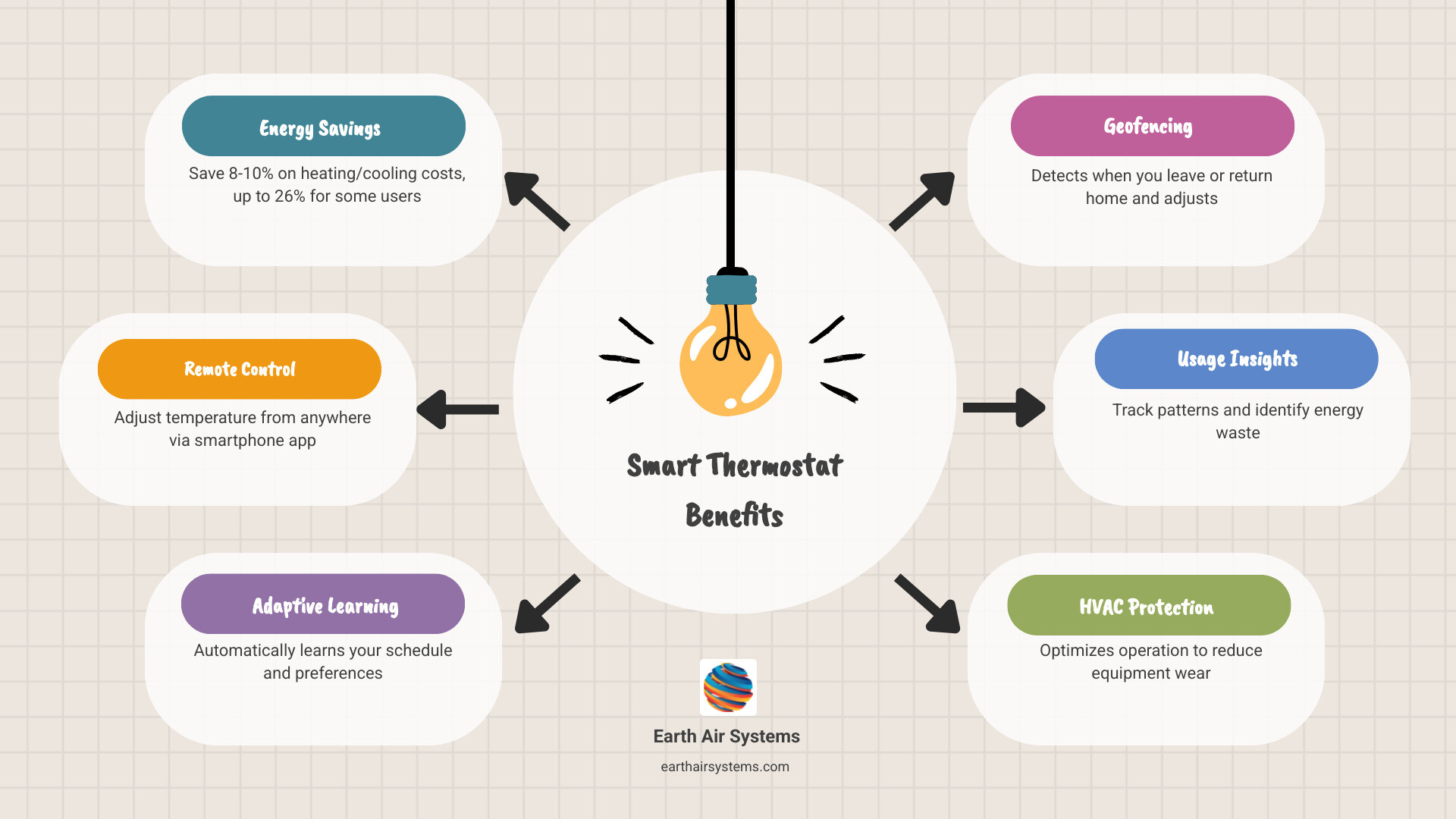
- Energy savings — ENERGY STAR-certified models save an average of 8–10% on heating and cooling costs, with some users saving up to 26%
- Remote control — Adjust your home’s temperature from anywhere using a smartphone app
- Adaptive learning — Your thermostat figures out your schedule and adjusts automatically
- Geofencing — The system detects when you leave or return home and responds accordingly
- Energy usage insights — Track patterns and spot waste through detailed usage reports
- HVAC system protection — Optimized operation reduces unnecessary wear on your equipment
- Environmental impact — Less energy use means a smaller carbon footprint
- Utility rebates — Many programs offer incentives to offset the upfront cost
- Home resale value — Buyers increasingly expect modern, energy-efficient features
Heating and cooling account for nearly half of the average American household’s annual energy bill — that’s more than $900 a year just to stay comfortable. And for most people, the thermostat controlling all of that is still a basic dial or a programmable model that never actually got programmed. The result? You pay more than you should, your home isn’t as comfortable as it could be, and you spend more mental energy managing your HVAC system than anyone should have to.
Smart thermostats fix all three of those problems. They learn your habits, respond to your location, and let you make adjustments from your phone — whether you’re on the couch or across the country. This guide breaks down exactly how they work, what benefits matter most, and how to know if your home is ready for one.
The Top Smart Thermostat Benefits for Homeowners
When we talk about upgrading your home’s “brain,” the thermostat is the best place to start. In places like San Diego, where the coastal breeze can turn into an inland heatwave in a matter of miles, having a system that reacts to real-time conditions is vital.
The primary smart thermostat benefits for homeowners center around three pillars: financial savings, personal comfort, and environmental responsibility. Research shows that the average American household spends over $2,300 a year on total energy bills. Since nearly half of that goes toward heating and cooling, even a small percentage of efficiency gain translates into significant annual savings.
| Feature | Manual Thermostat | Programmable Thermostat | Smart Thermostat |
|---|---|---|---|
| Control Method | Physical dial/buttons | Pre-set schedules | App, Voice, & Automation |
| Learning Ability | None | None | Learns habits & patterns |
| Remote Access | No | No | Yes (via Wi-Fi) |
| Energy Reports | No | No | Yes (Detailed insights) |
| Occupancy Sensing | No | No | Yes (Geofencing/Sensors) |
| Typical Savings | 0% | 0-5% (if used correctly) | 8-15% (Average) |
Beyond the monthly bill, these devices offer a boost to your home’s resale value. In April 2026, buyers view smart technology not just as a “perk” but as an expectation. A home equipped with an ENERGY STAR-certified smart thermostat signals to potential buyers that the property is modern and well-maintained.
Furthermore, the environmental impact is substantial. If every household switched to a certified smart model, we could collectively offset billions of pounds of greenhouse gas emissions. By reducing unnecessary HVAC runtime, you aren’t just saving money; you’re actively participating in a greener future for our community. For those looking to optimize their entire setup, our Air conditioning services in San Diego can help ensure your system is running at peak efficiency before the smart tech takes over.
Smart vs. Programmable: Why Intelligence Matters
You might be wondering, “I already have a programmable thermostat, so why do I need a ‘smart’ one?” It’s a fair question. The truth is that while programmable thermostats can save money, they rarely do in practice. Studies show that 40% to 70% of homeowners with programmable thermostats never actually set a schedule because the interfaces are too clunky and confusing.
Smart thermostats remove the “user error” variable. Instead of you trying to program it, the device uses learning algorithms to program itself. During the first week of installation, you simply adjust the temperature as you normally would. The thermostat watches these choices, notes when you leave for work, and realizes when you prefer the house a bit cooler for sleep.
Real-Time Adjustments and Weather Integration
Unlike a standard timer, a smart thermostat is connected to the internet. It knows if a heatwave is hitting El Cajon or if a cool marine layer is settling over La Jolla. It can adjust your cooling cycles based on outside humidity and temperature, ensuring your AC doesn’t work harder than it has to. It also allows for manual overrides that don’t “break” the schedule. If you come home early on a Tuesday, the thermostat detects your presence (or your phone’s proximity) and switches from “Away” to “Home” mode instantly.
Key Features That Drive Efficiency and Comfort
To truly understand the smart thermostat benefits for homeowners, we need to look under the hood at the specific technologies that make these devices so effective.
Maximizing Smart Thermostat Benefits for Homeowners with Geofencing
Geofencing is perhaps the most “magical” feature of a smart home. It uses the GPS on your smartphone to create an invisible perimeter around your house. When you cross that boundary (for example, when you are five miles away heading toward work), the thermostat automatically enters “Eco” or “Away” mode.
This eliminates the stress of wondering, “Did I leave the AC on full blast?” while you’re sitting at your desk or enjoying a day at the San Diego Zoo. Conversely, as you head home, the geofence triggers the system to start pre-cooling or pre-heating, so you walk into a perfectly comfortable environment the moment you step through the door. This “set it and forget it” approach maximizes energy waste reduction without requiring you to lift a finger.
Adaptive Learning: A Core Smart Thermostat Benefit for Homeowners
Adaptive learning goes beyond just a schedule. It creates a “thermal profile” of your home. It learns how long it takes your specific house to cool down by one degree and uses that data to start the system at exactly the right time.
These devices also provide:
- Maintenance Alerts: They can monitor your HVAC system’s health and send a notification to your phone if it detects a potential issue, like a filter that needs changing or a system that is taking too long to reach the target temperature.
- Humidity Control: Many models can manage whole-home dehumidifiers or adjust AC cycles to pull moisture out of the air, which is a huge comfort boost during our humid coastal nights.
- Software Updates: Unlike traditional hardware, smart thermostats get better over time. Manufacturers push “over-the-air” updates that include new energy-saving algorithms and features.
Ensuring Your Home is Ready for a Smart Upgrade
While we love the convenience of these devices, they do require a specific setup to work correctly. Before you run out and buy the latest model, there are a few compatibility checks we recommend.
The C-Wire Requirement
Most smart thermostats feature high-resolution touchscreens and constant Wi-Fi connectivity. This requires a steady stream of power. Older thermostats often ran on simple batteries or “power-stealing” methods, but modern units typically require a C-wire (Common wire).
If you pull your old thermostat off the wall and don’t see a blue or black wire tucked back there, you might need a C-wire adapter or a professional to run a new wire from your furnace or air handler. Trying to DIY a smart thermostat into a system that isn’t compatible can lead to “short-cycling,” which can damage your expensive HVAC equipment.
System Compatibility and Wi-Fi
Most smart thermostats work with standard forced-air systems, but if you have a multi-stage system, a heat pump, or a zoned system (where different rooms have different controls), you need to ensure the model you choose supports those features. Additionally, the thermostat needs a strong Wi-Fi signal. If your router is on the opposite side of a large house, you might need a Wi-Fi extender to ensure the thermostat stays connected to the app.
Frequently Asked Questions about Smart Thermostats
Do smart thermostats work with all HVAC systems?
Most modern smart thermostats are compatible with about 95% of 24-volt HVAC systems. This includes most gas furnaces, central air conditioners, and heat pumps. However, they typically do not work with high-voltage systems (like electric baseboard heaters) or some proprietary communicating systems used by specific high-end manufacturers. If your home was built before 1975 or uses an oil boiler, it’s always best to have a professional check compatibility first.
How much energy can I actually save?
On average, homeowners see a reduction of 8% to 15% on their heating and cooling bills. According to Google Nest, users save roughly 10-12% on heating and 15% on cooling. Ecobee has reported combined savings as high as 26% for some users. In a typical San Diego household, this usually translates to anywhere from $50 to $145 in annual savings. The more variable your schedule is, the more you stand to save, as the thermostat will be more aggressive about turning the system down when you aren’t there.
Is a smart thermostat worth it if I already have a programmable one?
Yes, absolutely. The “smart” part isn’t just about the schedule; it’s about the automation. A programmable thermostat is a static tool; a smart thermostat is an active manager. Features like remote monitoring allow you to catch system failures while you’re on vacation — potentially saving you from a flooded house due to a frozen pipe or a sweltering home that ruins your furniture. Plus, the availability of utility rebates often brings the net cost of the device down significantly, making the ROI (return on investment) very fast — often within one to two years.
Conclusion
At Earth Air Systems, we’ve spent over 40 years helping our neighbors across San Diego — from Chula Vista to Oceanside and everywhere in between — stay comfortable. We’ve seen HVAC technology evolve from simple mercury switches to the high-tech learning machines we use today.
The smart thermostat benefits for homeowners are clear: they save you money, protect your HVAC investment by reducing unnecessary wear, and give you the peace of mind that comes with total control. Whether you’re in a North County bungalow or a Downtown high-rise, a smart thermostat is one of the most cost-effective upgrades you can make to your home.
If you’re ready to stop “fiddling” with the dial and start enjoying automatic comfort, we’re here to help. From checking your wiring to performing a full system calibration, we ensure your transition to a smart home is seamless and stress-free. For expert assistance with your setup or any other Air conditioning services in San Diego, reach out to our team today. Let’s make 2026 the year your home finally starts working as hard as you do.
