
The Price of Comfort: Comparing Central Air and Ductless Costs
Compare mini split vs central ac cost comparison: installation, efficiency, maintenance and TCO for San Diego homes.
The Real Cost Difference Between Mini Splits and Central AC
mini split vs central ac cost comparison is one of the most common questions San Diego homeowners face when upgrading or replacing their home comfort system — and the answer isn’t as simple as picking the lower sticker price.
Here’s a quick breakdown to address what most people actually want to know:
| Factor | Mini Split | Central AC |
|---|---|---|
| Best for homes without ductwork | Yes | No (costly to add) |
| Best for homes with existing ducts | Possible | Yes |
| Energy efficiency (SEER2 range) | 20–30+ | 14–20 |
| Duct energy loss | None | 20–30% |
| Zoned temperature control | Built-in | Requires upgrades |
| Typical lifespan | 15–20 years | 12–15 years |
| Annual maintenance cost | Lower | Slightly higher |
| Whole-home cooling (large homes) | Multi-zone required | Well suited |
The right system depends on your home’s layout, whether you have existing ductwork, and how you use your space day to day. Both systems can deliver reliable comfort — but their long-term costs, efficiency profiles, and installation requirements differ in ways that matter a lot to your wallet.
In San Diego’s mild but sunny climate, energy efficiency plays a major role in which system pays off over time. Whether you’re cooling a single room addition, retrofitting an older home, or replacing an aging whole-home system, understanding the full cost picture — not just the upfront price — is what leads to a smart decision.
This guide walks you through every layer of that comparison, from installation to monthly bills to long-term ownership.
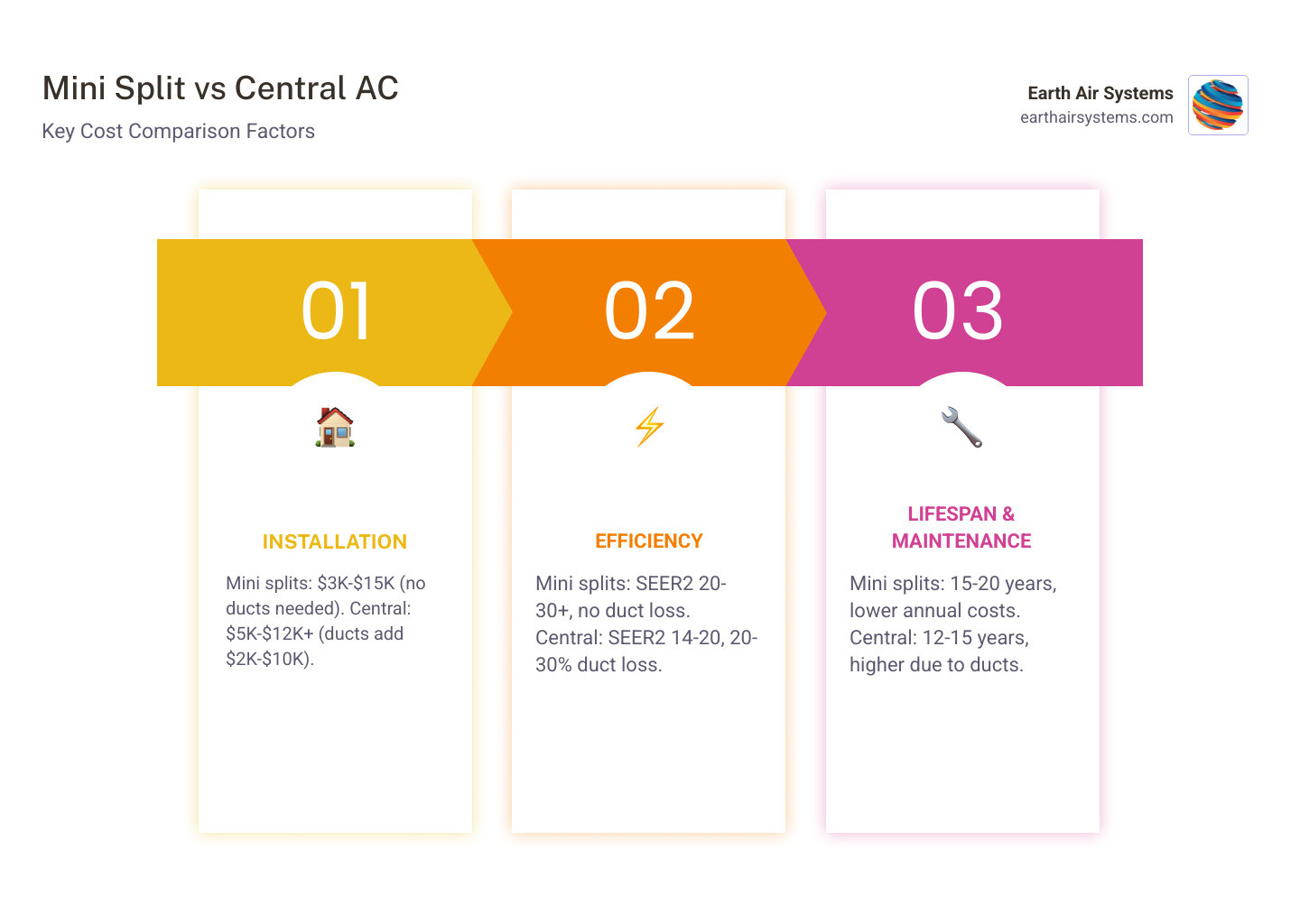
Initial Investment Factors for Mini Split vs Central AC Cost Comparison
When we sit down with homeowners in places like La Jolla or Chula Vista, the first hurdle is always the initial setup. The “sticker price” of the equipment is only one piece of the puzzle. The true mini split vs central ac cost comparison begins with your home’s bones—specifically, your ductwork.
The Ductwork Dilemma
If your home already has a healthy network of ducts, a central AC unit is often the path of least resistance. However, if those ducts are leaky, undersized, or non-existent, the financial picture shifts dramatically. Retrofitting an older San Diego home with brand-new ductwork is a massive undertaking that involves cutting into walls and ceilings, which can sometimes double the total project price.
Installation Complexity
Ductless mini-splits are famous for their “non-invasive” surgery. We only need to drill a small three-inch hole to connect the indoor air handler to the outdoor condenser. On the flip side, AC Installation in San Diego for a central system requires a much more intensive labor process to ensure the plenum and supply lines are airtight.
Efficiency Ratings and Capacity
The SEER2 (Seasonal Energy Efficiency Ratio 2) rating of your chosen unit plays a huge role in the initial price. High-efficiency units use more advanced technology, which costs more upfront but slashes your monthly overhead. Mini-splits often boast SEER2 ratings that soar into the 30s, while even premium central systems typically top out in the low 20s. For more details on what to expect during the process, check out The Ultimate San Diego AC Installation Guide for a Chill Summer.
Long-Term Operational Value and Efficiency
While the upfront price gets all the attention, it’s the monthly utility bill that truly defines the mini split vs central ac cost comparison. In our experience across San Diego County, the long-term savings of a ductless system can be eye-opening.
The Inverter Advantage
Mini-splits utilize inverter-driven, variable-speed compressors. Think of it like a dimmer switch for your lights versus a standard on/off switch. A traditional central AC unit often blasts at 100% capacity until the thermostat is satisfied, then shuts off completely. This “cycling” consumes a massive amount of energy. In contrast, a mini-split can ramp down to run at just a fraction of its power, maintaining a steady temperature with minimal electricity.
Eliminating Thermal Loss
According to the Department of Energy, typical central systems lose 20% to 30% of their conditioned air through duct leaks and poor insulation. This is essentially money escaping into your attic or crawlspace. Because mini-splits deliver air directly into the room, they have 0% duct loss. You can see how these efficiency gaps add up by using our SEER Calculator.
| Efficiency Factor | Ductless Mini-Split | Central Air Conditioning |
|---|---|---|
| Average SEER2 | 20–30+ | 14–20 |
| Compressor Type | Variable-Speed (Inverter) | Single-Stage, Two-Stage, or Variable |
| Duct Energy Loss | 0% | 20% – 30% |
| Zoning | Built-in (Room-by-Room) | Requires expensive motorized dampers |
If you’re tired of high summer bills, it might be time to stop patching an old system. Don’t Sweat the Swap with the Best Local AC Replacement Experts to see which technology fits your budget best.
How Zoning Impacts Your Mini Split vs Central AC Cost Comparison
Zoning is the “secret weapon” of the mini-split. Most central systems cool the entire house uniformly. If you’re sleeping in the master bedroom, you’re also paying to cool the guest room, the kitchen, and the laundry room.
Mini-splits allow for “targeted cooling.” You can turn off units in unoccupied rooms or set them to a higher temperature, significantly reducing energy waste. This flexibility is a game-changer for multi-story homes in North Park or Hillcrest where the upstairs often stays much warmer than the downstairs.
Total Cost of Ownership in a Mini Split vs Central AC Cost Comparison
When we look at a 10-year horizon, the mini split vs central ac cost comparison becomes even more nuanced.
- Repair Frequency: Central systems have more moving parts distributed throughout the home (blowers, dampers, extensive ducting), which can lead to more points of failure over time.
- Replacement Cycles: A well-maintained mini-split can last 15 to 20 years, whereas many central units begin to show significant wear after 12 to 15 years in our coastal San Diego environment.
- Component Durability: Mini-splits are built for longevity, but their sophisticated electronics (PCBs) can be sensitive to power surges. Central systems are simpler but rely heavily on the integrity of the ductwork, which can degrade over decades.
For those in high-value areas, finding the right balance is key. If you’re wondering How to Find the Best AC Replacement in La Jolla, CA Without Breaking a Sweat, remember to factor in these long-term operational costs. To explore your options further, visit our page on AC Replacement in San Diego.
Maintenance and Lifespan Considerations
We always tell our customers: an HVAC system is like a car—if you don’t change the oil, it won’t last. However, the maintenance tasks for these two systems are quite different.
Central AC Maintenance
Central systems require a professional eye to check the evaporator coils, refrigerant levels, and the health of the ductwork. Over time, ducts accumulate dust, pet dander, and allergens, necessitating professional duct cleaning every 3 to 5 years. Neglecting this can restrict airflow and force the unit to work harder, shortening its life.
Mini-Split Maintenance
Mini-splits shift some of the responsibility to the homeowner, but in a way that’s actually quite easy. The indoor filters should be rinsed every few weeks to maintain peak efficiency. Professionally, we focus on cleaning the “blower wheel” inside the wall unit, which can collect moisture and dust. Because there are no ducts, you never have to worry about hidden “dust bunnies” in your walls.
For a comprehensive look at what we do during a visit, see our Air Conditioning Services in San Diego. If you have more specific technical questions, our HVAC FAQs are a great resource.
Choosing the Right System for Your San Diego Home
Every home in San Diego is unique. A historic craftsman in North Park has different needs than a modern condo in Downtown San Diego.
When Central AC Wins
If your home already has high-quality ductwork and you prefer a “hidden” look, central AC is hard to beat. It provides uniform temperature throughout the house and is generally better at integrating high-end air purification systems like UV lights or HEPA filters into the central air stream.
When Mini-Splits Win
Mini-splits are the undisputed champions for:
- Older Homes: Homes built before central air was standard often lack the space for bulky ducts.
- Room Additions: If you’ve added a sunroom or converted a garage in Oceanside, a mini-split is much cheaper than trying to extend your existing central system.
- Zoned Comfort: If family members constantly fight over the thermostat, giving everyone their own remote is the ultimate peace-offering.
- Quiet Operation: Mini-splits are incredibly quiet, often operating at decibel levels lower than a whisper (around 19 dB).
For those looking to go green, many mini-splits also act as hyper-efficient heat pumps. Learn more about Heat Pump Replacement in San Diego and how it fits into your home’s future. Residents in the South Bay can also find tailored advice in our Local Guide to AC Installation Services in Chula Vista.
Frequently Asked Questions about HVAC Comparisons
Which system is more energy-efficient for whole-home cooling?
Strictly speaking, mini-splits are almost always more efficient. This is due to the combination of higher SEER2 ratings (up to 30+), inverter technology that avoids energy-heavy “start-up” cycles, and the total lack of energy loss through ductwork. However, for very large, open-concept homes, a high-efficiency central system can still be a very effective and economical choice.
How does existing ductwork affect the installation choice?
Existing ductwork is the single biggest “pivot point” in your decision. If your ducts are in good shape, the labor for a central AC replacement is significantly lower. If you don’t have ducts, the cost and mess of installing them usually make ductless mini-splits the more attractive and cost-effective option. For a deeper dive into this topic, see our guide: Everything You Need to Know About AC Replacement Services in Chula Vista.
Do mini-splits provide better indoor air quality than central AC?
It’s a toss-up. Mini-splits are better at preventing the accumulation of dust and mold because they don’t have ducts where these things can hide. They also offer multi-stage filtration in each room. Central AC, however, allows for more powerful, whole-home air purifiers and dehumidifiers to be installed directly into the air handler. If you’re in a high-humidity area, don’t miss our tips on how to Don’t Get Steamed Up Finding AC Installation in National City, CA.
Conclusion
At Earth Air Heating & Cooling, we’ve spent over 40 years helping San Diego neighbors navigate the mini split vs central ac cost comparison. We know that “comfort” isn’t just about the temperature on the wall—it’s about the peace of mind that comes from a reliable, efficient system and a fair price.
Whether you are in San Marcos, Escondido, or Coronado, our team provides flat-rate pricing and a 100% satisfaction guarantee. We don’t believe in high-pressure sales; we believe in professional consultations that help you find the system that fits your lifestyle and your budget.
Ready to find your perfect cooling solution? Explore our full range of Air Conditioning Services in San Diego or contact us today to schedule your consultation. We’re here to ensure you stay cool, no matter how high the San Diego sun climbs.
Fast Local Help
Need Help?
Contact us today to discuss your needs. Our team is ready to help.
Related Articles


Ready to Get Started?
Whether you need a repair, maintenance, or a new installation, our expert team is here to help.
- Licensed & Bonded · CSLB #1103686
- Family-Owned & Operated
- 100% Satisfaction Guarantee