
Why Is My AC Blowing Warm Air? Quick Answers for San Diego Homeowners
If you’re wondering why is my ac blowing warm air, you’re not alone — and the fix is often simpler than you think. Here are the most common reasons:
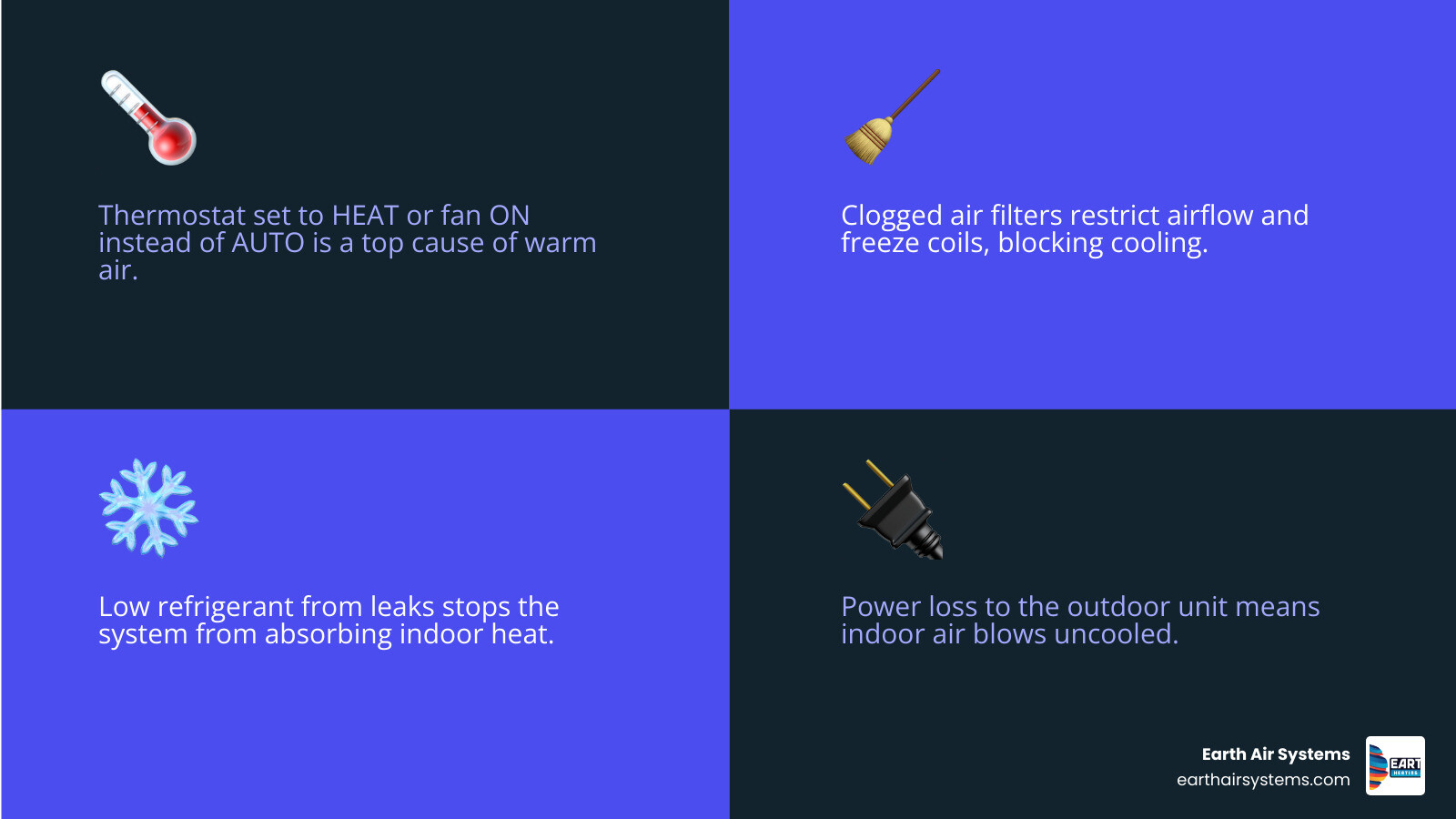
- Thermostat set incorrectly – Fan set to “ON” instead of “AUTO,” or mode switched to “HEAT”
- Clogged air filter – Restricted airflow causes evaporator coils to freeze and block cooling
- Low refrigerant or a leak – The system can’t absorb heat without enough refrigerant
- Outdoor unit has lost power – The indoor fan keeps running but pushes uncooled air
- Dirty or blocked condenser unit – Heat can’t escape, so the cooling cycle breaks down
- Frozen evaporator coil – Ice buildup stops airflow and cooling entirely
- Failing compressor, capacitor, or blower motor – Mechanical failures prevent heat transfer
Most of these problems have a clear cause and a clear fix. The trick is knowing which one you’re dealing with.
It’s a warm San Diego afternoon. You walk inside expecting relief, and instead feel a wave of warm air blowing from the vents. The system sounds like it’s running. The thermostat is on. But nothing is cooling down.
This is one of the most frustrating HVAC problems homeowners face — and it happens more often than you’d expect in San Diego, where AC systems run hard from spring through fall. The good news is that about 90% of warm air issues can be traced back to a handful of well-known causes, many of which you can check yourself in minutes.
This guide walks you through every likely reason your AC is blowing warm air, what you can safely check on your own, and when it’s time to call in a professional.
Why is my ac blowing warm air vocab explained:
- ac running but not cooling your home
- how to know if your ac is going bad
- when to call a professional for ac problems
Understanding How Your Air Conditioner Works
To understand why your air conditioner has suddenly decided to act like a space heater, it helps to know how it is supposed to work when everything is running smoothly.
A common misconception is that air conditioners create cold air out of thin air. In reality, your AC is a heat-removal system. It works by taking the heat out of your indoor air and dumping it outside, leaving only cool, comfortable air behind. This process relies on a continuous, pressurized cycle of refrigerant moving through several key components:
- The Evaporator Coil (Indoor Unit): Cold, liquid refrigerant flows through this copper coil. As the indoor blower motor pushes warm household air over the coil, the refrigerant absorbs the heat from the air. This causes the refrigerant to warm up and evaporate into a gas, while the newly cooled air is blown back into your living spaces.
- The Compressor (Outdoor Unit): Often called the “heart” of your AC, the compressor pumps and squeezes the warm gaseous refrigerant, raising its pressure and temperature even further.
- The Condenser Unit (Outdoor Unit): The hot, pressurized gas enters the outdoor condenser coils. A large outdoor fan blows air across these coils, releasing the trapped heat into the outdoor atmosphere. As the heat escapes, the refrigerant cools back down into a liquid state, ready to head back indoors and start the cycle all over again.
If any part of this delicate thermal dance is interrupted—whether due to restricted airflow, a mechanical failure, or a lack of refrigerant—the heat-removal process breaks down. When that happens, your indoor unit will continue to blow air, but because no heat is being extracted, that air will feel warm or room-temperature.
Common Reasons Why Is My AC Blowing Warm Air
When your air conditioner stops cooling, the issue usually stems from one of two areas: an airflow restriction or a failure in the outdoor heat-rejection process. In fact, about 90% of the time, the root cause of an AC blowing warm air traces back to the outdoor condenser unit.
If the outdoor unit loses power, gets blocked, or suffers a mechanical failure, the indoor blower fan will keep running blindly. It will pull warm air from your rooms, pass it over warm coils, and push it right back through your supply vents.

Let’s explore the most common culprits behind this frustrating issue.
Thermostat Settings: A Simple Reason Why Is My AC Blowing Warm Air
Before you panic and assume your entire system has collapsed, always check the simplest point of control: your thermostat. It is incredibly common for a thermostat to be bumped, misconfigured, or running on dying batteries.
- The “ON” vs. “AUTO” Fan Setting: If your thermostat’s fan setting is set to “ON,” the indoor fan runs continuously, 24 hours a day, regardless of whether the system is actively cooling. When the outdoor compressor cycles off, the indoor fan will keep blowing uncooled, room-temperature air through your vents, making it feel like the AC is blowing warm air. Switching the setting to “AUTO” ensures the fan only runs when the system is actively cooling.
- The Mode Setting: It sounds silly, but check that the system is actually set to “COOL” and not “HEAT” or “FAN.” Guests, children, or accidental bumps can easily switch the mode.
- Dead Batteries or Calibration Issues: If your thermostat screen is blank or fading, the batteries may be dying, preventing it from sending a signal to your outdoor condenser to turn on.
Clogged Air Filters: Why Is My AC Blowing Warm Air and How to Fix It
A dirty air filter is the leading cause of “ghost” AC problems and can easily cause the system to blow warm air. Many homeowners do not realize just how much a neglected filter can restrict airflow and damage their system.
When a filter is severely clogged with dust, pet dander, and debris, it acts like a wall, choking off the air flowing into your HVAC system.
- Without enough warm indoor air passing over the cold evaporator coils, the refrigerant inside the coils gets too cold.
- This drop in temperature causes moisture on the coils to freeze, turning the evaporator coil into a solid block of ice.
- Once the coils are frozen, they act as an insulator, completely blocking heat transfer. The system will struggle, run constantly, and eventually blow warm air while risking permanent damage to your compressor.
To prevent this, you should change your air filters every 1 to 3 months. If you want to keep your system breathing easy, check out our guide on how to stop suffocating your AC with old filters.
Low Refrigerant and System Leaks
Refrigerant is the lifeblood of your air conditioner. Unlike the gas in your car, refrigerant is not “used up” or consumed during normal operation; it circulates in a closed, sealed loop. If your system is low on refrigerant, it means you have a refrigerant leak.
When refrigerant levels drop:
- The system loses its ability to absorb heat from your indoor air.
- The pressure in the system drops, which often causes the indoor evaporator coils to freeze over, just like they do with a dirty filter.
- You might hear a distinct hissing or gurgling noise near the indoor or outdoor unit, which is the sound of pressurized refrigerant escaping through a tiny hole.
Running an AC with low refrigerant or a leak is highly dangerous for the system. It can lead to “liquid slugging,” where liquid refrigerant floods back into the compressor, causing catastrophic mechanical failure. If you suspect a leak, turn off the system immediately and call a licensed technician to locate and repair the leak before recharging the system.
Electrical and Mechanical Failures in the Cooling System
Because your air conditioner is split into an indoor unit (air handler) and an outdoor unit (condenser), they rely on separate electrical circuits and mechanical parts to work in perfect harmony. When a mechanical or electrical failure occurs, that harmony is broken.
Tripped Breakers and Power Loss to the Outdoor Unit
If the outdoor unit has lost power, the indoor fan can keep running while blowing uncooled (warm) air. This is a classic “half-working” scenario that confuses many homeowners.
Your indoor furnace or air handler runs on one circuit breaker, while the outdoor condenser runs on a separate, much larger double-pole breaker. If a power surge, grid fluctuation, or electrical overload trips the outdoor breaker, the outdoor unit will shut down completely. However, because your indoor unit still has power, its blower motor will keep pushing uncooled room-temperature air through your home.
Failing Compressor, Capacitors, or Blower Motor
Inside your outdoor unit are several hard-working mechanical and electrical components that can wear out over time, especially during the first major heatwave of the season when the system is suddenly forced to work under heavy load.
- The Capacitor: This small, cylindrical device acts like a temporary battery, delivering the high-voltage electrical boost needed to start up the compressor and outdoor fan motor. If the capacitor fails, the compressor cannot start, meaning no cooling can take place.
- The Contactor: This is an electrical switch that closes to send power to the compressor and fan. If the contactor gets dirty, pitted, or burns out, the outdoor unit won’t turn on.
- The Compressor: As the heart of the system, a failing compressor will prevent refrigerant from circulating. If you hear a loud grinding noise—similar to loose coins rattling in a dryer—when your AC tries to turn on, your compressor may be failing.
- The Blower Motor: If the indoor blower motor is struggling or failing, you will experience extremely weak airflow, which can lead to frozen coils and warm air.
If you are experiencing these symptoms, you can read more about how to fix an AC running but not cooling to help narrow down the mechanical culprit.
Outdoor Condenser and Ductwork Issues
Sometimes, the issue isn’t hidden inside the electrical panel or buried within the refrigerant lines. Instead, it can be caused by physical obstructions on the outside of your home or deep within your attic.
Dirty or Blocked Outdoor Condenser Unit
For your air conditioner to cool your home, the heat absorbed from indoors must be successfully released outside through the outdoor condenser unit. If the condenser coils are dirty or blocked, that heat gets trapped.
- Over time, the outdoor unit collects dirt, lawn clippings, leaves, pollen, and spiderwebs.
- In coastal San Diego neighborhoods like La Jolla, Coronado, Oceanside, and Carlsbad, the salt-heavy air can accelerate the buildup of grime and corrosion on these delicate aluminum fins.
- If a thick layer of dirt blankets the coils, or if overgrown landscaping blocks the airflow around the unit, the fan cannot pull enough air through the coils to disperse the heat. The system’s pressure rises, efficiency plummets, and the air coming out of your vents will turn warm.
Keeping a clear two-foot perimeter around your outdoor unit is essential. For step-by-step instructions on how to safely restore airflow, read our guide on how to fix a dirty condenser coil the right way.
Duct Leaks and Airflow Imbalances
If your air conditioning feels perfectly cold in your living room but is blowing warm air out of a single bedroom vent, the problem is likely in your ductwork.
Ducts run through unconditioned spaces like attics or crawlspaces, which can easily reach temperatures upwards of 140°F during a hot San Diego summer. If a duct joint pulls apart, or if rodents chew a hole in the flexible ducting, two things happen:
- Cold air escapes into your attic instead of reaching your room.
- The massive negative pressure pulls superheated, dusty attic air directly into the ductwork, blowing hot air straight out of your supply vents.
Safe DIY Troubleshooting Steps for Homeowners
Before you pick up the phone to call an HVAC technician, there are several safe, simple troubleshooting steps you can perform to see if you can resolve the issue yourself.
- Verify Thermostat Settings: Switch the fan setting from “ON” to “AUTO.” Ensure the mode is set to “COOL” and the temperature is set at least 5 degrees below the current room temperature. Replace the batteries if you haven’t done so in the last year.
- Inspect the Air Filter: Pull out your air filter. Hold it up to a light source. If no light can pass through the thick layer of grey dust, replace it immediately.
- Check the Outdoor Unit: Walk outside and look at your condenser. Are there weeds, bushes, or storage items crowding it? Clear away any debris to ensure at least two feet of open space on all sides.
- Check for Ice: Look at the copper refrigerant lines entering your indoor air handler and outdoor unit. If you see ice buildup or frost, turn the system off immediately at the thermostat and let it thaw for 24 hours.
- Check the Electrical Panel: Locate your home’s main electrical panel and check the breaker labeled “AC” or “Condenser.” If it is tripped (sitting in the middle position), flip it completely to “OFF” and then back to “ON” once. Note: If it trips again immediately, do not reset it a second time, as this indicates a serious electrical short.
To help you decide when to roll up your sleeves and when to step back, use this quick reference table:
| Symptom / Issue | Likely Cause | Recommended Action (DIY vs. Pro) |
|---|---|---|
| Thermostat screen blank / Fan runs constantly | Dead batteries or “ON” fan setting | DIY: Replace batteries; switch fan setting to “AUTO” |
| Airflow is weak and warm; ice on copper lines | Clogged air filter | DIY: Replace filter and keep system off to thaw |
| Outdoor unit is completely silent; indoor fan runs | Tripped outdoor circuit breaker | DIY: Reset breaker once. If it trips again, call a Pro |
| Hissing or bubbling noise; ice on coils | Refrigerant leak | Pro: Requires leak detection and EPA-certified repair |
| Outdoor fan runs but compressor hums/clicks | Failed capacitor or contactor | Pro: High-voltage components require professional replacement |
| Loud grinding or metallic rattling from outdoor unit | Failing compressor | Pro: Requires professional diagnostic and compressor replacement |
Frequently Asked Questions about AC Performance
Should I turn off my AC if it is blowing warm air?
Yes, absolutely. If your air conditioner is blowing warm air, you should turn it off at the thermostat immediately. Continuing to run a malfunctioning AC can turn a simple, straightforward repair into a catastrophic system failure.
For example, if the system is low on refrigerant, running it can cause the compressor to overheat and burn out. If the coils are frozen, continuing to run the fan can cause liquid refrigerant to flood back into the compressor (liquid slugging), instantly destroying a critical component in your system. Turn it off, set the fan to “AUTO,” and let the system rest while you troubleshoot or wait for a technician.
Why is my AC blowing warm air only during the hottest part of the day?
If your system cools fine in the morning and evening but struggles and blows warm air during peak afternoon heat, it usually points to one of three issues:
- Dirty Condenser Coils: When the outdoor temperature spikes, a dirty condenser cannot shed heat fast enough, causing the compressor to overheat and temporarily shut down on thermal overload.
- An Undersized System: Your AC may simply lack the cooling capacity to keep up with extreme heat loads.
- Low Refrigerant: A minor refrigerant shortage will become highly apparent when outdoor temperatures demand maximum cooling performance.
Why is one vent blowing warm air while others feel cool?
If only one vent is blowing warm air, your central AC unit is likely working fine. The issue is localized to your ductwork. A disconnected duct, a crushed flex duct in your attic, or a leaking joint is drawing in superheated attic air and delivering it directly to that specific room. It can also point to a failing damper in a zoned HVAC system.
When to Call a Professional HVAC Technician in San Diego
While checking a thermostat setting or swapping out a dirty air filter are great DIY fixes, most mechanical, electrical, and refrigerant issues require the specialized tools and expertise of a licensed professional. Working with high-voltage electricity and pressurized chemical refrigerants carries significant safety risks.
If you’ve checked the basics and your home is still heating up, we are here to help. At Earth Air Heating & Cooling, we have been keeping San Diego comfortable for over 40 years. Our team of professional, background-checked technicians specializes in rapid, reliable diagnostics and repairs across San Diego County—from the coastal breezes of Carlsbad, Encinitas, La Jolla, and Coronado to the warmer inland communities of San Marcos, Escondido, and Chula Vista.
We pride ourselves on our family-owned approach and our 100% satisfaction guarantee.
If your cooling system is giving you trouble, read our guide on when to call a professional for AC problems or explore our comprehensive AC maintenance services in San Diego to keep your system running beautifully all year long.
Don’t spend another afternoon sweating in your own living room. Contact Earth Air Heating & Cooling today or visit our AC Repair in San Diego service page to schedule your rapid diagnostic visit. We’ll get your cool air restored in no time!
