
Why Knowing How Often Should You Change Your HVAC Air Filter Could Save Your System
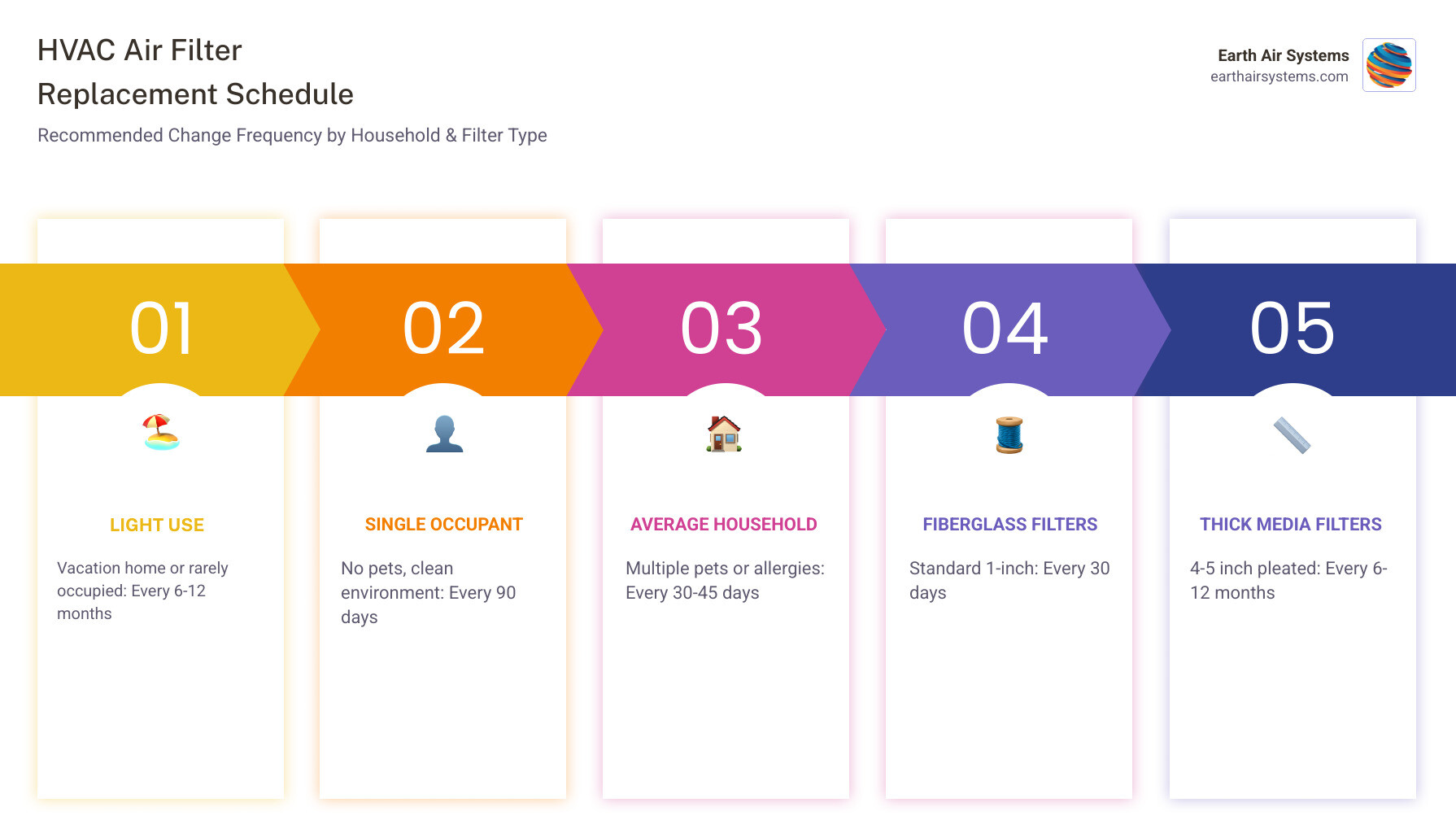
How often should you change your HVAC air filter depends on your filter type, household, and how hard your system works — but here’s a quick reference to get you started:
| Household Situation | Recommended Change Frequency |
|---|---|
| Vacation home / rarely occupied | Every 6-12 months |
| Single occupant, no pets | Every 90 days |
| Average household, no pets | Every 60-90 days |
| Household with one pet | Every 60 days |
| Household with multiple pets | Every 20-45 days |
| Allergies or asthma | Every 30-45 days |
| 1-inch fiberglass filter | Every 30 days |
| 1-inch pleated filter | Every 30-90 days |
| 4-5 inch thick media filter | Every 6-12 months |
Most homeowners don’t think about their air filter until something goes wrong. Maybe the air feels stuffy, the system is running constantly, or the energy bill creeps up for no obvious reason. Often, the culprit is something simple: a filter so clogged it’s slowly strangling the entire system.
Your HVAC filter is the first line of defense for both your indoor air quality and your equipment. When it gets overwhelmed with dust, pet hair, and airborne particles, your system has to work much harder to push air through. According to the U.S. Department of Energy, replacing a dirty filter can improve system efficiency by 5 to 15%. That’s a meaningful number — and it comes from one of the cheapest, easiest maintenance tasks a homeowner can do.
In San Diego, where systems run year-round thanks to warm summers and mild winters, filter maintenance matters even more than in colder climates where systems sit idle for months.
How Often Should You Change Your HVAC Air Filter in General?
In general, the industry “rule of thumb” for a standard 1-inch pleated filter is to replace it every 90 days. However, as it is May 2026, we’ve seen that climate shifts and lifestyle changes often make this 90-day window too long for many San Diego residents. While 90 days is a solid baseline for a single occupant in a clean environment, most active households need to look at a 30-to-60-day window, especially during peak usage seasons.
Peak usage in San Diego doesn’t just mean the heat of August. Because our region enjoys Mild Climates and Maintenance: How Often Should You Service Your System?, many homeowners keep their systems running in “fan only” mode or use the AC intermittently throughout the year. If your system is moving air, the filter is collecting debris.
The physical size of your filter also dictates the schedule. A standard 1-inch filter has very little surface area and can fill up quickly. Conversely, 4-inch or 5-inch deep-media filters are designed with significantly more surface area, allowing them to last anywhere from six months to a full year before they begin to restrict airflow.
How often should you change your hvac air filter with pets and allergies?
If you share your home with furry friends, your filters are working overtime. Pets are often called “filter killers” because they contribute more than just dust; they add heavy layers of fur and dander to the mix. During shedding seasons, a filter that looked clean two weeks ago can become “carpeted” in fur almost overnight. For households with one pet, we recommend checking the filter every 60 days. If you have multiple pets, that interval should drop to every 20–45 days.
For those dealing with allergies or asthma, the filter is more than just equipment protection—it’s a health necessity. To keep triggers like pollen, mold spores, and fine dust at bay, we suggest using filters with a MERV 11 to 13 rating and replacing them every 30 to 45 days. Frequent swaps ensure that the captured allergens aren’t just sitting in your ductwork, potentially recirculating into your living space. If you are looking for the best way to manage these triggers, check out The Ultimate Guide to AC Maintenance Services in San Diego for more professional tips.
Impact of home size and occupancy on your schedule
The more people you have under one roof, the more “biological load” your HVAC system has to handle. Every person in your home sheds skin cells and stirs up dust as they move. In a large household with four or more people, the sheer volume of air being circulated and the amount of debris generated means your filter will clog much faster than in a studio apartment.
Large homes also have higher air volume requirements. If you have a sprawling property in our Service Areas like North County or Chula Vista, your system is likely moving thousands of cubic feet of air every hour. More air moving through the filter means more particles being trapped. If you have a guest house or an ADU that is only used occasionally, those filters might last the full six months, but your primary residence will almost always need a more aggressive schedule.
Understanding Filter Types, MERV Ratings, and Thickness
Not all filters are created equal. Choosing the right one involves balancing air filtration quality with the physical capabilities of your HVAC motor.
| Filter Type | Material | MERV Rating | Average Lifespan |
|---|---|---|---|
| Fiberglass | Spun glass | 1–4 | 30 Days |
| Pleated | Synthetic/Cotton blend | 5–11 | 60–90 Days |
| High-Efficiency | Deep-pleat synthetic | 12–16 | 6–12 Months |
| HEPA | Dense glass fiber | 17–20 | Variable (usually annual) |
The MERV (Minimum Efficiency Reporting Value) scale measures how effectively a filter captures particles. While a higher MERV rating means cleaner air, it also means the filter is denser. If a filter is too dense for your specific system, it can act like a wall, causing the motor to overheat. For most homes, a MERV 8 to 11 is the “sweet spot.” If you’re in a coastal area and need help deciding, Don’t Sweat It: Finding the Best AC Maintenance in La Jolla, CA offers great localized advice.
How often should you change your hvac air filter based on material?
Fiberglass filters are the most affordable, but they are designed primarily to catch large “boulders” of dust to protect the motor, not to clean the air you breathe. Because they have very little surface area, they should be changed every 30 days without fail.
Pleated filters are the most common residential choice. They use a folded design to increase the surface area, allowing them to trap smaller particles like pollen and pet dander while maintaining better airflow. These typically last 60 to 90 days. HEPA filters are the gold standard for air purity, trapping 99.97% of particles, but they often require specialized high-pressure systems to function correctly. You can find more details on these in our HVAC FAQs.
The role of filter thickness in longevity
If your HVAC cabinet allows for it, a thicker filter is almost always a better investment. A 1-inch filter is standard, but 4-inch and 5-inch “media” filters are becoming common in modern Heating Services in San Diego.
Think of it this way: a 5-inch filter isn’t just thicker; it has much deeper pleats. If you were to stretch out the material of a 5-inch filter, it would cover a significantly larger area than a 1-inch filter. This extra material allows the filter to hold a massive amount of dust before it begins to restrict airflow, often lasting a full year in average households.
Signs Your Filter Needs Immediate Attention
Sometimes the calendar lies. Environmental factors like construction down the street or a particularly windy week in San Diego can clog a filter ahead of schedule. We recommend the “Light Test”: remove your filter and hold it up to a bright light or the sun. If you can’t see light passing through the fibers, the filter is “blind” (fully clogged) and needs to be replaced immediately, regardless of how long it’s been there.
Other warning signs include:
- Visible Graying: If the filter media has turned from white to a dark, dingy gray.
- Dusty Surfaces: If you notice a fine layer of dust settling on your furniture just a day after cleaning.
- Musty Odors: A “dirty sock” smell when the AC kicks on often indicates a filter laden with organic debris and moisture.
- Reduced Airflow: If the air coming out of your vents feels weaker than usual, the filter is likely the bottleneck. For residents in Coronado, maintaining this airflow is key to fighting coastal humidity; see Don’t Sweat the Heat with Professional AC Maintenance in Coronado for more.
The Risks of Neglecting Your HVAC Maintenance
What happens if you just… don’t change it? The consequences range from annoying to expensive. A clogged filter restricts the return air that your system needs to stay cool. Without enough air flowing over the evaporator coil, the temperature of that coil can drop below freezing, causing condensation to turn into ice. A frozen evaporator coil can shut down your whole system and, in some cases, lead to liquid refrigerant flooding back into the compressor—a “death sentence” for your AC.
Furthermore, a dirty filter forces the blower motor to work harder and run longer to reach the temperature set on your thermostat. This “short cycling” and motor strain lead to premature equipment failure. By simply swapping a filter, you protect your investment and can save 5–15% on your monthly energy bills.
Maintenance Tips for San Diego Homeowners
San Diego presents unique challenges for air filtration. Our coastal communities deal with salt air, which can make dust “stickier” and harder to filter. Meanwhile, inland areas like Escondido and San Marcos often face higher levels of seasonal dust and pollen.
Here are a few pro tips for our local climate:
- Wildfire Awareness: If there is smoke in the air from regional wildfires, check your filter immediately after the air clears. Smoke particles are incredibly fine and can clog a brand-new filter in just a few days.
- The “Fan On” Trick: During mild spring and fall months, you can run your HVAC fan in the “On” position instead of “Auto.” This keeps air moving through the filter even when the AC isn’t cooling, helping to scrub the air of allergens. Just remember that this will require more frequent filter changes.
- Washable Filters: While some homeowners use washable electrostatic filters, we generally find they require monthly cleaning and must be completely dry before reinsertion to prevent mold growth. For most, high-quality disposable pleated filters are more effective and convenient.
- Calendar Reminders: Use your phone to set a recurring alert. Better yet, write the date of installation on the edge of the filter frame with a permanent marker so you can see it at a glance.
If you’re unsure about your system’s specific needs, our Air Conditioning Services in San Diego can help you establish a custom maintenance plan.
Frequently Asked Questions about HVAC Filters
Can I wash and reuse a disposable air filter?
No. Disposable filters are made of paper, polyester, or cotton fibers that degrade when they get wet. Washing them destroys their ability to trap particles and can lead to mold growth within your ductwork. Unless it is specifically labeled as “washable,” always toss it and replace it with a new one.
How many air filters does my San Diego home have?
Most homes have at least one primary filter located in the return air grille (usually a large vent on a wall or ceiling) or in a slot right next to the indoor furnace or air handler. However, larger or multi-story homes in San Diego often have “zoned” systems, which may have multiple return vents, each with its own filter. It is important to find and change all of them to ensure the system isn’t struggling.
Does running the fan “On” instead of “Auto” affect filter life?
Yes. When the fan is set to “Auto,” it only runs (and filters air) when the system is actively heating or cooling. When set to “On,” the fan runs continuously. This provides superior air filtration and more consistent temperatures, but it means the filter is catching debris 24/7, which will likely cut its lifespan in half.
Conclusion
How often should you change your HVAC air filter isn’t just a matter of following a date on a box; it’s about listening to your home and your lifestyle. Whether you’re dealing with pet dander in Vista or coastal salt air in Solana Beach, regular filter maintenance is the simplest way to ensure your home stays comfortable and your energy bills stay low.
At Earth Air Systems, we bring over 40 years of experience to every home in San Diego County. We know the local climate, and we know exactly what it takes to keep your system running at peak efficiency. From simple maintenance tune-ups to full system replacements, our team is dedicated to your 100% satisfaction.
Don’t let a dusty filter stand between you and a cool, comfortable home. If you’re noticed reduced airflow or haven’t had your system inspected recently, contact us today to schedule our professional Air Conditioning Services in San Diego. We’re here to help you breathe easier!
