
Is It Time to Call a Pro? What San Diego Homeowners Need to Know About AC Problems
Knowing when to call a professional for AC problems can save you from a costly breakdown — especially on a hot San Diego afternoon when your system decides to quit. Some AC issues are simple enough to check yourself in a few minutes. Others are signs of something serious that needs a licensed technician right away.
Here’s a quick guide to help you decide:
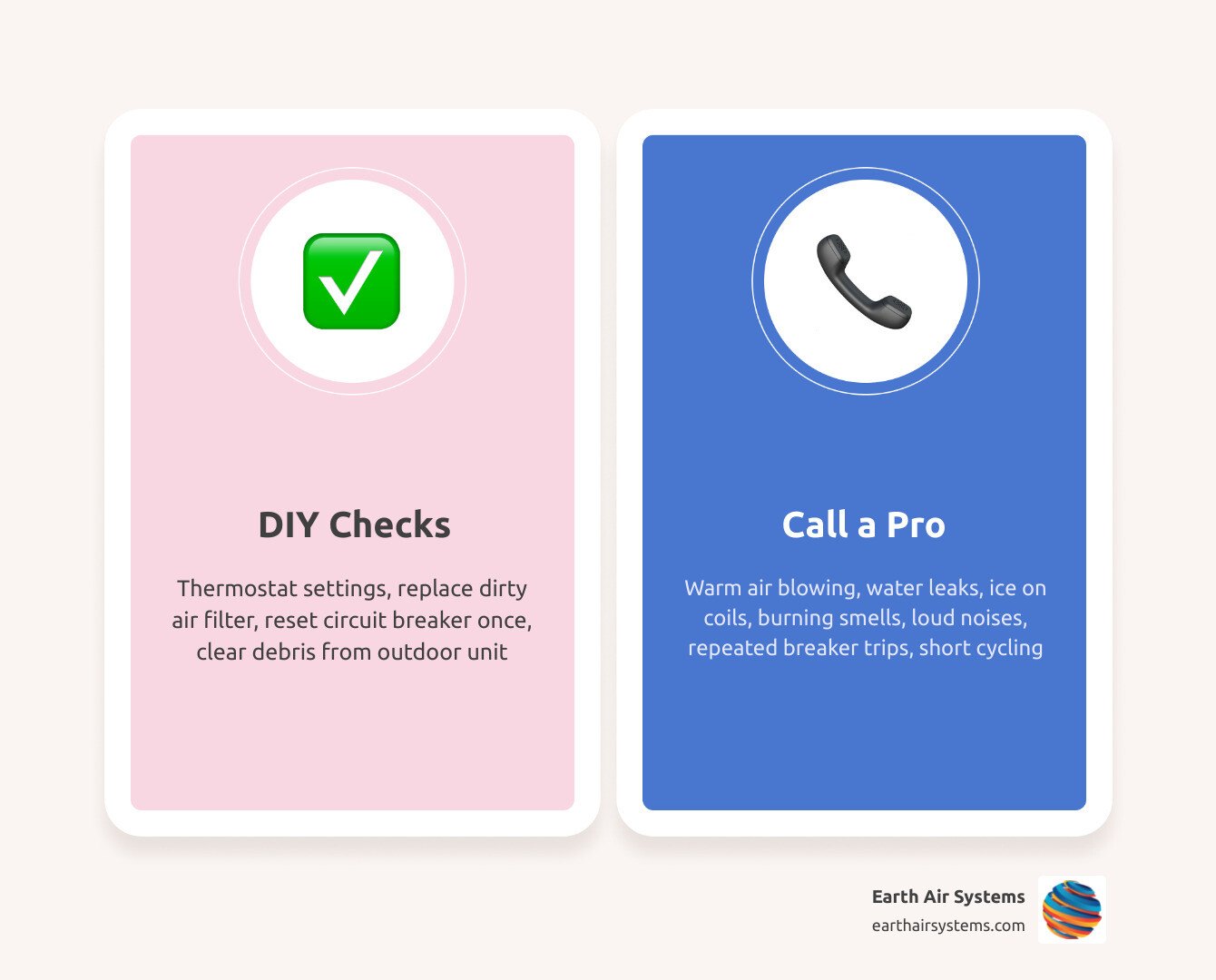
Call a professional immediately if you notice any of the following:
- Warm air blowing despite correct thermostat settings
- Water leaking from your indoor air handler or around the unit
- Ice forming on the evaporator coil or refrigerant lines
- Burning or electrical smells coming from any part of the system
- Loud grinding, banging, or screeching noises
- Breakers tripping repeatedly when you reset them
- System short cycling — turning on and off every few minutes
Safe to check yourself first:
- Thermostat settings (set to COOL, below room temperature)
- Air filter (replace if dirty or clogged)
- Circuit breaker (reset once if tripped)
- Outdoor unit (clear any debris blocking airflow)
The tricky part is that AC systems in San Diego face a unique mix of coastal humidity, inland heat, and long cooling seasons — meaning small issues can escalate fast. A clogged drain line that might sit unnoticed for weeks in a mild climate can trigger a water damage situation here before the end of the day.
The good news: most homeowners can rule out the simple stuff in under five minutes. If the problem persists after those basic checks, that’s your signal to stop guessing and pick up the phone.
When to call a professional for ac problems terminology:
Safe DIY Checks to Perform Before Calling for Service
Before you pick up the phone to book an emergency service call, it is always a good idea to perform a few basic, safe diagnostic checks. Every year, we receive calls from worried homeowners in Chula Vista and Carlsbad whose air conditioners “stopped working,” only to discover that a dead battery in the thermostat or a bumped switch was the sole culprit.
By taking five minutes to run through a quick checklist, you can easily determine if you are dealing with a minor system oversight or if it is officially time to call in the experts. If your system is currently powered on but refusing to lower the temperature, reviewing our guide on How to Fix AC Running But Not Cooling can help you rule out simple, common mistakes before you schedule a technician.
Checking Your Thermostat and Power Settings
The thermostat is the brain of your entire heating and cooling system. Sometimes, a seemingly major system failure is actually just a communication breakdown. Run through these steps first:
- Check the Display: If your thermostat screen is completely blank, the batteries may have died. Replace them with fresh AA or AAA batteries and wait a moment to see if the system boots back up.
- Verify the Mode: Make sure the thermostat is explicitly set to COOL, not “HEAT” or “FAN ONLY.” It sounds obvious, but during seasonal transitions in San Diego, it is incredibly easy for a family member to switch settings without you knowing.
- Set the Temperature: Ensure the target temperature is set at least 3 to 5 degrees below the current room temperature.
- Inspect the Fan Setting: Keep the fan set to AUTO rather than “ON.” The “ON” setting runs the fan continuously even when the AC is not actively cooling, which can blow warm, humid air back into your home.
- Check the Breakers: Locate your home’s main electrical panel. HVAC systems draw a lot of power, and a sudden surge can trip the breaker. If you find a tripped breaker, reset it once. If it immediately trips again, do not force it back on. A repeating trip indicates an electrical short or a failing component, which is a clear sign of when to call a professional for AC problems to prevent electrical fires.
Inspecting Air Filters and Vents
Airflow is the lifeblood of your air conditioner. When airflow is restricted, your system has to work twice as hard to cool your home, leading to poor performance, high utility bills, and eventual mechanical failure.
- Check the Air Filter: A heavily clogged, dusty air filter is the number one cause of weak airflow and frozen evaporator coils. During heavy summer use, you should inspect your filter monthly and replace it every 1 to 3 months. If you pull out a filter and it is covered in a thick grey blanket of dust, replace it immediately.
- Inspect Your Vents: Walk through your home and make sure all supply registers and return grilles are completely open and unobstructed by furniture, heavy drapes, or toys. Closing off vents in unused rooms does not save energy; instead, it alters the pressure balance within your ductwork, placing unnecessary strain on your blower motor.
When to Call a Professional for AC Problems Immediately
While a dirty filter or a dead battery is an easy fix, many air conditioning issues lie deep within the system’s mechanical and electrical architecture. Attempting to repair these complex components without specialized training is not only dangerous, but it can also permanently ruin your equipment.
If your system displays any of the following critical warning signs, skip the DIY videos and call a licensed specialist right away:
- Warm Air Output: If your thermostat is configured correctly and your filters are clean, but the air coming out of your vents is warm, you could be facing a failed compressor, a broken fan motor, or a refrigerant leak.
- Puddles and Water Leaks: Your AC naturally pulls moisture out of the air. This water is supposed to drain safely outside. If you notice water pooling around your indoor unit, in your attic, or dripping from your ceiling, your condensate drain line is likely blocked. Left unaddressed, this can cause thousands of dollars in structural water damage and foster mold growth.
- Ice Accumulation: If you see ice forming on your outdoor copper lines or on the indoor evaporator coil, your system has a serious airflow restriction or is low on refrigerant.
- Burnt or Electrical Odors: A fishy, sulfur-like, or plastic burning smell indicates overheating wires, a seized motor, or a failing capacitor. Shut down your system at the breaker immediately to prevent a fire.
- Loud Mechanical Noises: Screeching, grinding, clanging, or loud banging sounds mean a belt has slipped, motor bearings have failed, or the compressor is self-destructing. Turn the system off to prevent further internal damage.

If you are experiencing any of these severe symptoms, do not wait for the system to break down completely. Learn more about our rapid diagnostic and repair services by visiting our AC Repair in San Diego page to get your home back to a comfortable temperature.
Recognizing Severe Symptoms: When to Call a Professional for AC Problems
Why are certain AC repairs strictly off-limits for homeowners? The answer comes down to safety, specialized tools, and strict environmental laws.
Modern air conditioning units operate on high-voltage electrical circuits (typically 240 volts). They also contain heavy-duty electrical storage devices called capacitors. Capacitors act like temporary batteries, storing high-voltage energy to help start up the heavy motors inside your AC. Even if you have turned off the power to your unit at the breaker, a capacitor can still hold a lethal electrical charge. One wrong move with a screwdriver can result in a severe electrical shock or arc flash.
Furthermore, issues involving the cooling agent (refrigerant) require specialized handling. Under the Environmental Protection Agency (EPA) Section 608 regulations, it is illegal for anyone without proper certification to purchase, handle, or charge refrigerant into an air conditioning system. If your AC is low on refrigerant, it means you have a leak. Simply adding more refrigerant without finding and sealing the leak violates federal law, damages the environment, and will eventually destroy your compressor. A certified technician has the leak-detection tools, recovery equipment, and training to handle these chemicals safely and legally.
System Short Cycling and When to Call a Professional for AC Problems
Have you noticed your air conditioner turning on, running for two or three minutes, shutting off, and then repeating the cycle over and over again? This behavior is known as short cycling, and it is a major emergency for your HVAC system.
Short cycling places immense strain on your compressor and blower motor. The startup phase is the most taxing part of an air conditioner’s operation; when forced to start and stop continuously, the motor windings overheat, leading to premature motor burnout. Short cycling is also incredibly inefficient, causing your energy bills to skyrocket while leaving your home humid and unevenly cooled.
Common causes of short cycling include:
- An oversized AC unit that cools the air too quickly without removing humidity.
- Low refrigerant levels due to a system leak.
- A malfunctioning or poorly placed thermostat that is getting false temperature readings.
- Severely restricted airflow from a clogged filter or failing blower motor.
Because short cycling has multiple potential causes, it requires a professional diagnostic service call to identify the root issue and prevent a complete compressor failure.
The Impact of San Diego’s Climate on Your Air Conditioner
San Diego is famous for its beautiful, mild weather, but our unique microclimates present distinct challenges for residential cooling systems. From the salty, humid breezes of Oceanside and La Jolla to the intense summer heatwaves in inland communities like Escondido and San Marcos, your air conditioner has to work hard to keep your indoor environment comfortable.
Along the coast, high relative humidity prevents sweat from evaporating easily, making your home feel much warmer than the actual temperature. To combat this, your air conditioner must run long enough to dehumidify your indoor air. However, coastal salt air is highly corrosive. Over time, salt spray can corrode the delicate aluminum fins on your outdoor condenser coil, reducing heat transfer and causing the system to run hotter and wear out faster.
Inland, the primary challenge is sheer heat. When temperatures climb during summer heatwaves, older or unmaintained systems are pushed to their absolute limits. If your system has a minor, undiagnosed issue—such as a slightly weak capacitor or a tiny refrigerant leak—it will likely break down on the hottest day of the year when the system is under maximum thermal strain. If you are wondering whether your current unit is up to the task of handling the next major heatwave, check out our San Diego Homeowner Alert: Is Your AC Giving Up the Ghost? for advice on spotting early warning signs of system failure.
Why You Should Turn Off Your System While Waiting for Service
If you have discovered a serious issue and have scheduled a professional service visit, you might be tempted to leave the AC running in an attempt to squeeze out whatever little cool air you can get. Do not do this.
If you notice ice on your system, water leaking into your home, burning smells, or loud mechanical noises, turn the system completely OFF at the thermostat immediately.
Leaving a malfunctioning system running can turn a simple, inexpensive repair into a catastrophic failure. For example:
- If your coils are frozen: Leaving the system running with a block of ice on the evaporator coil can liquid-flood your compressor, destroying it instantly. Instead, turn the system to FAN ONLY mode. This keeps the indoor blower running to help thaw the ice safely before the technician arrives, while keeping the dangerous compressor turned off.
- If you have a water leak: Keeping the system running will continue to produce gallons of condensation, worsening the water damage to your drywall, ceilings, and flooring.
- If you hear grinding or screeching: Continuing to run the system can cause loose or broken parts to fly apart inside the cabinet, destroying other expensive components like the fan blades or coil tubing.
Deciding Between AC Repair and System Replacement
At some point, every homeowner faces a difficult financial decision: should you keep patching up an old, struggling air conditioner, or is it more practical to invest in a complete system replacement?
Most residential central air conditioning systems have an expected lifespan of 10 to 15 years with proper maintenance. Once a system crosses the decade mark, its internal components naturally degrade, mechanical efficiency drops, and the likelihood of expensive, compounding breakdowns increases.
If you are constantly calling for repairs, dealing with uneven temperatures, or watching your monthly energy bills climb, your unit may be telling you it is time to retire. To help you evaluate the state of your current system, read through our guide Is Your AC a Senior Citizen and Ready to Retire? to see if a replacement makes the most sense. For a closer look at your options for modern, energy-efficient upgrades in San Diego County, visit our AC Replacement in San Diego page.
Applying the $5,000 and 50% Rules for HVAC Decisions
To remove the guesswork from the repair-versus-replace dilemma, experienced HVAC professionals rely on two simple, time-tested financial guidelines: The $5,000 Rule and The 50% Rule.
The $5,000 Rule: Multiply the age of your air conditioning unit by the estimated cost of the repair. If the resulting number exceeds $5,000, you should replace the unit. If it is less, repairing it is generally the smarter financial move.
- Example A: A 12-year-old system needs a $500 repair. (12 x 500 = $6,000). Because $6,000 is greater than $5,000, replacement is recommended.
- Example B: A 6-year-old system needs the same $500 repair. (6 x 500 = $3,000). Because $3,000 is less than $5,000, proceeding with the repair is the logical choice.
The 50% Rule: If the cost of a single repair exceeds 50% of the value of a brand-new, modern system, you should always choose replacement. Spending thousands of dollars to fix an old, out-of-warranty unit is often a temporary band-aid on a system that will likely experience another component failure shortly down the road.
| Decision Factor | Choose AC Repair | Choose AC Replacement |
|---|---|---|
| System Age | Under 10 Years Old | Over 12-15 Years Old |
| Refrigerant Type | Modern R-410A / R-454B | Obsolete R-22 (Phased Out) |
| Repair Cost vs. Value | Under 30% of replacement cost | Over 50% of replacement cost |
| Energy Bills | Stable and manageable | Consistently rising |
| Frequency of Breakdowns | Rare, occasional minor issues | Multiple service calls per year |
| Warranty Status | Still covered under manufacturer warranty | Warranty has expired |
If you decide that a replacement is the most cost-effective path forward, our team can guide you through choosing the perfect unit for your home’s layout. Explore our AC Installation in San Diego page to learn about high-efficiency systems, modern variable-speed technology, and ductless mini-split options.
Frequently Asked Questions About Air Conditioning Repairs
How often should I schedule professional AC maintenance?
We strongly recommend scheduling professional AC maintenance at least once a year, ideally in the early spring before the summer heat arrives. Just like your car needs regular oil changes to run reliably, your air conditioning system requires professional cleaning, calibration, and safety testing to operate at peak efficiency.
During a standard maintenance visit, a technician will clean your condenser and evaporator coils, test electrical connections, check refrigerant levels, lubricate moving parts, and inspect your ductwork. Consistent maintenance not only prevents sudden mid-summer breakdowns, but it is also a strict requirement to keep your manufacturer’s parts warranty valid. To learn more about what is included in a professional tune-up, check out The Ultimate Guide to AC Maintenance Services in San Diego.
Can attempting DIY repairs void my air conditioner’s warranty?
Yes, absolutely. The vast majority of major HVAC manufacturers (including Carrier, Trane, Lennox, and Rheem) explicitly state in their warranty terms that all installations, maintenance, and repairs must be performed by a licensed and certified HVAC professional.
If you attempt to replace a complex component yourself—such as a compressor, blower motor, or capacitor—and cause further damage, the manufacturer will deny any future warranty claims. Always preserve your investment by leaving internal system repairs to licensed experts.
What are the most common mistakes homeowners make with DIY AC fixes?
When homeowners attempt to tackle complex AC repairs without proper training, they often end up making the problem worse (and much more expensive). Three of the most common mistakes include:
- Using High-Pressure Washers on Coils: While cleaning your outdoor condenser unit is great, using a high-pressure power washer on the exterior coils will instantly bend and crush the delicate aluminum fins, blocking airflow and permanently damaging the unit. Always use a gentle garden hose spray.
- Ignoring the Root Cause: Replacing a blown fuse or a bad capacitor might get your system running temporarily, but these parts usually fail because of a deeper issue, such as an overheating motor or a short circuit. Simply swapping parts without diagnosing why they failed leads to recurring breakdowns.
- Unsafe Capacitor Handling: As mentioned earlier, capacitors store dangerous levels of electricity. Attempting to replace one without properly discharging the stored energy can result in severe shock or fire.
Conclusion
Your home’s air conditioner is a complex, high-voltage machine that plays a massive role in your daily comfort and indoor air quality. While simple tasks like changing your air filter and setting your thermostat are perfectly safe to handle yourself, complex mechanical, electrical, and refrigerant issues require the touch of a seasoned professional. Knowing when to call a professional for AC problems keeps your family safe, protects your system’s warranty, and prevents minor issues from turning into expensive emergencies.
At Earth Air Systems, we have spent over 40 years keeping homes cool and comfortable across San Diego County—from La Jolla and Coronado to Oceanside and Escondido. As a family-owned, owner-operated business, we pride ourselves on delivering honest, dependable service with transparent, flat-rate pricing and a 100% customer satisfaction guarantee. Our certified technicians are always ready to provide rapid, reliable diagnostics and top-notch repairs to keep your home comfortable year-round.
Don’t let a failing air conditioner ruin your peace of mind. If your system is blowing warm air, making strange noises, or short cycling, let our experienced team handle the troubleshooting for you. Visit our AC Repair in San Diego page to schedule your professional diagnostic service call.
