
Why Santa Ana Winds Are One of the Biggest Threats to Your San Diego HVAC System
How dust from Santa Ana winds clogs your system is something every San Diego homeowner needs to understand — especially if your AC has ever struggled, made strange noises, or shut down completely during one of these infamous “Devil Wind” events.
Here’s the short answer:
How Santa Ana Winds Clog Your HVAC System
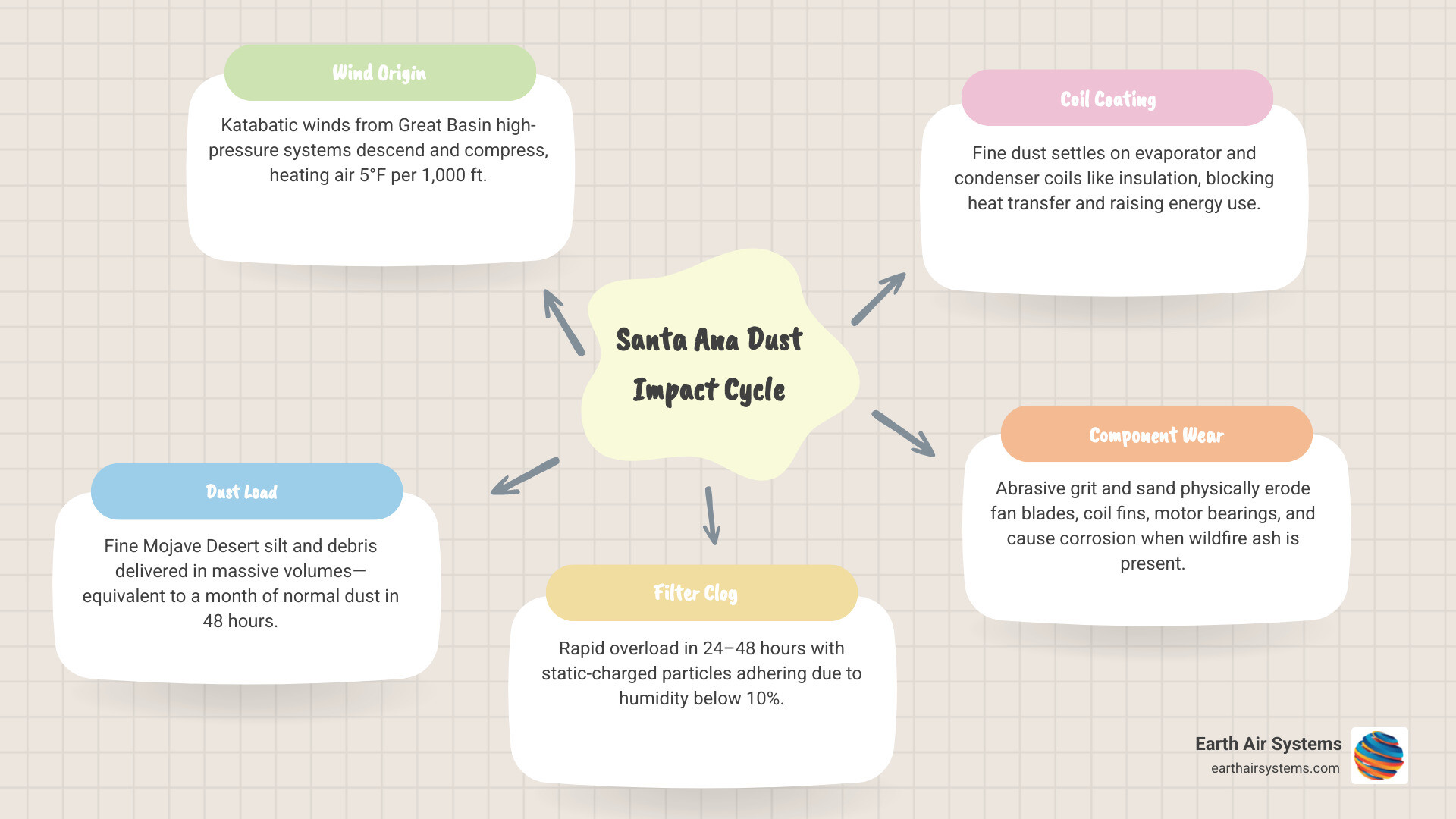
- Massive dust load — Santa Ana winds carry fine Mojave Desert silt and debris that can deliver the equivalent of a full month’s worth of dust in just 48 hours.
- Rapid filter overload — That volume of particulate can clog your air filter in as little as 24 to 48 hours, choking off airflow to your entire system.
- Static electricity adhesion — Humidity during these events drops below 10%, creating static charges that make dust particles cling aggressively to filters and internal components.
- Coil coating — Fine dust settles on evaporator and condenser coils like insulation, preventing proper heat transfer and forcing your system to work harder.
- Abrasive particle damage — Sand and grit carried in the wind physically wear down fan blades, coil fins, and motor bearings over time.
- Wildfire ash infiltration — When wind events overlap with fire season, sticky, alkaline ash enters the system and causes corrosion and sensor damage beyond what ordinary dust creates.
Southern California sees between 10 and 25 Santa Ana events every year, each lasting around three days on average. For San Diego homeowners, that adds up to a serious and repeated mechanical threat — not just a weather inconvenience. And a clogged filter during a heat spike is one of the most common causes of a frozen evaporator coil or a burnt-out blower motor.
This guide breaks down exactly what happens inside your HVAC system when these winds hit, and what you can do to prevent expensive damage.
The Science of How Dust from Santa Ana Winds Clogs Your System
To understand how dust from Santa Ana winds clogs your system, we first have to look at the unique physics of these winds. Santa Ana winds are “katabatic” winds, meaning they originate from high-pressure systems in the Great Basin (Nevada and Utah) and spill over the mountains toward the coast.
As this air drops in elevation toward communities like Escondido or San Marcos, it undergoes “compression heating.” This process warms the air by about 5°F for every 1,000 feet it descends. By the time it reaches your front door, it is hot, incredibly dry, and moving fast.
This dry air is the perfect vehicle for dust. When humidity levels drop into the single digits—drier than the Sahara Desert—the air loses its ability to hold moisture that would otherwise weigh down dust particles. Instead, the particles remain airborne, traveling hundreds of miles from the Mojave Desert directly into your HVAC intake.
For a deeper dive into why these conditions are so brutal for your air conditioner, check out our guide on Blowin’ in the Wind: Why Hot, Dry Gusts Are Your AC’s Worst Enemy.

How dust from Santa Ana winds clogs your system in under 48 hours
In normal San Diego weather, your air filter might last three months before needing a change. During a Santa Ana event, that timeline is completely thrown out the window. Because these winds can deliver a month’s worth of dust in just 48 hours, your filter can reach its maximum capacity almost overnight.
When the filter becomes a “solid wall of debris,” it creates high static pressure. Your blower motor has to work twice as hard to pull air through that blockage. This is often when we see systems overheat or short-cycle. If you are concerned about the air you’re breathing during these events, our Air Quality Services in San Diego can help you find more robust filtration solutions.
Why static electricity makes desert dust stickier
One of the most frustrating aspects of how dust from Santa Ana winds clogs your system is the role of static electricity. Low humidity (often below 10%) creates the perfect environment for friction-induced static charges.
As dust particles rub against each other and the surfaces of your ductwork, they develop a charge that makes them “stickier.” Instead of simply passing through or falling off, they bond to the fibers of your filter and the metal surfaces of your internal components. This bonding makes it much harder for a standard filter to “shake off” debris, leading to a faster and more stubborn clog.
Mechanical Damage Caused by Wind-Blown Debris
While the dust inside your home is a nuisance, the debris hitting your outdoor unit is a mechanical nightmare. Your outdoor condenser unit is designed to breathe, but during a Santa Ana event, it’s essentially being sandblasted.
How dust from Santa Ana winds clogs your system’s condenser coils
Your condenser coils are responsible for releasing the heat collected from inside your home. When fine desert silt coats these coils, it acts as a layer of insulation. This prevents the refrigerant from cooling down effectively, which significantly reduces your system’s Energy Efficiency Ratio (EER).
Even a minor layer of dirt can force the system to run longer and hotter. In extreme cases, the heat builds up so much that the compressor—the “heart” of your AC—can fail. Regular maintenance is the best defense against this; you can learn more in The Ultimate Guide to AC Maintenance Services in San Diego.
Impact on motors, bearings, and electrical components
It isn’t just dust; it’s also sand and organic matter. High-velocity sand acts like sandpaper, physically wearing down the leading edges of fan blades and working its way into motor bearings.
Furthermore, Santa Ana winds often cause power fluctuations or “brownouts” as lines sway in the wind. These voltage drops, combined with a motor that is already struggling against a clogged filter, are a recipe for electrical shorts and control board failures.
| Feature | Fine Desert Dust | Abrasive Sand | Wildfire Ash |
|---|---|---|---|
| Primary Target | Air Filters & Indoor Coils | Outdoor Fan Blades & Fins | Sensors & Metal Surfaces |
| Effect | Airflow Restriction | Physical Erosion/Pitting | Chemical Corrosion |
| Clog Speed | Very Fast (24-48 hours) | Moderate | Immediate Adhesion |
| Risk Level | High (Efficiency Loss) | Extreme (Mechanical Wear) | Critical (Corrosion) |
If you’re wondering how this compares to our usual coastal conditions, see our article on Don’t Let the Sea Breeze Clog Your HVAC.
Protecting Your HVAC System Before and During Wind Events
We always tell our neighbors in areas like La Jolla and Oceanside that preparation is half the battle. You don’t have to wait for the dust to settle to take action.
Choosing the right MERV rating for high-dust conditions
During Santa Ana season, the type of filter you use matters. We generally recommend a pleated filter with a MERV rating between 8 and 11.
- MERV 8: Great for general dust and larger particles.
- MERV 11-13: Better for fine silt and smoke, but check with us first to ensure your system can handle the higher static pressure.
Using a filter that is too restrictive can be just as bad as a clogged one. It’s all about finding the balance between clean air and healthy airflow.
Using recirculation mode to combat wildfire smoke and ash
Santa Ana winds frequently coincide with wildfire season. Fire ash is chemically different from desert dust—it is often alkaline and abrasive. When ash gets wet (even from the morning dew), it can become corrosive to the metal components in your AC.
If there is smoke in the air, switch your HVAC system to recirculation mode. This prevents the system from pulling in “fresh” (smoky) outside air and instead focuses on cleaning the air already inside your home. For more on managing indoor environments, read How Coastal Humidity Creates Mold Risk and How to Stop It.
Post-Wind Maintenance: How to Clear the Clog
Once the winds die down and the red flag warnings are lifted, your HVAC system needs a “recovery” session.
Post-Wind Inspection Checklist:
- Power Down: Turn off the system at the thermostat.
- Check the Filter: If it looks gray or fuzzy, replace it immediately.
- Clear Debris: Remove any leaves or branches trapped against the outdoor unit.
- Gently Rinse: Use a garden hose (never a pressure washer!) to rinse the outdoor coils from top to bottom.
- Straighten Fins: Use a fin comb to gently fix any delicate aluminum slats bent by the wind.
Warning signs your system is struggling after a storm
Keep an ear out for these “cries for help” from your HVAC:
- Weak Airflow: Even with a new filter, the air coming from vents feels faint.
- Unusual Noises: Rattling, buzzing, or whistling (often caused by debris in the fan or air leaks).
- Short Cycling: The system turns on and off every few minutes.
- Ice Formation: If you see ice on the copper lines, your airflow is likely blocked, causing the evaporator coil to freeze.
When to call a professional for deep cleaning
Sometimes, a garden hose isn’t enough. If dust has worked its way deep into the motor housing or if the “sandblasting” effect has damaged the electrical connections, you need a professional touch. We provide comprehensive system audits that include deep coil cleaning and electrical safety checks to ensure your system survives the next round of “Devil Winds.”
Frequently Asked Questions about Santa Ana Dust
How quickly can dust clog my HVAC filter during a wind event?
In extreme conditions, filters can become significantly clogged within 24 to 48 hours. We recommend checking your filter every day during an active wind event. If you can’t see the filter material through the dust, it’s time for a change.
Should I cover my outdoor AC unit during a windstorm?
No, do not fully cover your unit while it is in use. This will cause the system to overheat instantly. However, you can install a “windbreak” like a fence or breathable mesh barrier a few feet away to reduce the direct impact of wind-blown sand.
How does wildfire ash differ from regular desert dust?
Wildfire ash is much more dangerous to your system’s longevity. It is alkaline, meaning it can eat away at the protective coatings on your coils. It is also “stickier” than desert silt, often requiring specialized chemical cleaners to remove completely from sensors and delicate internal parts.
Conclusion
At Earth Air Heating & Cooling, we’ve spent over 40 years helping San Diego families stay comfortable through every weather extreme. Understanding how dust from Santa Ana winds clogs your system is the first step in protecting your investment. By staying proactive with filter changes and seasonal tune-ups, you can ensure your AC is ready to handle the heat and the dust.
Don’t let the “Devil Winds” burn out your motor or skyrocket your energy bills. From Chula Vista to Oceanside, we are here to help. Schedule your San Diego AC service today and breathe easier knowing your system is in expert hands.
