
When the Devil Winds Come for Your AC: What Every San Diego Homeowner Needs to Know
How santa ana winds affect your hvac system is one of the most important things to understand if you own a home in Southern California. These powerful, hot, dry gusts roll in from the desert — sometimes pushing temperatures 20 to 30 degrees above normal within just a few hours — and your air conditioner bears the brunt of it. What feels like a rough weather day outside can quietly become a serious mechanical problem inside your home.
Here’s a quick look at the main ways Santa Ana winds impact your HVAC:
- Filter overload — A filter that normally lasts 60 to 90 days can clog completely in as little as one to two weeks during a strong wind event
- Physical damage — High-speed gusts carry sand and debris that scratch coils, bend fins, and wear down fan blades
- Efficiency loss — Dust-coated coils can’t transfer heat properly, forcing your system to work harder and run longer
- Electrical stress — Low humidity creates static electricity that puts extra strain on sensitive components like capacitors
- Indoor air quality decline — Dust, pollen, wildfire ash, and soot get pulled into your ductwork and circulated throughout your home
- Hidden system failures — The sudden heat surge exposes weaknesses like refrigerant leaks or borderline capacitors that were coasting along just fine before
As Raymond Chandler once described Santa Ana conditions in his short story Red Wind: the kind of weather where “meek little wives feel the edge of the carving knife and study their husbands’ necks.” Your AC feels something similar — pushed past its limits when it’s least prepared for it.
One strong Santa Ana event can do the equivalent of a full year’s worth of wear and tear on a local AC unit. That’s not a small thing to ignore.
The Science of How Santa Ana Winds Affect Your HVAC System
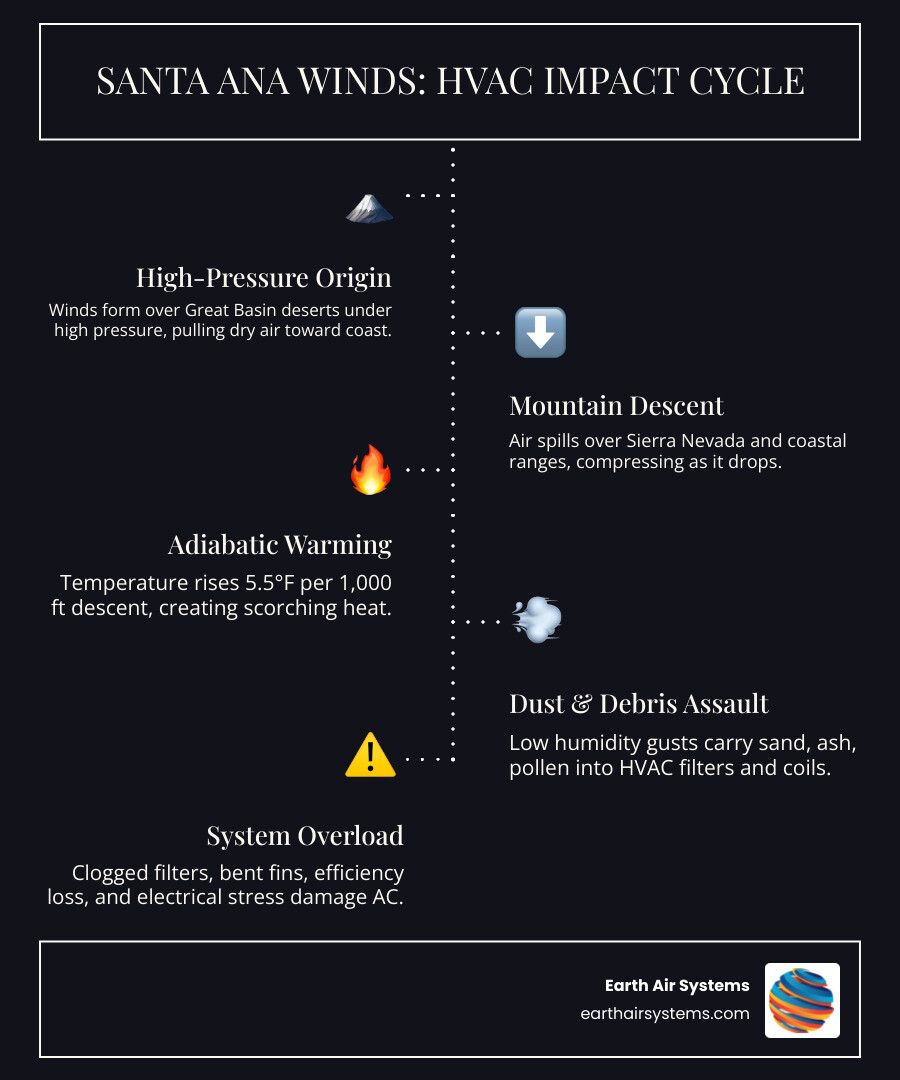
To understand the stress placed on your home comfort system, we have to look at the meteorology behind these “Devil Winds.” In April 2026, as we navigate another season of these atmospheric shifts, the science remains the same. Santa Ana winds are katabatic winds. This means they originate from high-pressure systems over the Great Basin (the high desert areas of Nevada and Utah).
As this air spills over the Sierra Nevada and coastal mountain ranges, it is pulled toward the lower pressure of the Pacific Ocean. As the air descends, it undergoes “adiabatic warming.” For every 1,000 feet the air drops in elevation, it heats up by about 5.5 degrees Fahrenheit due to compression. By the time it hits San Diego, Vista, or Chula Vista, it is bone-dry and scorching hot.
| Feature | Normal Coastal Condition | Santa Ana Wind Event |
|---|---|---|
| Temperature | 65°F – 75°F (Mild) | 90°F – 105°F (Extreme Spike) |
| Humidity | 50% – 70% (Moist) | < 10% (Bone Dry) |
| Wind Speed | 5 – 10 mph (Breeze) | 40 – 80+ mph (Gale Force) |
| Air Clarity | Clear / Marine Layer | Hazy / Dust-Laden |
| HVAC Load | Low to Moderate | Maximum Peak Demand |
This “triple threat” of high heat, extreme low humidity, and high-velocity wind creates a perfect storm for mechanical failure. When the humidity drops below 10%, static electricity becomes a major player, causing dust to cling to your HVAC components like a magnet. This is why our Air Conditioning Services in San Diego see such a massive spike in calls whenever the winds start to howl.
Physical Damage and Efficiency Loss
High winds don’t just blow; they sandblast. When gusts exceed 50 or 60 mph, they carry abrasive desert sand and grit that can physically strip the protective coatings off your outdoor condenser unit.
One of the most common issues we see is bent fins. The delicate aluminum fins on your outdoor coil are designed to allow air to pass through easily. When wind-blown debris or even the sheer force of the wind hits them, they flatten out. This “bruising” blocks airflow, meaning your AC can’t “breathe.”
Furthermore, the abrasive nature of the sand can wear down fan blades and put immense strain on the blower motor. If your system was already struggling with a weak capacitor or a tiny refrigerant leak, the 20 to 30-degree temperature jump will expose those flaws immediately. If your system stops blowing cold air during a gusty afternoon, you likely need AC Repair in San Diego to address components that have finally given up under the pressure.
Particulate Overload: Dust, Ash, and Debris
The Santa Ana winds act like a giant, reverse vacuum cleaner, dumping a month’s worth of Mojave dust into our neighborhoods in just 48 hours. But it’s not just sand. These winds often coincide with wildfire season, meaning they carry:
- Wildfire Soot and Alkaline Ash: This material is chemically reactive and sticky. It can corrode metal parts and lead to “dirty sock syndrome,” where organic buildup on the coils creates a foul odor.
- Organic Matter: Dried leaves and twigs can get sucked into the unit, trapping moisture against the metal and promoting rust.
- Pollen and Spores: The winds kick up allergens from the inland valleys, overwhelming your filtration system.
All of this “gunk” coats your evaporator and condenser coils. Much like wearing a parka in the middle of a San Diego summer, this layer of dust insulates the coils, preventing them from releasing heat. Your system then has to run twice as long to achieve the same cooling effect, leading to a massive spike in energy usage. To prevent this buildup from becoming permanent, regular AC Maintenance in San Diego is essential before and after the wind season.
Warning Signs Your HVAC is Struggling During a Wind Event
How do you know if the “Devil Winds” are winning the battle against your home’s comfort? Your HVAC system will usually try to tell you something is wrong before it shuts down completely.
Keep an eye out for these red flags:
- Smoky or “Dusty” Odors: If you smell smoke or a heavy “attic” smell when the air kicks on, it means outdoor particulates have bypassed your filtration.
- Longer Runtimes: If your AC is running for hours without reaching the set temperature, the coils are likely insulated by dust.
- Unusual Noises: Rattling or whistling can indicate that debris is stuck in the fan or that a panel has been loosened by the wind.
- Visible Dust Near Vents: If you see a fine layer of silt on your registers, your ductwork may have leaks that are sucking in wind-blown dirt.
- Health Symptoms: Increased sneezing, itchy eyes, or respiratory issues are often the first sign that your indoor air quality has plummeted.
If you are noticing any of these, checking our HVAC FAQs can help you troubleshoot the basics before calling in the pros.
How Santa Ana Winds Affect Your HVAC System Filter Lifespan
We cannot emphasize this enough: your air filter is the front line of defense. Under normal conditions, a standard pleated filter might last 90 days. During a Santa Ana event, that same filter can become a solid wall of dirt in just a week.
When a filter is completely blocked, it creates “static pressure” within the system. Imagine trying to run a marathon while breathing through a thick wool sweater—that is what your blower motor is going through. This strain can lead to:
- Frozen Evaporator Coils: Without enough airflow, the coils get too cold and turn into a block of ice.
- Blower Motor Failure: The motor overheats and burns out trying to pull air through the clogged filter.
- Short Cycling: The system turns on and off rapidly to protect itself from overheating.
During the peak of wind season, we recommend checking your filter every few days. If it looks grey or fuzzy, swap it out immediately.
Protecting Your Home: Before, During, and After the Gusts
You don’t have to be a helpless victim of the weather. There are proactive steps we recommend to all our neighbors in our Service Areas to minimize the impact of the winds.
Before the Winds Arrive:
- Trim the Greenery: Ensure trees and shrubs are at least 2-3 feet away from your outdoor unit. This prevents branches from striking the fins.
- Clear the Perimeter: Remove loose items like patio furniture covers or toys that could be blown into the unit.
- Seal the Gaps: Check the weatherstripping on your doors and windows to keep the dust outside where it belongs.
During the Wind Event:
- Recirculation Mode: Switch your HVAC to “recirculate” rather than pulling in “fresh” (but smoky/dusty) outside air.
- Keep Windows Closed: It sounds obvious, but even a few minutes of “airing out the house” can dump pounds of dust into your carpets and intake vents.
- Monitor Performance: If you hear a loud “thud” or “bang” from the outdoor unit, turn it off and inspect it for large debris like palm fronds.
After the Gusts Subside: Once the air clears, your system needs a little TLC. This is the time to switch over and ensure your Heating Services in San Diego are also ready for the cooler desert nights that often follow wind events.
Post-Event Recovery and Maintenance
Don’t wait for the next heatwave to find out your system is compromised. After the winds die down:
- Gently Hose the Coils: Use a low-pressure garden hose to rinse the dust off your outdoor unit. Never use a pressure washer, as this will flatten the fins.
- Check the Fins: If you see bent fins, a professional “fin comb” can be used to straighten them out and restore airflow.
- Replace the Filter (Again): Even if you changed it right before the winds, check it again. It’s likely full.
- Inspect Electrical Connections: Strong vibrations from high winds can occasionally loosen wiring in the outdoor disconnect box.
Long-Term Resilience and Indoor Air Quality Upgrades
If you’re tired of the “dust bowl” effect every autumn, it might be time to look at long-term solutions. Modern technology allows us to create a “fortress” around your indoor air quality.
- MERV 13 Filtration: Upgrading to a higher MERV (Minimum Efficiency Reporting Value) filter can capture much finer smoke and soot particles that standard filters miss.
- Whole-Home Air Purifiers: Systems like the iWave or REME HALO use ionization to clump dust particles together, making them easier for your filter to catch.
- UV Germicidal Lights: These kill mold spores and bacteria that the winds might carry into your damp evaporator coil.
- Duct Sealing: If your ducts have holes, they are sucking in dusty attic air. Sealing them can improve your system’s efficiency by up to 20%.
- Smart Thermostats: These can alert you when your filter needs changing based on actual system runtime and air pressure, rather than just a calendar date.
Professional Inspections and How Santa Ana Winds Affect Your HVAC System Longevity
While DIY maintenance is great, there is no substitute for a professional eye. A deep cleaning by a certified technician involves more than just a garden hose. We use specialized foaming cleansers that penetrate deep into the coil fins to remove the “silt” that a hose can’t reach.
We also perform a component wear analysis. By measuring the electrical draw of your motors and the “capacitance” of your start-run capacitors, we can predict a failure before it happens. This proactive approach can extend the life of your system by 30% to 40%, ensuring you aren’t stuck without air on a 100-degree day in El Cajon or Oceanside.
Frequently Asked Questions about Santa Ana Winds and HVAC
Should I run my AC during a Santa Ana wind event?
Yes, you can run your AC, but you should take precautions. Ensure all windows and doors are tightly shut and that your system is set to “recirculate.” Monitor the outdoor unit for debris. If the wind is severe enough to cause power flickers, it is safer to turn the system off at the thermostat to prevent electrical surges from damaging the compressor.
How often should I change my filter during wind season?
During an active Santa Ana event, you should check your filter every 48 to 72 hours. While you may not need to change it that often, it is not uncommon for a filter to reach its capacity in just 7 to 10 days when the air is thick with desert dust and wildfire ash.
Can wind-blown dust cause my AC to break down?
Absolutely. Dust is the #1 killer of HVAC systems. It acts as an abrasive on moving parts and an insulator on cooling coils. If the dust buildup becomes thick enough, it will cause the system to overheat, potentially leading to a burnt-out compressor or blower motor—both of which are major, expensive repairs.
Conclusion
At Earth Air Systems, we’ve spent over 40 years helping San Diego families navigate the unique challenges of our local climate. From the salty air of La Jolla to the intense Santa Ana heat in Escondido, we know exactly how santa ana winds affect your hvac system and how to stop the damage before it starts.
Don’t let the “Devil Winds” blow away your home’s comfort or your hard-earned money. Whether you need an emergency repair, a seasonal tune-up, or a full system replacement, our team is committed to flat-rate reliability and 100% customer satisfaction.
Ready to protect your home from the next wind event? Contact us today for the best Air Conditioning Services in San Diego and breathe easier knowing your system is ready for whatever the desert sends our way.
