
Why Coastal Humidity Is a Serious Mold Risk for San Diego Homeowners
How your HVAC system prevents mold near the coast comes down to three core functions: controlling indoor humidity, filtering airborne spores, and keeping air moving so moisture never has a chance to settle.
Here’s a quick breakdown:
- Humidity control – Your HVAC removes moisture from the air, keeping indoor relative humidity between 30–50%, the safe zone where mold cannot take hold
- Air filtration – High-quality filters trap mold spores before they can circulate and land on surfaces
- Ventilation – Consistent airflow prevents the stagnant, damp pockets where mold colonies establish themselves
- Condensate management – Your system collects and drains the moisture it pulls from the air, preventing standing water near components
- Advanced features – UV lights, smart thermostats, and whole-home dehumidifiers add extra layers of protection in high-risk coastal climates
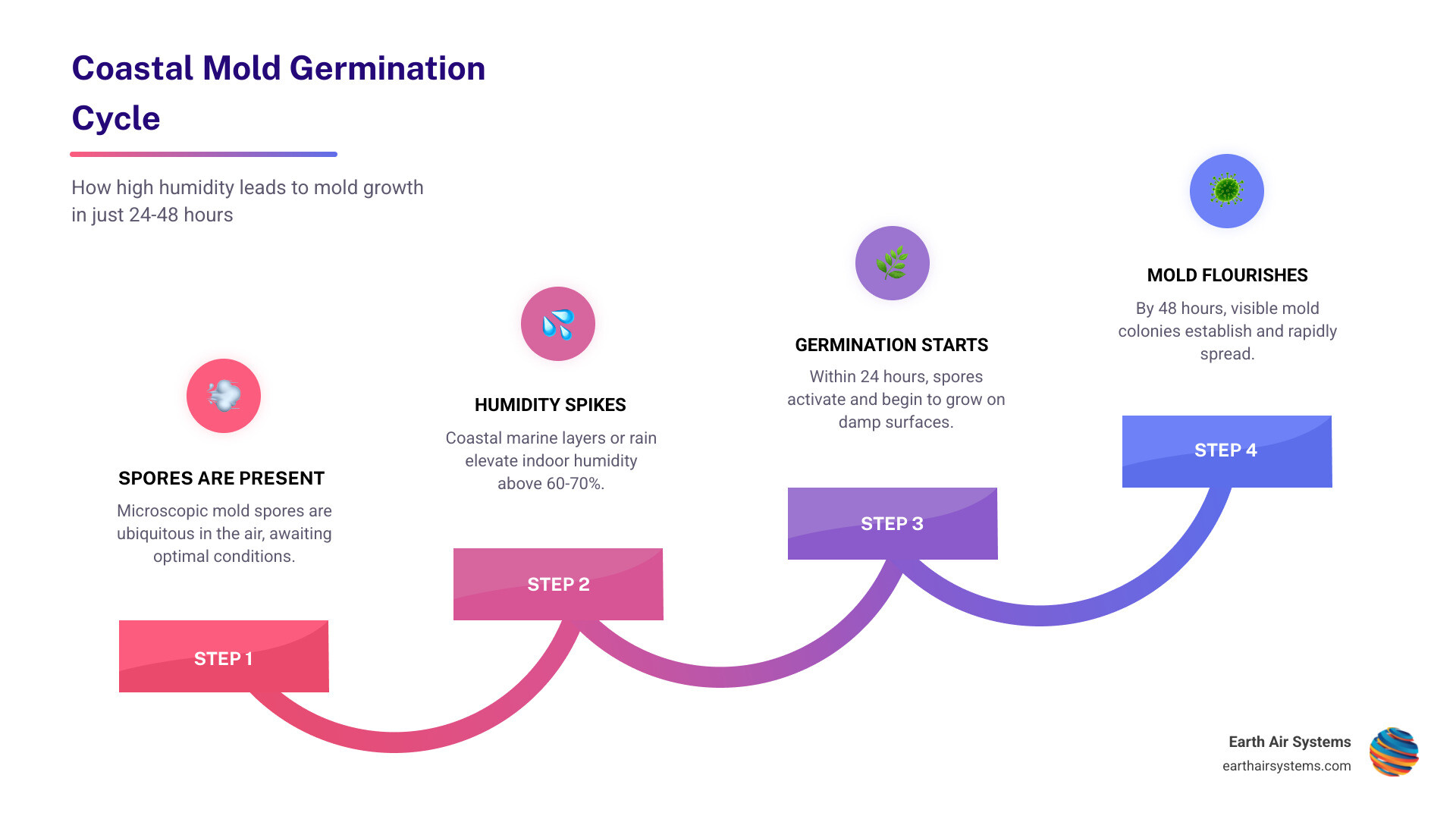
San Diego’s coastal microclimate is beautiful — but it’s also relentless. The marine layer rolls in most mornings, salt air drifts inland, and humidity levels stay elevated year-round. For homeowners near the coast, that combination creates a real problem indoors. Mold spores are always present in the air around us, but they only become a threat when moisture gives them something to work with. In high-humidity conditions, those spores can begin to flourish within just 24 to 48 hours — and without proper humidity control, indoor humidity in a sealed coastal home can spike above 70% in less than two days after a summer rainstorm. Your HVAC system is your first and most important line of defense.
Why Coastal Homes Face a Higher Risk of Mold Growth
Living in San Diego, from the shores of La Jolla to the beachfronts of Oceanside and Coronado, means dealing with a unique set of environmental challenges. While we love the ocean breeze, that air is laden with moisture and salt—two ingredients that mold absolutely loves.
The primary driver of mold in our region is the 60% humidity threshold. Scientific research shows that mold begins to flourish on various surfaces the moment indoor humidity levels exceed 60%. In coastal environments, outdoor humidity often sits between 60% and 70% year-round. Without an active HVAC system to pull that moisture out, your home can quickly become a breeding ground. Within just 48 hours of a typical summer rainstorm or a heavy marine layer morning, indoor humidity can spike to 70% or higher.
| Indoor Humidity Level | Mold Growth Risk | Impact on Home |
|---|---|---|
| Under 30% | Low | Air may feel too dry; potential skin/nasal irritation. |
| 30% – 50% | Ideal | Optimal comfort; mold growth is inhibited. |
| 55% – 60% | Moderate | Marginal safety; mold can begin to activate in stagnant areas. |
| 60% – 70% | High | Mold flourishes on walls, ceilings, and inside ducts. |
| 70%+ | Extreme | Rapid mold germination (24-48 hours); structural damage likely. |
Beyond just “wet air,” coastal homes deal with salt-induced electrochemical pitting. Tiny salt particles from the Pacific settle on surfaces and attract even more moisture. This “salty” moisture is highly corrosive. It creates gaps in building materials and corrodes HVAC metal parts, leading to refrigerant leaks and excess condensation.
When you combine this moisture with organic food sources—like the paper backing on drywall, wood framing, or even the dust settled in your vents—you have a recipe for disaster. For sensitive individuals, this leads to respiratory irritation, allergies, and asthma flare-ups. For the home itself, it means structural damage and “dirty sock syndrome” (that musty, lingering smell).
How Your HVAC System Prevents Mold Near the Coast
Many people think their air conditioner is only there to change the temperature. In reality, an AC unit is a giant dehumidifier. How your HVAC system prevents mold near the coast is primarily through the process of latent heat removal. As warm, moist air from your home is pulled across the freezing-cold evaporator coils, the moisture in the air condenses into liquid water—much like beads of sweat on a cold soda can.
This water drips into a condensate pan and is funneled out of your home. By removing this “latent heat” (the energy held in water vapor), the system leaves the air both cooler and significantly drier. This constant extraction is what keeps your home from feeling “sticky” or “clammy,” which are the first signs that your humidity is too high.
Furthermore, proper air circulation ensures that no corner of your home becomes a stagnant “dead zone.” Mold loves still air. By keeping the air moving, your HVAC system prevents moisture from settling on cool surfaces like window sills or the back of closets. For those looking to maximize their protection, exploring Air Quality Services in San Diego can help ensure your system is calibrated perfectly for our local coastal climate.
Active Humidity Control and the 30-50% Target
To keep mold at bay in places like Carlsbad or Del Mar, we generally aim for a target indoor relative humidity of 30% to 50%. While some coastal standards (like those in Florida) suggest staying under 55% is acceptable, we find that the 50% mark provides the best buffer against sudden spikes in the marine layer.
When your HVAC system is properly sized, it runs long enough to complete a full dehumidification cycle. If a system is oversized—a common problem in some beach builds—it will “short cycle,” meaning it cools the house down so fast that it shuts off before it has a chance to actually pull the moisture out of the air. This leaves you with a house that is 70 degrees but 65% humidity—the perfect “clammy” environment for mold to grow.
Advanced Filtration to Capture Airborne Spores
Every time your HVAC fan runs, it’s scrubbing the air. Mold spores are microscopic, but they aren’t invisible to a high-quality filter. By using MERV 13 or even HEPA-rated filters, you can trap these spores before they ever have a chance to land on a damp surface and start a colony.
In coastal San Diego, we recommend checking your filters monthly. The salt and moisture in the air can cause dust to “clump” on the filter faster than it would in a dry desert climate like Borrego Springs. A clean filter ensures maximum airflow, which is vital for the moisture-removal process.
Essential Components and Features for Coastal Mold Prevention
Certain parts of your HVAC system are more vulnerable than others. Because the evaporator coil and condensate drip pan are constantly wet, they are the most likely spots for mold to start. If your ductwork isn’t properly insulated, it can “sweat” in the attic or crawlspace, leading to hidden mold growth that you might not smell until it’s a major problem.
To combat this, we often recommend variable-speed air handlers. Unlike traditional fans that are either “on” or “off,” variable-speed motors can run at lower speeds for longer periods. This provides “whisper-quiet” circulation that constantly filters the air and prevents the stagnant pockets where mold thrives.
How Your HVAC System Prevents Mold Near the Coast with UV Lights
One of the most effective upgrades for a coastal home is the installation of UV germicidal lights. These lamps are usually installed right next to the evaporator coil inside your air handler. They emit a specific wavelength of ultraviolet light that scrambles the DNA of mold spores, bacteria, and viruses.
In the humid environments of Chula Vista or Encinitas, these lights act as a 24/7 sterilization system. They prevent organic growth from ever forming on your coils, which not only keeps your air clean but also keeps your system running efficiently. Without them, mold “biofilm” can build up on the coils, reducing their ability to remove heat and moisture by up to 30%.
Smart Thermostats and ‘Cool to Dry’ Technology
In 2026, smart technology is one of our best weapons against mold. Modern thermostats from brands like Google Nest and Ecobee include features often called “Cool to Dry” or “Overcool to Dehumidify.”
Here is how it works: If the thermostat detects that your indoor humidity has climbed above 60% or 70% (common during a heavy marine layer event), it will turn on the air conditioner even if the house is already at your target temperature. It might cool the house by an extra degree or two, but the goal is to run the compressor long enough to pull that dangerous moisture out of the air.
This is especially vital for vacation homes in places like Coronado or Solana Beach. If you leave for a few weeks and turn the AC off to save money, the humidity can spike to 80% within days. A smart thermostat allows you to monitor your home remotely and ensures the system kicks in automatically to prevent you from returning to a mold remediation project.
Maintenance Strategies for How Your HVAC System Prevents Mold Near the Coast
Maintenance isn’t just about preventing breakdowns; it’s about mold prevention. In coastal San Diego, your maintenance routine needs to be a bit more rigorous than it would be inland.
- Quarterly Coil Rinsing: Salt air causes electrochemical corrosion. We recommend gently rinsing your outdoor condenser coils with a low-pressure garden hose once a month to remove salt deposits.
- Drain Line Flushing: The “gunk” that grows in condensate lines is often a mix of dust and mold. Regularly flushing these lines prevents backups that could lead to standing water inside your home.
- Duct Inspections: We recommend a professional duct inspection every 1 to 2 years. We look for “sweating” ducts, leaks that pull in humid attic air, and any signs of early spore colonization.
- Refrigerant Checks: If your refrigerant is low due to salt-air corrosion leaks, your coils might freeze. When they thaw, they dump an enormous amount of water into your system, often overflowing the drain pan and soaking your drywall.
Identifying Warning Signs of HVAC Mold
You don’t always need a lab test to know you have a problem. Keep an eye (and a nose) out for these red flags:
- Musty Odors: If you smell a “damp basement” or “dirty sock” smell specifically when the AC turns on, mold is likely growing on your coils or in your ducts.
- Visible Spotting: Look at your supply vents. If you see small black or brown spots on the louvers, spores are likely colonizing the dust on the grates.
- Clumping Dust: If the dust in your home feels “heavy” or clumps together on your fan blades, your humidity is too high.
- Foggy Windows: Condensation on the inside of your windows in the morning means your HVAC system isn’t winning the battle against coastal moisture.
Frequently Asked Questions about Coastal Mold and HVAC
Can an HVAC system completely eliminate mold?
No system can completely eliminate mold spores—they are a natural part of the environment. However, a well-maintained HVAC system makes your home inhospitable to mold. By removing the moisture mold needs to grow and filtering out the spores that attempt to settle, the system keeps the population at a level that is harmless to your home and health.
Is a whole-home dehumidifier necessary if I have AC?
In many San Diego coastal homes, yes. During the “shoulder seasons” (spring and fall), the temperature outside might be a comfortable 68 degrees, but the humidity might be 80%. Because it’s not “hot,” your AC won’t turn on, which means the moisture stays trapped inside. A whole-home dehumidifier can run independently of the cooling system to keep you at that 30-50% sweet spot year-round.
How often should coastal HVAC systems be inspected?
We recommend a bi-annual schedule (twice a year) for homes within five miles of the ocean. A spring visit prepares your system for the heavy dehumidification load of summer, and a fall visit ensures that salt air hasn’t caused any corrosion that could lead to leaks during the winter.
Conclusion
Protecting your home from the unique challenges of the San Diego coast requires a proactive approach. How your HVAC system prevents mold near the coast is through a combination of smart technology, high-efficiency filtration, and consistent moisture removal.
At Earth Air Systems, we have over 40 years of experience helping homeowners from San Marcos to National City navigate these exact issues. We understand the local microclimates and the specific toll that salt air takes on mechanical systems. Our commitment to 100% customer satisfaction and our flat-rate pricing ensures that you get the high-quality service you need to keep your air clean and your home comfortable.
If you’re concerned about the humidity levels in your home or want to upgrade your system with UV lights or advanced filtration, contact us today. Let’s make sure your “coastal living” stays as healthy and refreshing as the ocean view. Explore our Air Quality Services in San Diego to learn more about how we can protect your indoor environment.
