
Why the Ocean Breeze Is Your HVAC’s Biggest Enemy in San Diego
If you’ve been searching for an hvac maintenance checklist for mild coastal climates, here’s what San Diego homeowners need to do every year to protect their system:
Quick HVAC Maintenance Checklist for Mild Coastal Climates:
- Replace air filters every 30-45 days
- Rinse the outdoor condenser unit with fresh water monthly
- Flush the condensate drain line monthly with a vinegar solution
- Clear at least 2 feet of clearance around the outdoor unit
- Schedule professional coil cleaning and inspection twice a year (spring and fall)
- Check electrical terminals and refrigerant levels annually
- Install surge protection to guard against coastal storm damage
- Maintain indoor humidity between 40-50%
- Inspect for signs of salt corrosion quarterly (white powder, pitting, rust)
- Test thermostat calibration seasonally
San Diego feels like paradise — warm breezes, mild temperatures, and that famous coastal air. But that same ocean air is quietly working against your HVAC system every single day. Salt, moisture, and the marine layer don’t take days off, and neither does the wear they cause on your equipment.
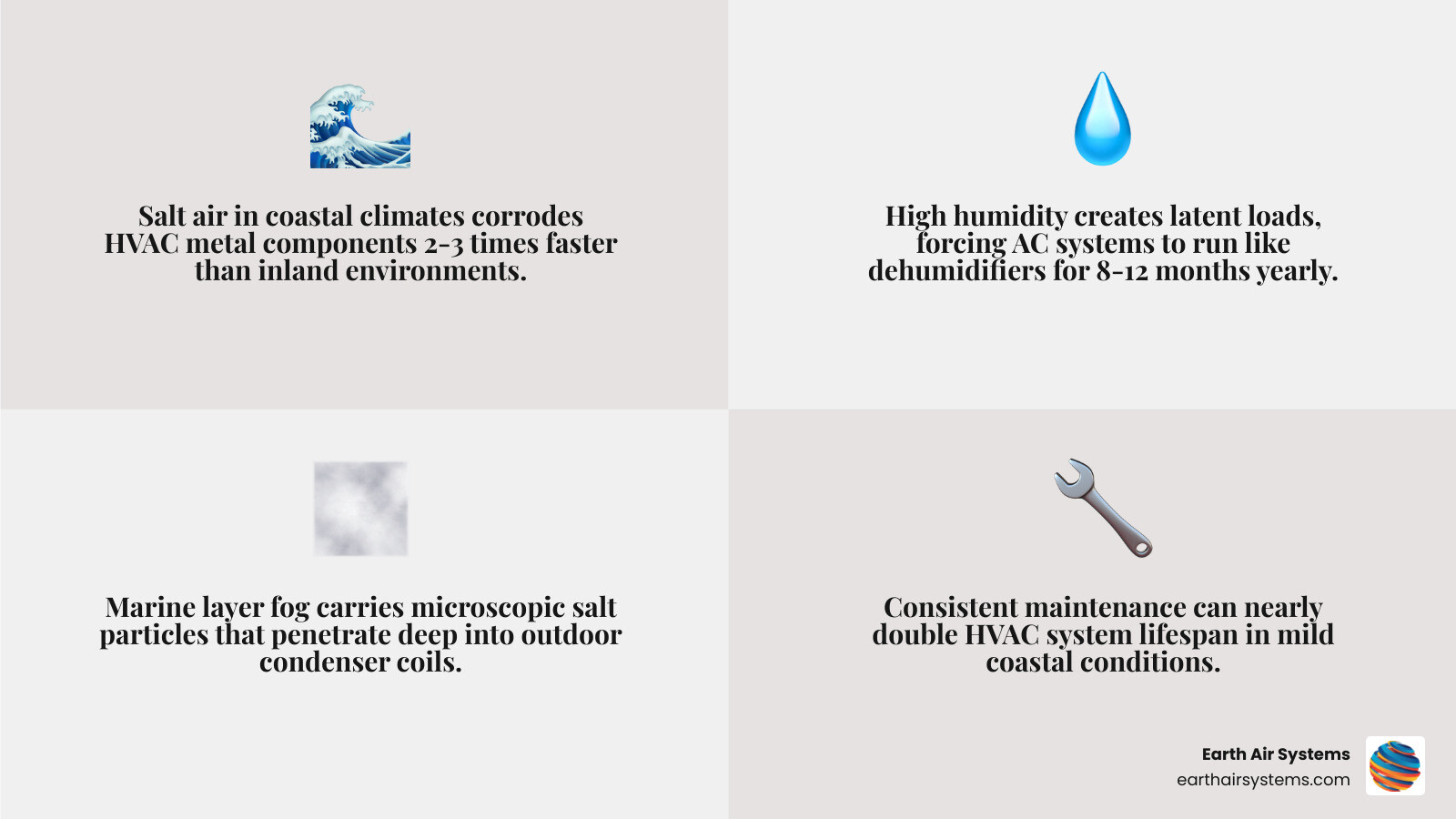
Here’s the problem most homeowners don’t realize: mild weather doesn’t mean easy conditions for your HVAC. In fact, systems in coastal San Diego can run 8 to 12 months a year — compared to just 3 to 4 months in inland climates. That’s a lot of operating hours. Add in salt air that corrodes metal components up to 2 to 3 times faster than inland environments, and you’ve got a recipe for premature system failure if maintenance gets skipped.
The good news? Most of the damage is preventable. A consistent routine built specifically for coastal conditions can nearly double your system’s lifespan and keep energy bills from creeping up season after season.
This guide walks you through exactly what to do — and when.
Why You Need an HVAC Maintenance Checklist for Mild Coastal Climates
Living in areas like La Jolla, Coronado, or Oceanside means we enjoy a “3C” warm marine climate. It’s beautiful, but for a mechanical system, it’s a high-stress environment. Unlike inland areas that face extreme heat peaks, coastal homes deal with a “latent load”—which is just a fancy way of saying there is a lot of moisture in the air.
In San Diego, our HVAC systems often act more like giant dehumidifiers than just coolers. Because the weather is mild, systems run for long periods at lower capacities to pull moisture out of the air. This “no days off” schedule leads to significant wear. Furthermore, the marine layer—that thick, salty fog we see in the mornings—carries microscopic salt particles that settle deep into your outdoor unit.
Skipping maintenance in this environment is risky. Neglected systems in coastal zones might only last 8 to 12 years, whereas a well-maintained unit can easily reach 15 to 20 years. To learn more about how our local weather dictates your service schedule, check out our guide on Mild Climates and Maintenance: How Often Should You Service Your System?.
The Silent Threat of Salt Air in San Diego
Salt is the primary “silent killer” of HVAC systems in San Diego County. When salt air hits the aluminum fins and copper tubes of your outdoor condenser, it triggers an electrolytic reaction. Think of it as a slow-motion battery that eats away at the metal.
This process, known as pitting, creates tiny holes in your coils, eventually leading to refrigerant leaks. Once a leak starts, your system has to work twice as hard to cool your home, sending your energy bills through the roof. To combat this, we recommend looking for systems with coastal-rated coils, 316 stainless steel fasteners, and specialized protective coatings that act as a barrier against the salt.
Managing High Humidity and Latent Loads
In coastal regions, managing humidity is often more important than lowering the temperature. We want to aim for an indoor Relative Humidity (RH) of 40% to 50%. If the humidity stays too high, you’ll notice that “clammy” feeling, or worse, you might start smelling musty odors—often referred to as “dirty sock syndrome”—caused by biological growth on the indoor coils.
High humidity also means your condensate drain line is working overtime. In places like Chula Vista or Coronado, these lines can quickly clog with algae or salt-crusted gunk. For more on keeping your system running smoothly in these humid spots, see our tips on Don’t Sweat the Heat with Professional AC Maintenance in Coronado.
Monthly DIY Tasks: Your Coastal HVAC Maintenance Checklist
You don’t need to be a pro to handle the most important parts of your hvac maintenance checklist for mild coastal climates. A little DIY love goes a long way in preventing a total system breakdown.
Air Filtration for Coastal Pollen and Salt
Your air filter is the “respiratory system” of your home. In coastal San Diego, filters don’t just catch dust; they trap pollen and microscopic salt particles that make it past your windows.
- Frequency: Check your filter every 30 days. If you have pets or live right on the coast (like in La Jolla), you’ll likely need to replace it every month.
- MERV Rating: We recommend a MERV 8 to 11 filter. This provides a great balance of capturing particles without restricting the airflow your system needs to stay efficient.
- The Benefit: A clean filter can improve system efficiency by up to 15%.
For residents in specific coastal neighborhoods, you can find more tailored advice in our guide to Don’t Sweat It: Finding the Best AC Maintenance in La Jolla, CA.
Clearing the Condensate Drain Line
Because our air is so moist, your AC produces gallons of water every day. That water flows through a drain line that can easily become a breeding ground for algae.
To keep it clear, pour about a cup of white vinegar down the condensate drain line once a month. This simple step prevents clogs that could otherwise back up and cause water damage to your floors or ceilings. Many modern systems have a “float switch” that will shut the whole system down if the drain clogs—if your AC suddenly won’t turn on, a clogged drain is often the culprit. For more localized help, explore Don’t Sweat It: Finding the Top AC Maintenance Company in Chula Vista.
Seasonal and Professional HVAC Maintenance Checklist for Mild Coastal Climates
While DIY tasks are essential, there are some things only a professional with the right tools should handle. We recommend a professional tune-up twice a year: once in the spring before the humidity picks up, and once in the fall.
| Task | DIY | Professional |
|---|---|---|
| Filter Replacement | Yes | Yes |
| Rinse Outdoor Unit | Yes | Yes |
| Deep Coil Cleaning | No | Yes |
| Refrigerant Level Check | No | Yes |
| Electrical Terminal Inspection | No | Yes |
| Clearing Major Drain Clogs | No | Yes |
If you’re looking for a reliable partner for these checks, check out Don’t Get Steamed: Your Guide to Local AC Maintenance Contractors.
Professional Coil Cleaning and Protective Coatings
A professional cleaning is much deeper than a simple garden hose rinse. We use specialized, HVAC-safe cleaners to dissolve salt deposits and sand that get wedged between the fins. We also check for bent fins and use a “fin comb” to straighten them, ensuring maximum airflow.
For homes within a mile of the ocean, we often discuss protective coatings like epoxy or phenolic barriers. These coatings are applied to the coils to provide a shield against the corrosive salt air, significantly extending the life of your unit. Learn more about our specific AC Maintenance in San Diego services.
Preparing for Santa Ana Winds and Storm Debris
San Diego isn’t just about the beach; we also have to deal with Santa Ana winds. These hot, dry winds blow dust and debris from the inland deserts toward the coast.
- Clearance: Always maintain at least 2 feet of clear space around your outdoor unit. Trim back any hibiscus or palm fronds that might get sucked into the fan.
- Post-Storm Check: After a heavy wind event or a storm, check your unit for “hidden” debris like plastic bags or large amounts of sand.
- Surge Protection: Coastal storms and grid fluctuations can cause power surges. Installing a dedicated surge protector on your HVAC unit can save your expensive control boards from frying.
Don’t forget the heating side of your system! Even in mild climates, you want your heat pump or furnace ready for those chilly coastal nights. See our Heating Maintenance in San Diego page for more info.
Advanced Strategies for Coastal HVAC Longevity
If you are looking to upgrade your system, coastal homeowners should consider variable-speed technology. Unlike traditional units that are either “all on” or “all off,” variable-speed (inverter) compressors can run at very low speeds for long periods. This is the “gold standard” for San Diego because it allows for constant, gentle dehumidification without over-cooling your home.
When it’s time for a change, you want experts who understand the nuances of the local climate. Check out Don’t Sweat the Swap with the Best Local AC Replacement Experts to see your options.
Integrating Smart Thermostats and ERVs
Modern tech can do a lot of the heavy lifting for you.
- Smart Thermostats: These can be programmed to account for our diurnal temperature swings (the big difference between a cool morning and a warm afternoon). They can even track humidity levels and alert you if they get too high.
- ERVs (Energy Recovery Ventilators): An ERV can bring in fresh outdoor air while “recovering” up to 70% of the energy from the conditioned indoor air. This is a great way to improve indoor air quality during wildfire season or high-pollen days without losing your cooling efficiency.
Frequently Asked Questions about Coastal HVAC Care
How often should I rinse my outdoor unit near the beach?
If you live within a mile of the ocean, we recommend a gentle fresh water rinse of your outdoor condenser coils once a month. Use a garden hose with low pressure. Never use a power washer, as the high pressure will flatten the delicate aluminum fins and ruin your system’s airflow.
What are the signs of salt air damage on my AC?
Keep an eye out for these “red flags”:
- White Powder: This is often the first sign of aluminum corrosion.
- Pitting: Look for small “craters” or a rough texture on the metal coils.
- Weak Airflow: Salt and sand can clog the fins, making it harder for the system to breathe.
- Unusual Odors: Musty smells often mean the system isn’t managing humidity properly.
- Rising Bills: If your usage hasn’t changed but your bill has jumped 10-20%, your system is likely struggling with efficiency due to corrosion.
Does a mild climate mean I can skip annual maintenance?
Actually, it’s the opposite! Because San Diego systems run nearly year-round, they accumulate wear faster than systems in the Midwest that sit idle for months. Regular maintenance prevents about 90% of common repairs and ensures your system doesn’t die years before its time.
Conclusion
Protecting your home’s comfort shouldn’t be a source of stress. By following this hvac maintenance checklist for mild coastal climates, you can enjoy the San Diego breeze without worrying about what it’s doing to your equipment.
At Earth Air Heating & Cooling, we bring over 40 years of experience to every job site. Whether you are in Downtown San Diego, North County, or anywhere in between, our team is dedicated to providing transparent, flat-rate pricing and a 100% satisfaction guarantee. We know the local salt air challenges better than anyone, and we’re here to make sure your system stands the test of time.
Don’t wait for the marine layer to take its toll. Schedule your San Diego HVAC maintenance today and breathe easy knowing your coastal home is protected.
