
How Long Does an HVAC System Last in Southern California?
How long does an hvac system last in southern california depends on the system type, your local microclimate, and how well the equipment is maintained — but here’s a quick answer:
| System Type | Typical SoCal Lifespan |
|---|---|
| Central Air Conditioner | 10–15 years |
| Heat Pump | 10–15 years |
| Gas Furnace | 15–20 years |
| Ductless Mini-Split | 15–20+ years |
| Window AC Unit | 5–10 years |
These ranges are shorter than national averages. Southern California’s intense summer heat, year-round cooling demand, coastal salt air, inland dust, and wildfire smoke all put extra stress on HVAC equipment.
Most homeowners are caught off guard when their system fails ahead of schedule. And in a region where summers can push inland temperatures past 100°F — and where AC runs far longer than it does in most of the country — that’s not uncommon.
The good news: with the right maintenance habits and a clear understanding of what shortens system life in SoCal, you can squeeze more years out of your equipment and plan ahead when replacement does make sense.
This guide covers everything you need to know — from coastal corrosion and inland heat stress to the $5,000 repair-or-replace rule and local rebate options.
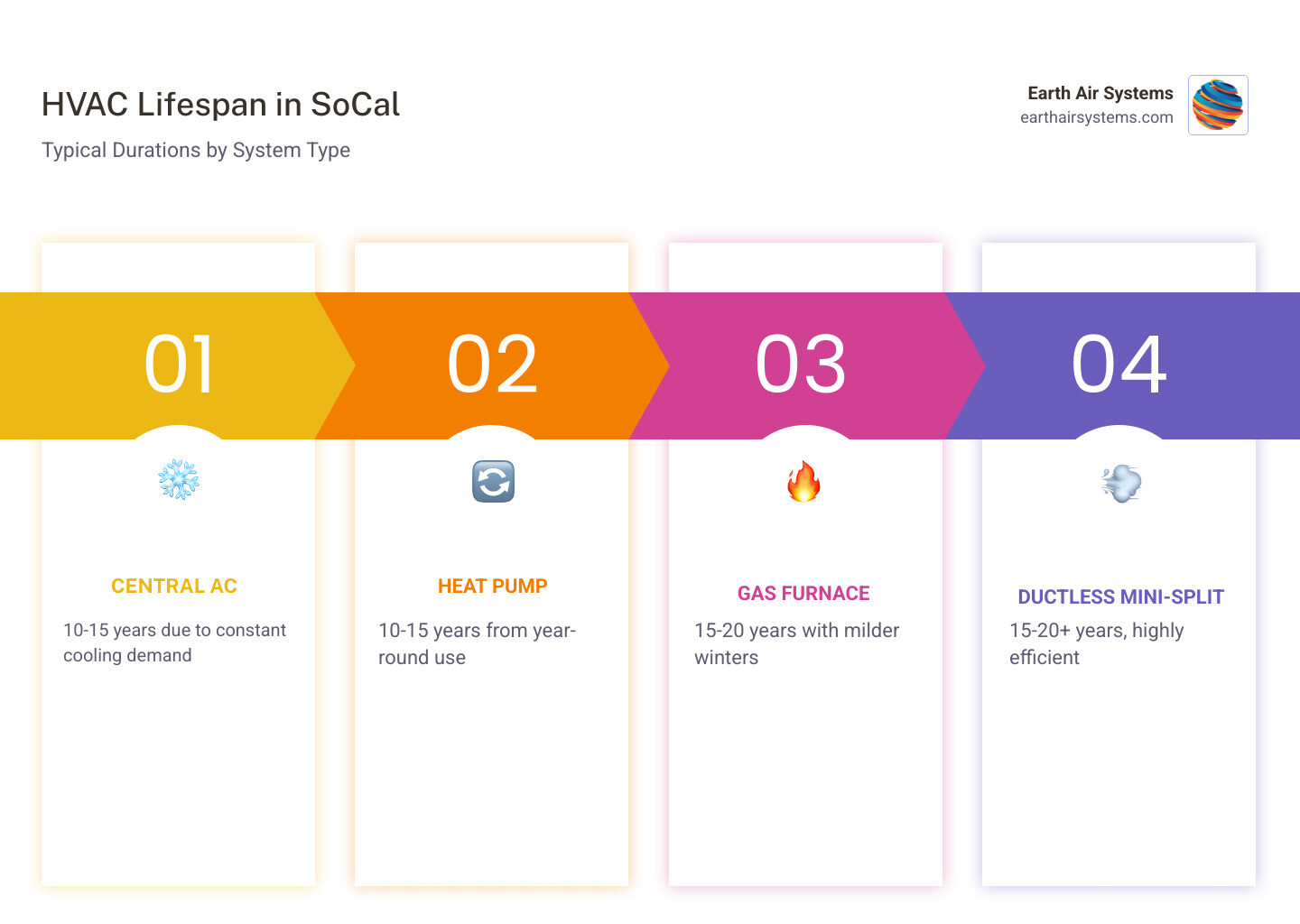
Average Lifespan of an HVAC System in Southern California
When we talk about how long these systems last, we have to look at the “big three” of Southern California living: heat, usage, and environment. While a furnace in a mild climate might easily cruise past its 20th birthday, an air conditioner in the heart of San Diego often starts showing its age much sooner.
Central Air Conditioning (10–15 Years)
In our neck of the woods, the central AC is the workhorse of the home. Because we often experience warm weather well into October and even November, these units don’t get much of an “off-season.” This constant cycling wears down the compressor—the heart of the system. If your unit is pushing the 12-year mark and you’re noticing it struggling during a July heatwave, it might be time to look into AC Replacement in San Diego.
Heat Pumps (10–15 Years)
Heat pumps are becoming incredibly popular in Southern California because they handle both heating and cooling efficiently. However, because they work year-round to provide both comfort modes, they experience significant mechanical wear. We find that a well-maintained heat pump can hit that 15-year mark, but heavy usage in hotter areas might skip it toward the lower end of the scale. If yours is struggling to switch between modes or making odd noises, Heat Pump Replacement in San Diego is a common conversation we have with local homeowners.
Gas Furnaces (15–20 Years)
Since our winters are relatively mild compared to the East Coast, our furnaces don’t have to work nearly as hard. This usually results in a longer lifespan. The main component to watch here is the heat exchanger. Over time, the metal can expand and contract, leading to cracks. Even if a furnace “works,” a cracked heat exchanger is a safety hazard that usually signals the end of the road for the unit.
Ductless Mini-Splits (20+ Years)
Ductless systems are the overachievers of the HVAC world. Because they don’t rely on a complex network of ducts (which can leak and force the system to work harder), and they often use advanced inverter technology, they tend to last longer. Many San Diego residents in older homes or room additions find these to be the most durable long-term investment.
How long does an hvac system last in southern california coastal areas?
If you live in Coronado, La Jolla, or Oceanside, you know that the ocean breeze is a blessing and a curse. That salty sea air is highly corrosive. We often see outdoor condenser coils in coastal homes “pitting” or corroding much faster than those inland.
Without protective coatings or regular rinsing, a coastal AC unit might only last 8 to 12 years. Salt accumulation traps moisture against the metal, leading to rapid decay. This is why AC Maintenance in San Diego is so critical for our beachside neighbors; a simple professional cleaning can wash away those corrosive deposits before they eat through your coils.
How long does an hvac system last in southern california inland valleys?
Move inland to Escondido, San Marcos, or Chula Vista, and the enemy shifts from salt to heat and dust. In these areas, summer temperatures regularly exceed 90°F or even 100°F. Your AC compressor has to work under extreme pressure to move heat out of your home.
Thermal expansion—the way parts grow and shrink in the heat—can lead to refrigerant leaks and electrical failures. Furthermore, the dry, dusty air of the valleys can clog fins and filters, forcing the motor to run hotter and longer. If your inland unit is frequently tripping the breaker during a heatwave, you likely need AC Repair in San Diego to address the strain before the compressor gives out entirely.
Environmental Stressors Unique to the Southland
It isn’t just the temperature that dictates how long does an hvac system last in southern california; it’s the quality of the air itself. We live in a beautiful but rugged environment that throws several curveballs at our mechanical systems.
- Wildfire Smoke and Particulates: As we’ve seen in recent years, wildfire season can blanket the region in fine ash and smoke. These particulates don’t just stay outside; they get sucked into your HVAC system. Ash is abrasive and can coat the evaporator coils, reducing efficiency and causing the system to “choke.”
- Santa Ana Winds: These seasonal winds bring high-speed gusts filled with fine desert dust. This dust acts like sandpaper on the moving parts of your outdoor unit and can quickly overwhelm a standard air filter.
- High MERV Filtration: To combat poor air quality, many of us switch to high-efficiency MERV 13 filters. While great for your lungs, these filters are denser and harder to blow air through. If your system wasn’t designed for that level of resistance, it can actually shorten the life of your blower motor by making it work twice as hard.
To navigate these challenges, we recommend checking out The Ultimate Guide to AC Maintenance Services in San Diego. Keeping your system clean is the only way to counter the “Southland Stress” that our environment provides.
Warning Signs Your System is Nearing Retirement
Your HVAC system usually won’t just quit without a word; it will “whisper” its problems to you first. Recognizing these signs early can save you from a total breakdown in the middle of a San Diego “June Gloom” or an August scorcher.
- Rising Utility Bills: If your energy costs are creeping up but your habits haven’t changed, your system is likely losing its efficiency. As parts wear out, the unit has to run longer to reach the same temperature.
- Inconsistent Temperatures: Is the living room a freezer while the bedroom feels like a sauna? This often points to a failing blower motor or aging ductwork that can no longer move air effectively.
- Frequent Repairs: If you’ve had the repair technician out twice in the last year, you’re likely throwing good money after bad.
- Strange Odors: A “dirty sock” smell usually indicates mold or bacteria on the coils. However, an electrical burning smell is a major red flag. If you smell ozone or burning plastic, shut the system off at the breaker immediately and call for Furnace Repair in San Diego or Heat Pump Repair in San Diego.
The $5,000 Rule for Repair vs. Replace
Deciding whether to fix an old unit or buy a new one is a tough choice. To make it easier, we often use the $5,000 Rule.
Take the age of your equipment and multiply it by the cost of the repair. If the total is more than $5,000, it is usually smarter to replace the unit.
- Example: A 12-year-old AC unit needs a $500 repair. (12 x 500 = 6,000). Since 6,000 is greater than 5,000, a replacement is likely the better financial move.
Another factor is the R-22 Refrigerant Phase-out. If your system was built before 2010, it likely uses R-22 (Freon), which is no longer produced. Repairing a leak in these older units is becoming prohibitively expensive, making Furnace Replacement in San Diego or a full AC upgrade the more logical path.
Strategies to Maximize HVAC Durability in 2026
It is now April 2026, and HVAC technology has come a long way. However, the basics of maintenance remain the most powerful tools in your arsenal to extend your system’s life.
- Bi-Annual Inspections: We cannot stress this enough. A spring tune-up for your AC and a fall check-up for your heater can extend your system’s life by up to 40%. These visits allow us to catch small issues—like a failing capacitor or a loose belt—before they cause a catastrophic failure. Check out our Heating Maintenance in San Diego for more on how we prep systems for the year.
- Filter Changes: In Southern California, you should check your filters every 30 days. If you have pets or live near a dusty area like North County, you might need to change them monthly. A dirty filter is the #1 cause of HVAC breakdowns.
- Smart Thermostats: Modern thermostats prevent “short-cycling” (when the unit turns on and off too rapidly). By maintaining a more consistent temperature, you reduce the “start-stop” stress on the compressor.
- Home Insulation and Duct Sealing: If your home is “leaky,” your HVAC system has to run constantly to keep up. Sealing your ducts and beefing up your attic insulation can reduce your system’s runtime by 20% or more, directly adding years to its life.
Proper Installation and Warranty Protection
The most important day in the life of your HVAC system is the day it’s installed. If a unit is oversized, it will short-cycle and burn out the motor. If it’s undersized, it will run forever and never get the house cool.
We always perform a “Manual J” load calculation to ensure the system is perfectly sized for your home’s square footage, window orientation, and insulation levels. Once installed, be sure to register your warranty. Most manufacturers offer a 10-year parts warranty, but only if you register the unit within 60 days of installation. We also recommend looking into local rebates from San Diego utility providers, which can often offset the cost of high-efficiency upgrades.
Frequently Asked Questions about SoCal HVAC Longevity
Should I replace my AC and furnace at the same time?
Generally, yes. While it’s a larger upfront investment, replacing both ensures that the two units are “matched.” Modern AC units require specific airflow patterns that older furnaces might not be able to provide. Plus, you’ll save on labor costs by having the crew do both at once, and you’ll “reset the clock” on your entire home comfort system. For more common questions, visit our HVAC FAQs.
How does home insulation impact my HVAC’s life?
Think of insulation as a thermal blanket for your house. In the summer, it keeps the San Diego sun from heating your rooms. This means your AC doesn’t have to turn on as often. The fewer “miles” you put on your HVAC system, the longer it will last. A well-insulated home can easily add 2–3 years to the lifespan of an air conditioner.
What is the best thermostat setting for SoCal summers?
The Department of Energy recommends 78 degrees Fahrenheit when you are home. While that might sound warm to some, every degree you drop below that adds significant strain to your compressor. If you can use ceiling fans (running counter-clockwise) to stay cool, you can keep the thermostat higher and give your AC a much-needed break.
Conclusion
So, how long does an hvac system last in southern california? While the environment works against us with salt, heat, and dust, you have the power to protect your investment. By prioritizing regular maintenance, staying on top of filter changes, and recognizing the warning signs of an aging unit, you can ensure your home stays a sanctuary of comfort.
At Earth Air Systems, we’ve spent over 40 years helping our neighbors in San Diego, Vista, Carlsbad, and across the Southland maximize their home comfort. Whether you need a quick tune-up to survive the summer or a full system replacement to upgrade your efficiency, our team is here to provide flat-rate pricing and a 100% satisfaction guarantee.
Don’t wait for the next record-breaking heatwave to find out if your system is up to the task. Contact our experts for an HVAC evaluation today and let us help you keep your cool for years to come!
