
The Truth About Thermostat Habits and Your Energy Bill
Does turning thermostat up and down waste energy? The short answer: it depends on how you’re doing it.
Quick answer:
- Constant random adjustments throughout the day = yes, this wastes energy and stresses your HVAC system
- Strategic setbacks (lowering at night or when away for 8+ hours) = no, this actually saves energy
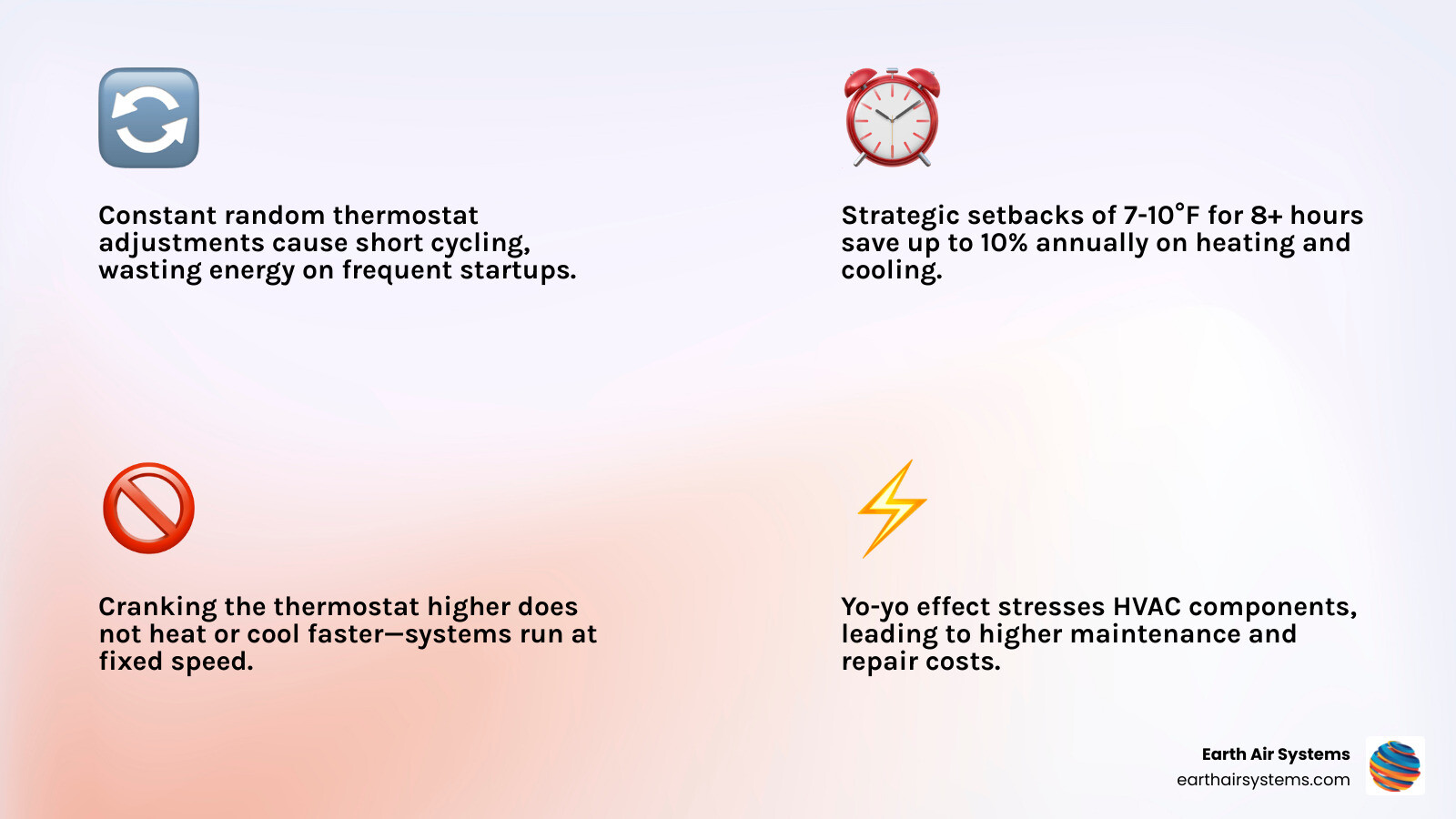
- Cranking the thermostat higher to heat or cool faster = myth — your system works at the same speed regardless
- Small gradual changes under 5 degrees = minimal impact on energy use
Most homeowners have been in a thermostat tug-of-war at some point. It’s too warm, so you turn it down. Then it gets too cold, so you crank it back up. Repeat all day. It feels harmless, but this back-and-forth puts real strain on your HVAC system and can quietly push your utility bills higher.
At the same time, there’s a lot of confusing advice out there. Some people swear by turning everything off when they leave. Others insist it’s better to leave the heat running all day. The truth sits somewhere in the middle — and the science behind it is simpler than you might think.
According to the U.S. Department of Energy, you can save up to 10% per year on heating and cooling just by adjusting your thermostat 7–10 degrees for 8 hours a day. That’s a significant number from a surprisingly small habit change.
In this guide, we’ll cut through the myths and show you exactly what your thermostat habits are doing to your energy bill — and what to do instead.
Does Turning Thermostat Up and Down Waste Energy?
When we talk about the “Yo-Yo Effect,” we are referring to the habit of manually adjusting the temperature every time we feel a slight chill or a bit of a sweat. Many homeowners ask us, does turning thermostat up and down waste energy, and the answer lies in the physics of heat transfer and the mechanical limits of your equipment.
Your HVAC system is designed to reach a “baseline temperature” and maintain it. When you constantly fiddle with the dial, you force the system into a cycle of “reactionary” heating or cooling. Instead of running a steady, efficient cycle, the system is hit with sudden demands. This leads to energy spikes because the initial startup of an air conditioner or furnace often requires more power than simply keeping it running at a low, steady state.
Furthermore, manual adjustments often lead to overshooting. If you’re cold and you bump the heat up by five degrees, you might forget about it until the house feels like a sauna. Then, you’ll likely drop it by six degrees to compensate. This constant oscillation means your system is never operating in its “sweet spot.” For more specific answers on common system behaviors, check out our HVAC FAQs.
Why turning thermostat up and down waste energy through short cycling
One of the most damaging results of frequent manual adjustments is “short cycling.” This occurs when your HVAC system turns on and off too frequently. Every time your air conditioner or furnace starts up, it experiences a surge of electricity and mechanical stress.
Think of it like a car: you get much better gas mileage cruising on the freeway than you do in stop-and-go traffic. Constant thermostat fiddling creates “stop-and-go” conditions for your home comfort system. This doesn’t just waste energy; it significantly reduces component longevity. The motors, compressors, and electrical relays in your system are rated for a certain number of cycles. By doubling or tripling those cycles through constant adjustments, you’re fast-tracking your way to a major repair or an early system replacement.
The myth of “cranking it” to heat or cool faster
We’ve all done it: you walk into a hot house in July and set the AC to 60 degrees, thinking it will cool the room faster. This is a total myth. Most HVAC systems operate at a fixed rate. Whether you set the thermostat to 70 or 60, the air coming out of the vents is the exact same temperature.
Setting an extreme temperature doesn’t increase the “speed” of the cooling; it only changes the “finish line.” The system will simply run longer until it hits that lower (and likely uncomfortable) number. This leads to massive energy waste and overshooting your comfort zone. The same applies to boilers and furnaces—they don’t “burn hotter” just because you turned the dial higher. They just stay on longer, costing you more money in the process.
Strategic Setbacks vs. Constant Fiddling
There is a massive difference between “fiddling” and “setbacks.” Fiddling is impulsive; setbacks are planned. A strategic setback is when you adjust your thermostat for a long period—typically 8 hours or more—such as when you are at work or asleep.
| Feature | Manual Fiddling | Programmed Setbacks |
|---|---|---|
| Frequency | Multiple times per hour/day | Twice per day (Morning/Night) |
| Energy Impact | Increases due to cycling | Decreases by up to 10% annually |
| System Wear | High stress on components | Low, predictable wear |
| Comfort | Inconsistent/Drafty | Consistent schedules |
The 8-hour rule is the gold standard for energy savings. According to the U.S. Department of Energy (DOE), turning your thermostat back 7–10°F from its normal setting for 8 hours a day can save you as much as 10% a year on heating and cooling. This is because the house loses heat more slowly when the interior temperature is closer to the outside temperature. To ensure your system is ready to handle these transitions efficiently, consider scheduling Heating Maintenance in San Diego.
Recommended settings for winter and summer 2026
As we move through 2026, energy efficiency is more important than ever. To balance comfort with your bank account, we recommend the following baselines for San Diego residents:
- Winter: Aim for 68°F while you are awake and at home. When you’re asleep or away, a setback to 60°F or 58°F is ideal.
- Summer: Set your AC to 78°F when you’re home. When you’re away, let it drift up to 85°F.
Humidity plays a huge role in how you perceive temperature. In San Diego’s coastal areas, high humidity can make 78°F feel much warmer. Using ceiling fans can make a room feel 4 degrees cooler through the wind-chill effect, allowing you to keep the thermostat higher without losing comfort. Additionally, dressing in layers during our cooler North County nights can save you from reaching for the “up” button.
How smart technology eliminates the guesswork
The easiest way to stop the “Yo-Yo Effect” is to take the human element out of the equation. Programmable and smart thermostats are designed to handle setbacks automatically. Smart thermostats, like the Nest or Ecobee, use learning algorithms to understand your routine. They can sense when you’ve left the house and adjust the temperature accordingly.
Research shows that Nest users save an average of 12% to 15% on heating and cooling costs. These devices also integrate with local weather forecasts; if they know a heatwave is hitting Chula Vista tomorrow, they can pre-cool your home during off-peak hours when electricity is cheaper. If you’re looking to upgrade, our team can help with professional AC Maintenance in San Diego to ensure your new tech is perfectly calibrated.
How Your HVAC System Type Changes the Rules
Not all heating and cooling systems react to thermostat changes in the same way. The “does turning thermostat up and down waste energy” question has a slightly different answer depending on whether you have a furnace, a heat pump, or electric baseboard heat.
For traditional gas or oil furnaces, setbacks are almost always a win. These systems are designed to provide a blast of heat to recover the temperature quickly. However, for electric baseboard heaters, which are common in some older San Diego apartments, the recovery time is very fast, but they are incredibly energy-intensive.
If you’re curious about how your specific system stacks up, our Ultimate Guide to AC Maintenance Services in San Diego covers the nuances of different equipment types.
Why heat pumps require a different approach to does turning thermostat up and down waste energy
Heat pumps are the “marathon runners” of the HVAC world. They are most efficient when they maintain a steady state. If you drop the temperature on a heat pump by 10 degrees at night and then try to raise it 10 degrees in the morning, the system might perceive this as an “emergency.”
To catch up quickly, the heat pump may activate its “backup” or “emergency” heat—usually electric resistance strips. This backup heat is far less efficient and can cause your electricity bill to skyrocket. For heat pumps, we generally recommend “set it and forget it,” or making very small, gradual adjustments of no more than 2 degrees at a time.
The impact of home insulation and drafts
Your thermostat is only as good as your home’s “envelope.” If your home in La Jolla or Coronado has poor insulation or drafty windows, your HVAC system will have to work twice as hard to recover from a setback.
Heat loss occurs through walls (35%), roofs (25%), and windows (10%). If you find that your house takes hours to warm up after you turn the thermostat up, you might not have a thermostat problem—you might have an insulation problem. Draft-proofing doors, sealing attic leaks, and ensuring your windows are properly caulked can prevent the energy you pay for from leaking out into the San Diego night.
Best Practices to Stop the Yo-Yo Effect
Breaking the habit of thermostat fiddling is easier when you have a plan. Here are the best practices we recommend for our neighbors in San Marcos, Oceanside, and beyond:
- Use a Schedule: Program your thermostat to start cooling or heating 30 minutes before you arrive home. This prevents the urge to “crank it” when you walk through the door.
- Zoning Systems: If you have a multi-story home in Escondido, use a zoning system. This allows you to keep the upstairs cool for sleeping while leaving the downstairs at a higher, energy-saving temperature.
- Occupancy Sensors: Invest in sensors that tell the thermostat which rooms are actually being used. There’s no need to perfectly condition a guest room that hasn’t been opened in weeks.
- Change Your Filters: A dirty filter makes your system run longer and harder to reach the same temperature. We recommend changing them every 1–3 months, especially if you have pets.
How to implement a 2-degree rule for comfort
If you absolutely must adjust the temperature, follow the 2-degree rule. Instead of jumping from 72 to 68, move it to 70 and wait at least 30 minutes. Often, a slight 1 or 2-degree shift is enough to change the perceived temperature, especially if you also turn on a fan to improve airflow.
In our unique San Diego climate, humidity control is often more important than the actual temperature. Sometimes, simply running the AC for a short cycle to pull moisture out of the air will make a 76-degree room feel perfectly comfortable.
Frequently Asked Questions about Thermostat Efficiency
Does lowering the thermostat by one degree really save money?
Yes! According to the U.S. Department of Energy, lowering your thermostat by just one degree can reduce your energy bill by about 1% for every 8-hour period it remains at that lower setting. While one degree seems small, the cumulative impact over a full San Diego winter or summer can lead to significant savings.
Is it better to leave the heat on all day?
Generally, no. This is a common myth. It is almost always more efficient to turn the heat down when you are away. Houses lose heat faster when the temperature difference between inside and outside is large. By letting the house cool down while you’re gone, you slow down the rate of heat loss, meaning the system has less “total work” to do when you return.
Does turning thermostat up and down waste energy more than a constant setting?
Frequent, impulsive manual changes waste energy because they cause short cycling and prevent the system from reaching its most efficient operating state. However, a single, long-term adjustment (like turning the heat down before bed and up in the morning) is much more efficient than keeping a constant high temperature 24/7.
Conclusion
Managing your home’s climate shouldn’t feel like a full-time job. By moving away from the “Yo-Yo Effect” of constant manual adjustments and embracing strategic setbacks, you can protect your HVAC system and keep your utility bills in check.
At Earth Air Systems, we’ve spent over 40 years helping San Diego homeowners find the perfect balance of comfort and efficiency. Whether you need a smart thermostat installation in Encinitas or a full system inspection in Downtown San Diego, our team is here to ensure your home remains a sanctuary.
Ready to stop the thermostat tug-of-war? Optimize your home comfort with Earth Air Systems today and start saving on your next energy bill!
