
Why Electrical Safety Tips for Homeowners Can Save Lives and Property
Electrical safety tips for homeowners are one of the most important things you can learn as a homeowner. According to the U.S. Consumer Product Safety Commission, roughly 31,000 home electrical fires occur every year in the United States. Those fires cause hundreds of deaths, thousands of injuries, and billions of dollars in property damage annually.
Here are the most important electrical safety tips every homeowner should follow:
- Never overload outlets or power strips with too many devices at once
- Use extension cords temporarily only – never as a permanent wiring solution
- Install GFCI outlets in kitchens, bathrooms, garages, and outdoor areas
- Install AFCI breakers to detect dangerous arc faults before they start fires
- Unplug appliances when not in use to reduce fire risk and phantom drain
- Match light bulb wattage to fixture ratings to prevent overheating
- Keep all electrical devices away from water at all times
- Watch for warning signs like flickering lights, burning smells, or warm outlet covers
- Use tamper-resistant outlets to protect children and visitors
- Call a licensed electrician for any wiring work or persistent electrical issues
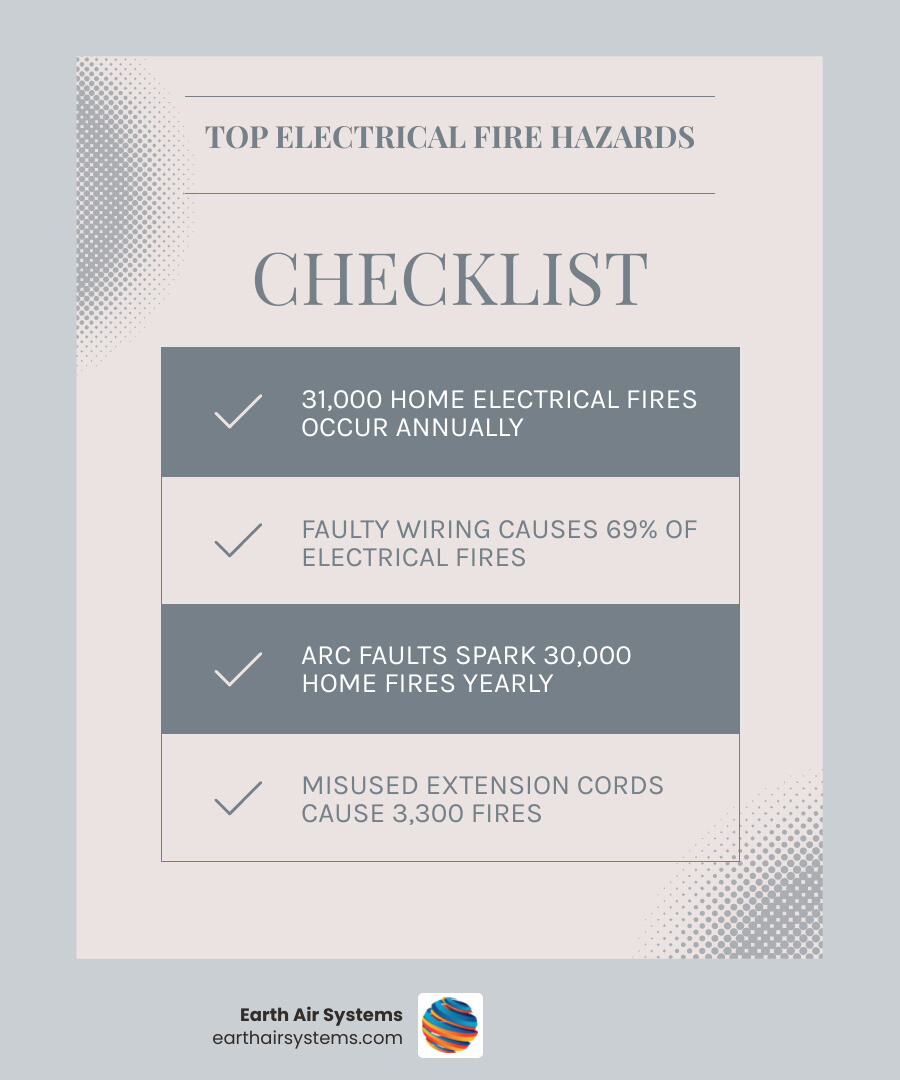
The risks are real and closer to home than most people think. Faulty or damaged wiring alone accounts for roughly 69% of electrical fires, according to the NFPA. Arc faults – a less visible but equally dangerous hazard – cause an estimated 30,000 home fires each year. And something as simple as a misused extension cord contributes to around 3,300 home fires annually, killing approximately 50 people in the process.
The good news? Most electrical hazards are preventable. A combination of simple daily habits, the right safety devices, and knowing when to call a professional can dramatically reduce your risk.
Common Causes of Residential Electrical Fires
Understanding why fires start is the first step in prevention. In our 40+ years of experience serving San Diego homeowners, we have seen how easily a small oversight can turn into a major hazard. Statistics from 2019–2023 show that electrical distribution or lighting equipment is associated with nearly 32,000 home fires per year.
The primary culprit is often faulty wiring. National Fire Protection Association (NFPA) data indicates that wiring equipment is linked to 4% of all home fires but a staggering 6% of deaths. Many of these issues stem from aging systems that simply weren’t designed to handle the electrical load of a modern 2026 home filled with high-powered appliances, EV chargers, and smart devices.
Arc faults are another silent killer, causing roughly 30,000 fires annually. An arc fault occurs when electricity “jumps” between loose connections or through damaged insulation. This can happen behind your walls if a nail is accidentally driven into a wire while hanging a picture, or if a rodent chews through the protective coating.
Finally, misuse of extension cords remains a leading cause of preventable disasters. These cords are involved in about 3,300 fires every year. When they are pinched under furniture, run under rugs where heat cannot escape, or used to power high-wattage appliances like space heaters, they become a significant fire risk. Ensuring your home has adequate Air conditioning services in San Diego and proper electrical capacity is vital to avoiding these common pitfalls.
Essential Electrical Safety Tips for Homeowners
Safety starts with awareness. We recommend performing a “walk-through” of your home once a month to check for potential hazards. It doesn’t take long, but it could save your property.
One of the most overlooked electrical safety tips for homeowners is matching light bulb wattage to the fixture’s requirements. If you put a 100-watt bulb in a lamp rated for 60 watts, the excess heat can melt the socket and the insulation on the wires. If a fixture isn’t marked with a wattage limit, the rule of thumb is to use a bulb no higher than 60 watts.
Proper air circulation is also critical. Appliances like refrigerators, televisions, and computers generate heat. If they are tucked into tight enclosures without room for air to move, they can overheat and fail. Similarly, ensure your exhaust fans in the kitchen and bathroom are kept clean; a buildup of lint and dust in a fan motor is a common ignition point for fires.
When buying new gadgets, always look for NRTL listings, such as the UL (Underwriters Laboratories) seal. This ensures the product has been tested to meet strict safety standards. Additionally, be mindful of “phantom drain”—the energy appliances use even when turned off. Unplugging unused electronics not only saves money but also removes a potential electrical path for surges.
Table: Power Strips vs. Extension Cords
| Feature | Power Strip (with Surge Protector) | Extension Cord |
|---|---|---|
| Primary Purpose | Adding extra outlets for low-power electronics | Temporary reach for a device |
| Safety Feature | Often includes a circuit breaker/surge protection | Rarely includes protection |
| Duration of Use | Long-term (for computers/TVs) | Temporary only (hours or days) |
| Appliance Compatibility | Good for multiple small devices | Not for high-heat appliances |
Daily Electrical Safety Tips for Homeowners
Developing safe habits is the best defense against accidents. Here are a few “golden rules” for your daily routine:
- Dry Hands Only: Never touch a switch, plug, or appliance with wet hands. Water is an excellent conductor of electricity and significantly increases the risk of a fatal shock.
- Pull the Plug, Not the Cord: When disconnecting a device, always grasp the plastic plug head. Yanking on the cord can fray the internal wires and loosen the connections inside the outlet.
- Store Cords Loosely: Don’t wrap cords tightly around appliances while they are still warm, as this can damage the insulation over time.
- Polarized Plugs: If a plug has one prong wider than the other, it is “polarized” to ensure it’s inserted correctly. Never file down a prong to force it into an old outlet.
Safe Usage of Extension Cords and Power Strips
Extension cords are a temporary fix, not a permanent solution. If you find yourself relying on them for more than 90 days, it’s a sign that your home needs more permanent outlets installed by a professional.
When choosing a cord, pay attention to the AWG (American Wire Gauge) rating. Counterintuitively, a lower number means a thicker wire that can handle more power. For example, a 14 AWG cord is safer for power tools than a 16 AWG cord.
Never “daisy-chain” power strips (plugging one into another). This creates a massive overload risk that can trip breakers or start a fire. Also, keep cords out from under rugs or doorways where they can be stepped on or pinched, leading to heat buildup and wire damage.
Advanced Protection: GFCI, AFCI, and Tamper-Resistant Outlets
Modern technology has given us incredible tools to prevent electrocution and fires. If your home was built before the mid-90s, you might be missing these essential upgrades.
GFCI (Ground-Fault Circuit Interrupter) outlets are designed for areas where water is present. They monitor the flow of electricity and can detect a “leak” as small as 1/2000th of an amp. If the outlet senses that electricity is flowing through a person (a ground fault), it shuts off power in a fraction of a second.
AFCI (Arc-Fault Circuit Interrupter) protection is different. While GFCIs prevent shocks, AFCIs prevent fires. They use advanced electronics to “listen” to the electrical current. If they detect the specific signature of a dangerous arc—like a loose wire sparking behind a wall—they trip the breaker before the heat can start a fire.
For families with children, Tamper-Resistant Receptacles (TRRs) are a must. These look like standard outlets but have internal shutters that only open when equal pressure is applied to both sides simultaneously (like when you plug in a lamp). If a child tries to poke a paperclip or a fork into one side, the shutter stays closed, preventing a dangerous shock. The National Electrical Code now requires these in all new residential constructions, regardless of whether children live there.
Recognizing Warning Signs and When to Call a Pro
Your home’s electrical system will often give you “hints” before a major failure occurs. Learning to read these signs is one of the most proactive electrical safety tips for homeowners.
If you notice your lights flickering when the refrigerator or air conditioner kicks on, your circuits may be overloaded. Buzzing or sizzling sounds coming from an outlet or switch are a major red flag—this usually indicates a loose connection or active arcing.
Perhaps the most urgent sign is a burning smell or an outlet cover that feels warm to the touch. This means the plastic is likely melting due to excessive heat. If you see sparks when plugging in a device, or if your circuit breakers trip frequently, do not simply flip them back on. Your system is telling you there is a fault that needs professional attention.
Critical Electrical Safety Tips for Homeowners to Spot Trouble
Keep an eye out for these specific “danger zones”:
- Tingling Appliances: If you feel a slight “tingle” or shock when touching a metal appliance, stop using it immediately. It likely has a ground fault.
- Discolored Outlets: Charring or brown/black marks on an outlet indicate that it has overheated or sparked.
- Loose Plugs: If a plug falls out of an outlet easily, the internal contacts are worn. This creates resistance, which generates heat.
- Rodent Damage: In San Diego, pests can sometimes find their way into attics or crawlspaces. Check visible wiring for teeth marks; chewed wires are a leading cause of “mysterious” house fires.
- Hidden Wiring: Be cautious when drilling into walls for DIY projects. Always use a stud finder with a wire-sensing feature to avoid hitting live lines.
Safety Measures for Appliances and Outdoor Spaces
Outdoor electricity requires even more vigilance because of exposure to the elements. All outdoor outlets should be protected by GFCIs and housed in weather-protective covers (often called “in-use” covers) that keep rain out even when something is plugged in.
Your HVAC system is one of the largest electrical draws in your home. Regular maintenance is not just about efficiency; it’s about safety. During a professional inspection, technicians check for worn capacitors, loose wiring, and debris that could cause an electrical short. In our local climate, ensuring your Air conditioning services in San Diego are up to date helps prevent the system from straining and overheating during our hot summer months.
When working outside, always look up and stay at least 10 feet away from overhead power lines. Never use corded power tools in the rain or on wet grass. If you are using a ladder, ensure it is made of fiberglass or wood rather than aluminum to avoid conducting electricity if it accidentally brushes a wire.
Frequently Asked Questions About Home Electrical Safety
How often should I test my GFCI and AFCI outlets?
We recommend testing your GFCI and AFCI outlets once a month. Simply press the “Test” button; the “Reset” button should pop out, cutting power to the outlet. Press “Reset” to restore power. If the button doesn’t pop out or won’t reset, the device is faulty and must be replaced immediately by a licensed professional.
Can I use an extension cord for my air conditioner or space heater?
No. High-power, heat-producing appliances should always be plugged directly into a wall outlet. These devices draw a lot of current, which can cause standard extension cords to overheat rapidly, melting the insulation and starting a fire. Furthermore, the voltage drop caused by an extension cord can damage the motor of your air conditioner.
What should I do in the event of an electrical fire?
- Don’t use water: Water conducts electricity and will spread the fire or cause electrocution.
- Cut the power: If it is safe to reach, turn off the main breaker at the electrical panel.
- Use a Class C extinguisher: Only use a fire extinguisher labeled for electrical fires (Class C).
- Evacuate and call 911: If the fire is not out in seconds, get everyone out of the house and call emergency services.
Conclusion
Electricity is a powerful force that makes our modern lives possible, but it demands respect. By following these electrical safety tips for homeowners, you can protect your family from the devastating effects of fires and shocks. From simple daily habits like unplugging the toaster to advanced upgrades like AFCI breakers, every step you take adds a layer of protection to your home.
At Earth Air Systems, we are committed to keeping San Diego homes safe and comfortable. With over 40 years of experience, our team specializes in high-quality HVAC maintenance and repair. We understand the unique electrical needs of homes in North County, Chula Vista, and throughout the San Diego area. Whether you need a 26-point inspection to ensure your system is running safely or a full replacement, we offer flat-rate pricing and a 100% satisfaction guarantee.
Don’t wait for a flickering light to become a fire. If you have concerns about your home’s electrical load or need expert Air conditioning services in San Diego, give us a call today. We’re here to ensure your home remains the safe haven it’s meant to be.
