
What Every San Diego Homeowner Should Know About How a Heat Pump Works
How does a heat pump work is one of the most common questions homeowners ask before upgrading their home comfort system — and for good reason. Unlike a furnace that burns fuel or a resistance heater that converts electricity directly into warmth, a heat pump does something smarter: it moves heat that already exists rather than creating it from scratch.
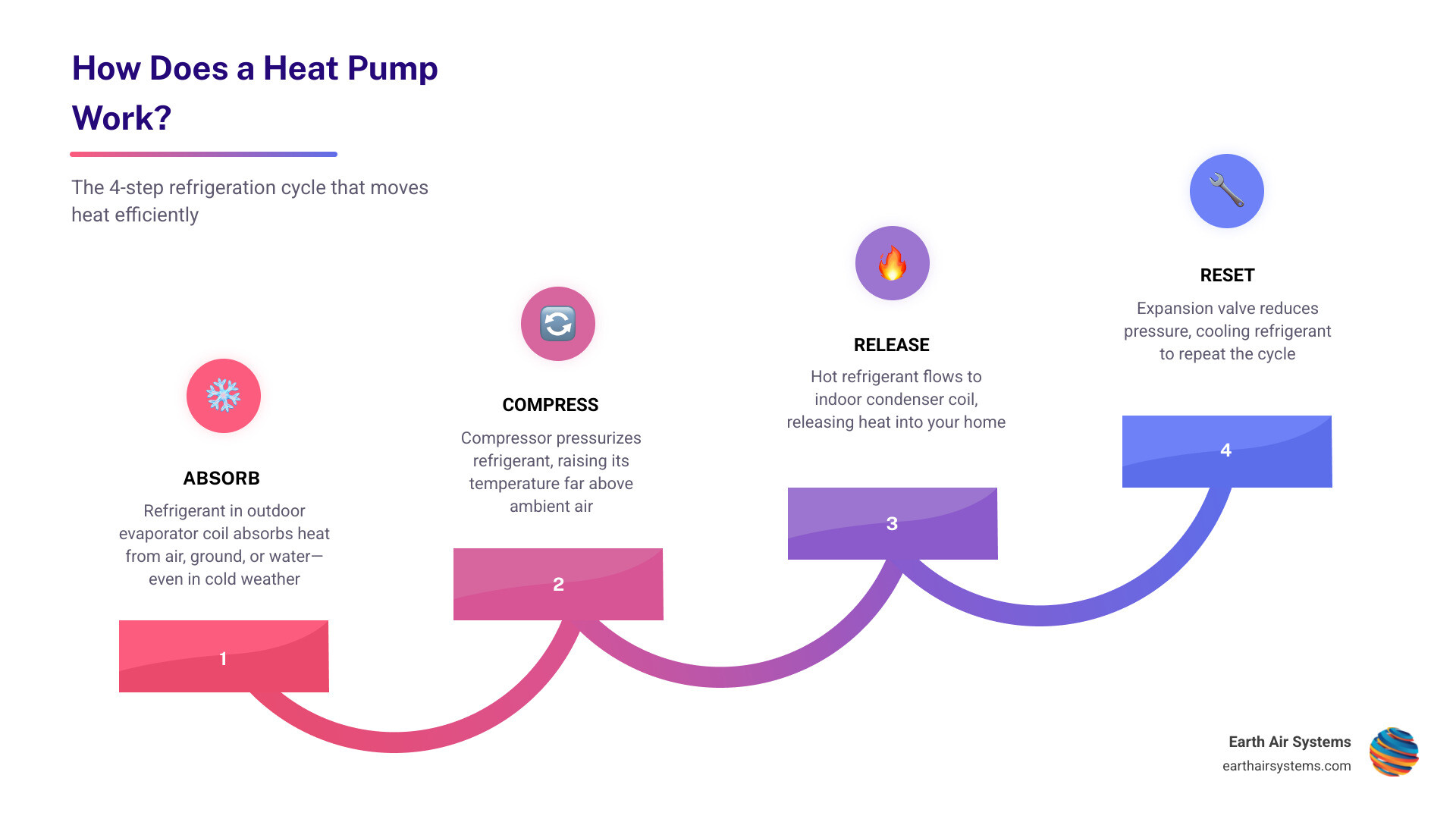
Here is a quick breakdown of the core process:
- Absorb – A refrigerant fluid circulates through an outdoor coil (evaporator), absorbing heat energy from the surrounding air, ground, or water
- Compress – The compressor pressurizes the refrigerant, raising its temperature significantly
- Release – The hot refrigerant flows to the indoor coil (condenser), releasing that heat into your living space
- Reset – An expansion valve drops the refrigerant back to low pressure, cooling it down so the cycle can start again
- Reverse – In summer, a reversing valve flips the direction of refrigerant flow, pulling heat out of your home and dumping it outside — effectively acting as an air conditioner
That single closed loop handles both heating and cooling. No combustion, no flame, no fossil fuels burned on-site.
The reason this matters for efficiency is straightforward: instead of generating 1 unit of heat per 1 unit of electricity (like a resistance heater), a heat pump can deliver up to 4 units of thermal energy for every 1 unit of electricity it consumes. That ratio — known as the Coefficient of Performance, or COP — is what makes heat pumps 3 to 5 times more energy-efficient than gas boilers under comparable conditions.
For homeowners in San Diego, where winters are mild and cooling season stretches long, a heat pump is often one of the most practical and cost-effective HVAC choices available. The technology is mature, the efficiency gains are real, and the dual-purpose design means one system handles year-round comfort.
The sections below walk through every layer of how this works — from the physics of the refrigeration cycle to cold-weather performance, system types, and what it all means for your home.
Understanding the Core: How Does a Heat Pump Work?
To truly grasp the magic of this technology, we have to look at the vapor-compression cycle. It sounds like something out of a sci-fi novel, but it is actually the same principle that keeps your milk cold in the refrigerator. The fundamental secret is that heat naturally flows from a warmer place to a cooler one. A heat pump simply uses a little bit of mechanical work to “pump” that heat uphill, moving it from a cold “source” (like the outdoor air in January) to a warm “sink” (your cozy living room).
This process relies on a specialized fluid called a refrigerant. This substance is unique because it has an incredibly low boiling point, allowing it to evaporate and absorb heat even when it feels chilly outside. By April 2026, modern systems have become so refined that they can find usable heat in air that would make most of us reach for a heavy parka.
For homeowners considering an upgrade, understanding this “moving vs. creating” distinction is vital. If you are looking into Heat Pump Replacement in San Diego, you are essentially investing in a transportation system for thermal energy.
The Four Essential Components of the Cycle
The refrigeration cycle isn’t just one big machine; it is a team effort. Four main components work in a continuous loop to change the state of the refrigerant and move heat:
- The Evaporator (Outdoor Coil in Winter): Here, the liquid refrigerant is kept at a very low pressure. Because it is colder than the outside air, it soaks up heat. As it warms up, it undergoes a phase change, turning from a cold liquid into a low-pressure gas.
- The Compressor: This is the heart of the system. It takes that low-pressure gas and squeezes it tightly. When you compress a gas, its temperature skyrockets. This is where we take “thin” heat from the outside and concentrate it into high-grade warmth.
- The Condenser (Indoor Coil in Winter): The hot, high-pressure gas travels to your indoor unit. As your home’s air blows over these coils, the refrigerant releases its latent heat. The gas cools down and “condenses” back into a high-pressure liquid.
- The Expansion Valve: Before the refrigerant goes back outside, it passes through this valve. It acts like a nozzle on a spray can, rapidly dropping the pressure. This causes the temperature to plummet, resetting the refrigerant so it is ready to absorb more heat from the outdoors.
Reversing the Flow: How Does a Heat Pump Work in Summer?
One of the coolest (pun intended) features of a heat pump is the reversing valve. This component allows the system to switch directions. In the summer, the heat pump stops acting like a heater and starts acting exactly like an air conditioner.
It picks up heat from inside your house at the indoor coil (which now acts as the evaporator) and dumps it outside via the outdoor coil (which now acts as the condenser). If your system ever struggles to make this switch, you might need Heat Pump Repair in San Diego to ensure that reversing valve is functioning correctly.
The Physics of Efficiency and Performance
When we talk about how well a heat pump does its job, we use a few specific metrics. The most important is the Coefficient of Performance (COP). A typical household heat pump has a COP of around 4.0. In plain English, that means for every 1 kilowatt-hour (kWh) of electricity you pay for, the system delivers 4 kWh of heat to your home.
Compare that to an electric space heater, which has a COP of 1.0 (it can only turn 1 unit of electricity into 1 unit of heat). Even the most efficient gas boilers only reach about 90-95% efficiency. Heat pumps are literally off the charts by comparison, often operating at 300% to 500% efficiency.
To help you compare models, look for these ratings:
- SEER2 (Seasonal Energy Efficiency Ratio): Measures cooling efficiency.
- HSPF2 (Heating Seasonal Performance Factor): Measures heating efficiency over a season.
- Energy Star: A certification for units that meet strict efficiency guidelines set by the EPA.
| Heating System | Efficiency (COP/AFUE) | Energy Source |
|---|---|---|
| Heat Pump | 3.0 – 5.0 COP | Electricity (Moving Heat) |
| Gas Boiler | 0.85 – 0.95 AFUE | Natural Gas (Combustion) |
| Electric Baseboard | 1.0 COP | Electricity (Resistance) |
Extracting Warmth: How Does a Heat Pump Work in Cold Weather?
A common myth is that heat pumps stop working when the temperature drops. While it is true that older models struggled in the snow, modern cold-climate heat pumps are beasts. They use variable-speed compressors (also called inverter technology) that can ramp up or down to match the exact heating demand.
How do they find heat in freezing air? Physics! Heat exists in all matter down to “absolute zero” (-459.67°F). Even at 30°F, there is plenty of energy for a refrigerant that is -40°F to soak up. High-performance models can now operate efficiently down to -5°F or even -22°F. If you’re wondering Why Your Escondido Home Needs a Heat Pump Replacement Now, it’s often because these modern cold-weather capabilities have made older, less efficient systems obsolete.
The Role of Modern Low-GWP Refrigerants
As we move through 2026, the industry is shifting toward more environmentally friendly refrigerants. Older refrigerants had a high Global Warming Potential (GWP). Today, we use options like R-32 or R-454B. These fluids have excellent thermodynamic properties, meaning they carry heat more efficiently while having a much lower impact on the planet if they ever leak. Using low-GWP refrigerants is a key part of the global effort toward decarbonization.
Exploring Different Types of Heat Pump Systems
Not all heat pumps pull energy from the air. Depending on your property, one of these three types might be better:
- Air-Source Heat Pumps (ASHP): The most common type. They exchange heat with the outside air. They are easy to install and perfect for the San Diego climate.
- Ground-Source Heat Pumps (GSHP): Also known as geothermal. These use a “loop” of pipes buried underground. Since the earth stays at a steady 55-60°F year-round, these systems are incredibly stable and efficient, reaching COPs as high as 6.0.
- Water-Source Heat Pumps: These pull heat from a nearby lake, well, or even industrial waste water.
Ductless Mini-Split Versatility
If your home doesn’t have existing ductwork—common in many older Hillcrest or North Park bungalows—you don’t have to miss out. Ductless mini-splits consist of a small outdoor unit connected to one or more indoor heads mounted on the wall. They offer zoned comfort, allowing you to heat the bedroom while keeping the kitchen cool. For a deep dive into these systems, check out The Complete Hillcrest Heat Pump Replacement Handbook.
Choosing the Right System for Southern California
In Southern California, our “winters” consist of cool coastal nights and occasional chilly mornings. We don’t usually deal with sub-zero blizzards, which makes an air-source heat pump the “goldilocks” solution for us. They handle our moderate humidity and provide excellent cooling during those 90-degree September days.
Whether you are in Chula Vista or Carlsbad, the ability to dehumidify while cooling is a major plus. For more local insights, see Everything You Need to Know About Heat Pump Replacement in Chula Vista, CA.
The Pros and Cons of Switching to a Heat Pump
We love heat pumps, but we also believe in giving you the full picture. Here is a quick look at the advantages and the things to consider:
The Pros:
- Energy Savings: You can save up to 40-50% on your utility bills compared to electric resistance heating.
- Two-for-One: You get a world-class heater and a high-efficiency air conditioner in one package.
- Safety: No combustion means no risk of carbon monoxide leaks from the unit.
- Environmentally Friendly: They are a major step toward a carbon-free home.
- Even Comfort: Variable-speed models avoid the “blast of hot air then cold” cycle of traditional furnaces.
The Cons:
- Maintenance: Because they run year-round (heating and cooling), they require more frequent check-ups than a system that only runs half the year.
- Milder Heat: If you are used to a gas furnace that blows 130°F air, the 90-100°F air from a heat pump might feel “cool” at first, even though it is warming your house just as effectively.
- Upfront Complexity: Installation requires specialized knowledge of refrigerant lines and electrical sizing.
For a detailed breakdown of what to expect during an upgrade, our Heat Pump Replacement Guide La Jolla, CA is a great resource.
Frequently Asked Questions about Heat Pump Mechanics
What is the average lifespan of a heat pump?
Typically, a well-maintained heat pump will last between 15 and 25 years. Because the outdoor unit works hard in both summer and winter, bi-annual maintenance is the secret to longevity. Checking refrigerant levels and cleaning coils ensures the compressor doesn’t have to work harder than necessary. If you need a pro to take a look, The Ultimate Guide to Finding a Heat Pump Repair Company in La Jolla can help you find the right experts.
Do heat pumps work when it is freezing outside?
Yes! Modern systems use technologies like flash injection to maintain capacity even in extreme cold. While standard models might lose some efficiency below 25°F, specialized cold-climate models can handle temperatures down to -22°F. In San Diego, we rarely hit these lows, but it’s nice to know your system has the “muscle” to handle a surprise cold snap. Most systems also include “backup heat strips” (electric resistance) just in case the temperature drops below the system’s operating range.
Can a heat pump replace both my AC and furnace?
Absolutely. This is the primary reason people switch. It is an all-in-one system that saves space and simplifies your home’s infrastructure. By going all-electric, you can often remove gas lines from your HVAC closet entirely. For more on how to make the switch in our local area, read How to Find the Best Heat Pump Replacement in San Diego, CA.
Conclusion
Understanding how does a heat pump work is the first step toward a more comfortable, efficient, and sustainable home. By moving heat instead of creating it, these systems offer a level of performance that traditional furnaces simply can’t match. In the unique climate of San Diego—from the coastal breezes of Coronado to the inland heat of Escondido—the heat pump is truly the MVP of HVAC.
At Earth Air Systems, we bring over 40 years of experience to every home we service. We understand the nuances of the San Diego climate and specialize in high-quality heat pump installations and repairs. We believe in transparency, which is why we offer flat-rate pricing and a 100% customer satisfaction guarantee. Whether you are in Downtown San Diego, National City, or Oceanside, our team is ready to help you “pump up” your home comfort.
Ready to see what a heat pump can do for your utility bills and your comfort? Schedule your professional heating services in San Diego with Earth Air Systems today!
