
How Federal Tax Credits for Heat Pump Upgrades Work (And What San Diego Homeowners Need to Know)
Federal tax credits for heat pump upgrades can reduce what you owe the IRS by up to $2,000 — covering 30% of your qualifying installation costs — under the Energy Efficient Home Improvement Credit (Section 25C).
Here’s a quick summary before we dive in:
| What You Want to Know | The Short Answer |
|---|---|
| How much is the credit? | 30% of costs, up to $2,000 per year |
| What qualifies? | ENERGY STAR Most Efficient air-source heat pumps (2025 requirement) |
| Who can claim it? | Homeowners and renters — primary or second home, no income limit |
| Does it expire? | Yes — installations must be completed by December 31, 2025 |
| Is it refundable? | No — it reduces taxes owed, but won’t generate a refund |
| How do you claim it? | IRS Form 5695, filed with your federal tax return |
| Can you combine it with other credits? | Yes — up to $3,200 total annually across eligible upgrades |
If you installed a qualifying heat pump any time between January 1, 2023 and December 31, 2025, you may be sitting on a significant tax benefit you haven’t claimed yet. And if you’re still planning your upgrade, time matters — the clock on this credit is running out.
The Inflation Reduction Act of 2022 expanded these credits significantly. In 2024 alone, more than 2.3 million families claimed over $2 billion in credits for energy-efficient home improvements, averaging around $880 per household. For San Diego homeowners evaluating a heat pump upgrade, understanding how these credits work — and how to claim every dollar you’re entitled to — is worth a few minutes of your time.
This guide breaks it all down in plain language: what qualifies, who’s eligible, how to claim it, and how to stack incentives smartly.
Understanding Federal Tax Credits for Heat Pump Upgrades
When we talk about saving money on your HVAC system, we usually think about monthly utility bills. However, the federal government has made it much easier to handle the upfront investment through the Inflation Reduction Act (IRA). As we move through 2026, many of our neighbors in San Diego are looking back at their 2025 installations to ensure they capture these savings.
The primary mechanism for these savings is the 25C Tax Credit, officially known as the Energy Efficient Home Improvement Credit. This isn’t a deduction (which just lowers your taxable income); it is a dollar-for-dollar credit that reduces your actual tax bill.
The 25C Credit vs. The 25D Credit
It is important to distinguish between the two types of credits available for heat pump technology. Most San Diego residents opt for air-source heat pumps, which fall under Section 25C. If you are going the extra mile with a geothermal system, you fall under Section 25D.
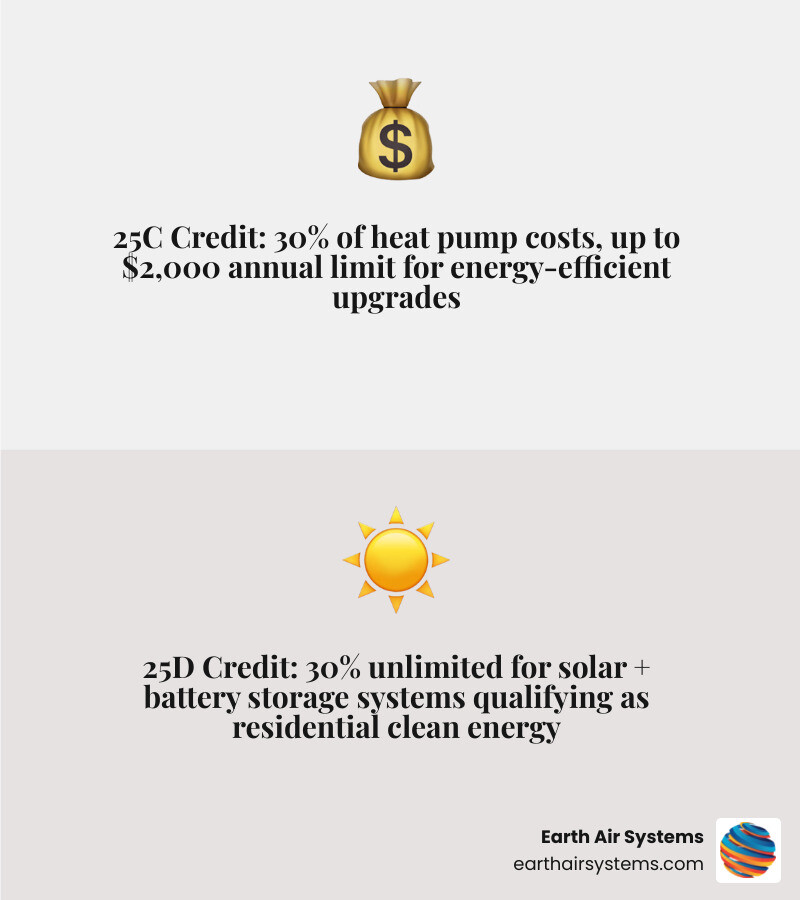
- Section 25C (Air-Source): This covers 30% of the project cost, including labor, capped at an annual limit of $2,000. This credit was designed to be used for Heat Pump Replacement in San Diego and is available for systems installed through the end of 2025.
- Section 25D (Geothermal): This is part of the Residential Clean Energy Credit. It offers a flat 30% credit on the entire cost with no dollar limit. This credit is currently slated to remain at 30% through 2032 before it begins to step down.
| Feature | Air-Source Heat Pump (25C) | Geothermal Heat Pump (25D) |
|---|---|---|
| Credit Percentage | 30% of total cost | 30% of total cost |
| Annual Dollar Cap | $2,000 | No limit |
| Labor Included? | Yes | Yes |
| Carry-Forward? | No (Use it or lose it) | Yes (Apply to future years) |
| Main Requirement | ENERGY STAR Most Efficient | ENERGY STAR Certified |
One critical thing to remember is that the 25C credit is non-refundable. This means if you owe $1,500 in taxes but qualify for a $2,000 credit, the IRS will bring your tax bill down to zero, but they won’t cut you a check for the remaining $500. Furthermore, unlike the geothermal credit, you cannot carry the leftover amount into the next tax year.
Eligibility and Efficiency Standards for 2025-2026
To claim federal tax credits for heat pump upgrades, the IRS has specific rules about who can claim the credit and where the equipment is installed.
- Principal Residence: For the 25C credit, the heat pump must be installed in an existing home that you use as your primary residence.
- Renters: Good news for those leasing! Renters are actually eligible to claim this credit if they pay for the upgrade themselves in their primary residence.
- Second Homes: While you can claim the 25D (geothermal) credit for a second home, the 25C (air-source) credit is generally reserved for your main home.
- Existing Homes only: You cannot claim the 25C credit for a new construction home. The home must already exist. If you’re curious about how this applies to specific areas, check out our guide on Everything You Need to Know About Heat Pump Replacement in Chula Vista, CA.
Efficiency Requirements for Federal Tax Credits for Heat Pump Upgrades
Not every heat pump qualifies. The IRS wants to reward “the best of the best” in terms of efficiency. For any system installed starting January 1, 2025, the unit must be recognized as ENERGY STAR Most Efficient.
The Consortium for Energy Efficiency (CEE) sets the tiers that the IRS follows. Generally, your system needs to meet the highest non-advanced tier. This usually translates to specific SEER2 (Seasonal Energy Efficiency Ratio) and HSPF2 (Heating Seasonal Performance Factor) ratings. Because San Diego is in a “South” climate region, the requirements often focus on cooling efficiency just as much as heating.
If you aren’t sure where your current or prospective unit stands, you can use a SEER Calculator to understand the efficiency levels of different models.
Claiming Federal Tax Credits for Heat Pump Upgrades on Your Return
When tax season rolls around in 2026, you will need to be prepared. To claim the credit, you must file IRS Form 5695, Residential Energy Credits.
Starting with 2025 installations, there is a new hurdle: the Qualified Manufacturer Identification Number (QMID) or a specific PIN. The IRS now requires that you report the manufacturer’s code for the equipment to prove it meets the efficiency standards. Without this code, your claim could be denied. We always recommend our customers keep a digital folder with their invoices, manufacturer certification statements, and the specific model numbers. If you have more questions about the technical side of things, our HVAC FAQs cover many of the common hurdles homeowners face.
Strategic Planning to Maximize Annual Savings
If you are planning a complete home energy overhaul, doing everything at once might actually cost you money in lost tax credits. The 25C credit has an aggregate annual limit of $3,200.
Here is how that breaks down:
- $2,000 specifically for heat pumps or heat pump water heaters.
- $1,200 for other “building envelope” improvements (like windows, doors, and insulation).
A smart strategy we often suggest is spreading upgrades over multiple years. For example, in Year 1, you might focus on a Heat Pump Replacement Guide La Jolla, CA and claim your $2,000. In Year 2, you could replace your windows and doors to claim another $1,200.
Before you start, we highly recommend a home energy audit. Not only does this help you prioritize where you’re losing the most energy, but the audit itself qualifies for a tax credit of 30%, up to $150. It’s a great way to get professional eyes on your attic insulation—which we suggest optimizing before you install a new heat pump to ensure the system isn’t oversized.
Combining Incentives and Rebates
One of the most common questions we get is: “Can I use rebates and tax credits together?” The answer is yes, but the math gets a little tricky.
HEEHRA and State Rebates
The High-Efficiency Electric Home Rebate Act (HEEHRA) provides point-of-sale discounts specifically for low-to-moderate-income households. In California, these programs are administered at the state level. If you qualify, you could receive up to $8,000 off a heat pump installation.
However, the IRS requires you to subtract the rebate amount from the total project cost before calculating your 30% tax credit.
Example:
- Total project cost: $10,000
- State Rebate received: $4,000
- Net cost for tax credit: $6,000
- Tax Credit (30% of $6,000): $1,800 (This is under the $2,000 cap, so you get the full $1,800).
Utility subsidies and purchase-price adjustments from manufacturers also need to be subtracted. However, state energy incentives that aren’t classified as “rebates” (like certain tax exemptions) usually don’t reduce your federal credit basis. It’s always best to consult a tax professional to see how these stack in your specific bracket. For more on navigating these local nuances, see our article on Finding the Best Heat Pump Replacement Services in San Diego.
Frequently Asked Questions about Heat Pump Incentives
Can I carry forward unused tax credits to future years?
For the 25C Energy Efficient Home Improvement Credit (air-source heat pumps), the answer is no. It is a “use it or lose it” credit for the tax year the equipment was installed. However, for the 25D Residential Clean Energy Credit (geothermal), you can carry forward the unused portion to future tax years. This is a major advantage for geothermal systems which often have a higher initial investment.
Do heat pumps work effectively in cold climates for credit eligibility?
Absolutely. While we enjoy mild weather in San Diego, modern “cold-climate” heat pumps are designed to work efficiently even when temperatures drop to -10 degrees Fahrenheit. To qualify for the “Cold Climate” pathway for the tax credit, the unit must meet specific performance metrics at low temperatures. In our region, most homeowners qualify through the “Cooling-Dominated” pathway, which emphasizes SEER2 ratings.
What documentation do I need for an IRS audit?
To protect yourself in case of an audit, keep the following for at least three years:
- The Manufacturer’s Certification Statement (usually found on the brand’s website).
- Detailed installation receipts showing labor and equipment costs separately.
- The QMID or QM Code for your specific model.
- The PIN number if provided by the manufacturer.
- A copy of your filed IRS Form 5695.
For more tips on choosing the right system and keeping your paperwork in order, check out How to Pick the Best Heat Pump Replacement in San Diego, CA.
Conclusion
Upgrading your home’s comfort shouldn’t be a financial burden. By taking advantage of federal tax credits for heat pump upgrades, you can significantly offset the cost of moving to a cleaner, more efficient way of living.
At Earth Air Systems, we’ve spent over 40 years helping San Diego homeowners navigate the complexities of HVAC technology and the incentives that come with it. Whether you are in Chula Vista, La Jolla, or Downtown, our team is here to ensure your installation meets the strict ENERGY STAR Most Efficient standards required for these credits.
Ready to claim your savings and upgrade your home comfort? Contact us today for expert Heating Services in San Diego and Air Conditioning Services in San Diego. We’ll help you find the perfect system that keeps you cool all summer, warm all winter, and keeps your tax bill as low as possible.
