
Why Every San Diego Homeowner in an Older House Needs an Electrical Safety Checklist
An electrical safety checklist for older homes is a structured inspection covering your wiring type, panel capacity, outlet grounding, GFCI protection, and warning signs like flickering lights or burning odors — performed every six months by homeowners and every one to three years by a licensed electrician.
Quick checklist for older home electrical safety:
- Identify your wiring type (knob-and-tube, aluminum, or copper)
- Check your panel capacity (100-amp minimum; 200-amp is today’s standard)
- Test all GFCI outlets in kitchens, bathrooms, and outdoor areas
- Look and listen for warning signs: flickering lights, buzzing sounds, warm switch plates, or burning odors
- Inspect all cords for fraying, cracking, or compression under furniture
- Confirm all outlets near water sources are GFCI protected
- Verify smoke detectors are present on every level and tested monthly
- Schedule a professional inspection if your home was built before 1990
San Diego is home to thousands of beautiful historic properties — craftsman bungalows in North Park, Victorian homes in Hillcrest, mid-century ranches in Escondido. They have character, craftsmanship, and stories built into every wall. But behind those walls, the electrical systems in many of these homes were designed for a world that no longer exists.
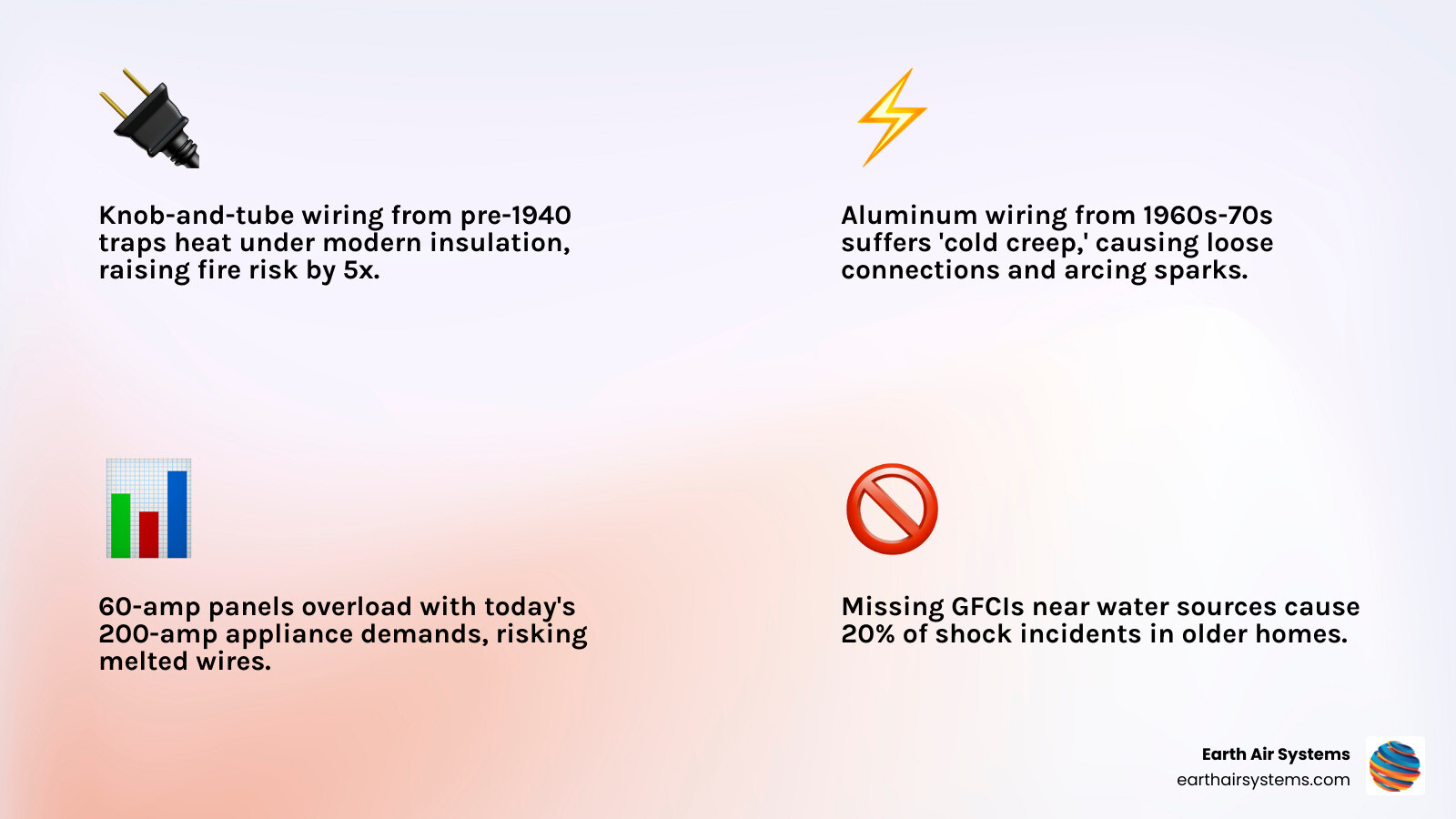
Homes built before 1990 may not meet today’s safety standards. Many were originally wired for just 60 amps — a fraction of the 200-amp service that modern households routinely demand. Some still contain knob-and-tube wiring installed before World War II, or aluminum branch wiring from the 1960s and 70s, both of which carry real fire and shock risks when paired with today’s appliances, smart devices, and EV chargers.
The stakes are significant. Electrical fires account for an estimated 53,600 home fires in the U.S. every year, causing over 500 deaths and more than $1.4 billion in property damage annually. And the hazards are rarely obvious — a system that looks and feels fine can still be quietly overheating inside your walls.
The good news is that a simple, consistent routine can catch most problems before they become emergencies. That’s exactly what this guide is built to help you do.
Identifying Legacy Hazards in San Diego’s Historic Properties
When we walk through a historic home in Old Town or a mid-century gem in La Jolla, we often admire the original wood floors or the hand-carved molding. However, as experts in home systems, our eyes usually go straight to the outlets and the electrical panel. In San Diego, “historic” can mean anything from a 1920s cottage to a 1970s ranch, and each era brings its own set of electrical quirks.
Identifying what is behind your walls is the first step in any electrical safety checklist for older homes. Many homeowners are surprised to find that their home uses a combination of different wiring types, often the result of decades of piecemeal DIY repairs or unpermitted additions.

Why Knob-and-Tube is a 2026 Liability
If your home was built before 1950, there is a high probability it originally featured knob-and-tube (K&T) wiring. This system uses porcelain “knobs” to support wires and “tubes” to protect them as they pass through wood framing. While it was a marvel in its day, it is a significant liability in May 2026.
Knob-and-tube wiring is an “air-cooled” system. The wires were designed to be suspended in open air to dissipate heat. A major danger arises when modern homeowners add fiberglass or spray-foam insulation over these wires to improve energy efficiency. This traps the heat, which can lead to the cloth-backed insulation becoming “crispy,” flaking off, and leaving energized wires exposed. Furthermore, K&T systems lack a grounding wire, meaning they cannot safely handle modern electronics or high-draw appliances like a high-efficiency air conditioner.
The Danger of Aluminum Wiring and Cold Creep
For homes built between the mid-1960s and late 1970s, aluminum wiring was often used as a cost-effective alternative to copper. The problem is a phenomenon known as “cold creep.” Aluminum expands and contracts significantly more than copper when it heats up. Over time, this movement causes connections at outlets and switches to loosen.
Loose connections create electrical arcing, which generates intense heat. If you live in a 1970s home in San Marcos or Oceanside and notice a “fishy” or burning plastic smell near an outlet, it could be the result of failing aluminum connections.
Copper vs. Aluminum Wiring Safety
| Feature | Copper Wiring | Aluminum Wiring (Vintage) |
|---|---|---|
| Stability | Highly stable; minimal expansion | High expansion/contraction (Cold Creep) |
| Durability | Resistant to oxidation | Oxidizes easily, creating resistance |
| Fire Risk | Low (with proper installation) | Higher due to loosened connections |
| Standard | Current residential standard | Requires special connectors (CO/ALR) |
If you are concerned about how your wiring might affect your home’s comfort systems, you can find More info about air conditioning services in San Diego to see how we ensure your HVAC setup is compatible with your home’s infrastructure.
The Danger of 60-Amp Electrical Panels
We often use the analogy that running a modern San Diego home on a 60-amp service is like trying to sip a thick milkshake through a tiny cocktail straw. In the 1940s, a home might have had a few light bulbs and a radio. Today, we have electric ovens, car chargers, multiple air conditioning units, and high-powered computers.
A 200-amp service is the current standard for modern living. If your panel is rated for 60 or 100 amps, you are likely experiencing frequent breaker trips. Worse yet, certain brands of older panels, such as Federal Pacific or Zinsco, are notorious for failing to trip even when overloaded. These “no-trip” breakers allow wires to melt and catch fire without ever cutting the power.
The Ultimate Electrical Safety Checklist for Older Homes
Performing a DIY audit doesn’t require you to be an electrician. It just requires you to use your senses: Sight, Sound, and Touch. We recommend running through this electrical safety checklist for older homes every six months, ideally when you change your clocks for daylight savings.
The Sensory Inspection:
- Touch: Lightly touch your outlet faceplates and switch plates. They should never feel warm. If they do, it indicates a loose connection or an overloaded circuit. (Note: Dimmer switches may feel slightly warm during normal use, which is usually fine).
- Listen: Listen for buzzing or sizzling sounds behind the walls. This is often the sound of electricity “jumping” or arcing between loose wires.
- Smell: Be alert for the smell of burning plastic or a strange “fishy” odor, which is often the scent of melting wire insulation.
- Sight: Look for flickering lights, especially when a large appliance (like your refrigerator or AC) kicks on. Also, check if plugs fit “snugly” into outlets. If a plug falls out easily, the internal contacts are worn and pose a fire risk.
Essential electrical safety checklist for older homes: The Exterior
In San Diego, our coastal environment adds a unique challenge: salt air corrosion. If you live in Coronado, La Jolla, or Solana Beach, the salt in the air can accelerate the rusting of your electric meter and outdoor panels.
- Check the Meter: Inspect your electric meter for signs of rust or water intrusion.
- Outdoor Outlets: Ensure all outdoor outlets have weatherproof “in-use” covers and are GFCI protected.
- Tree Clearance: Make sure branches are not rubbing against the service lines coming from the utility pole to your house.
- Extension Cords: Never use an indoor extension cord outside. They cannot handle the humidity and temperature swings of our San Diego climate.
Interior electrical safety checklist for older homes: Room-by-Room
Kitchen and Bathrooms:
- GFCI Protection: Every outlet within six feet of a sink must be a Ground Fault Circuit Interrupter (GFCI). These are the outlets with “Test” and “Reset” buttons.
- Appliance Placement: Keep cords away from hot surfaces like toasters or stove burners.
- Unplug Small Appliances: Toasters and hair dryers should be unplugged when not in use to eliminate “phantom” power draw and potential points of failure.
Bedrooms and Living Areas:
- Bulb Wattage: Check the maximum wattage rating on your light fixtures. Using a 100-watt bulb in a fixture rated for 60 watts can melt the socket.
- Cord Safety: Never run extension cords under rugs or pinch them behind furniture. This can damage the insulation and lead to a fire.
- Space Heaters: If you use a portable heater during those chilly Chula Vista winters, keep it at least three feet away from curtains and bedding.
Modernizing Your System: AFCIs, GFCIs, and Surge Protection
Modernizing an older home isn’t just about replacing old wires; it’s about adding layers of “smart” protection that didn’t exist when your house was built.
1. GFCI (Ground Fault Circuit Interrupters): These protect people. They monitor the flow of electricity and shut off the power in milliseconds if they detect a leak (a ground fault), preventing electrocution. These are essential in kitchens, bathrooms, and garages.
2. AFCI (Arc Fault Circuit Interrupters): These protect property. Unlike standard breakers that only trip during a short circuit, AFCIs detect dangerous “arcing” patterns — the kind caused by a nail accidentally hitting a wire in the wall or a rodent chewing through insulation.
3. Whole-Home Surge Protection: Older homes are particularly vulnerable to voltage spikes. A whole-home surge protector installed at the main panel protects your expensive appliances and HVAC systems from external surges (like lightning or utility grid issues). For more on keeping your systems running efficiently, check out More info about HVAC system upgrades.
4. Tamper-Resistant Outlets (TROs): If you have young children in your San Diego home, TROs are a must. They have built-in shutters that prevent foreign objects (like hairpins) from being inserted into the slots. They are much more effective than those plastic “plugs” that kids eventually learn to pull out.
When to Call a Professional Electrician
While a DIY electrical safety checklist for older homes is great for maintenance, certain signs require immediate professional intervention:
- Frequent Breaker Trips: If you can’t run your microwave and your coffee maker at the same time without the power cutting out.
- Flickering Lights: Specifically if the lights dim significantly when your San Diego air conditioner starts its cycle.
- Tingles or Shocks: If you feel a slight “tingle” when touching a metal appliance, you have a serious grounding issue.
- Insurance Requirements: Many insurance companies in California now require a “four-point inspection” for homes over 30 years old. If your wiring is flagged, you may need professional certification or upgrades to maintain coverage.
Impact on Home Insurance and Resale Value
In May 2026, the real estate market in San Diego remains competitive, but buyers are more safety-conscious than ever. Documenting your electrical upgrades can significantly increase your home’s resale value. More importantly, many insurance providers will no longer cover homes with active knob-and-tube wiring or specific recalled electrical panels.
Upgrading your system to modern standards can often lead to lower insurance premiums and makes your home much easier to finance for potential buyers. It transforms a “charming but risky” house into a “historic and secure” home.
Frequently Asked Questions about Older Home Wiring
How often should I perform an electrical safety check in a home built before 1970?
We recommend a DIY visual inspection every six months. However, for homes over 40 years old, a professional inspection should be conducted every one to two years to ensure that aging insulation hasn’t become a hazard.
Can I just use a three-prong adapter for my two-prong outlets?
No. These are often called “cheater” adapters for a reason. While they allow you to plug in a three-prong cord, they do not provide an actual path to ground unless the center screw is connected to a grounded metal box — which most older homes don’t have. Using these can result in damage to sensitive electronics and poses a shock risk.
Why do my lights dim when my San Diego air conditioner kicks on?
This is a classic sign that your electrical system is struggling to meet the “inrush current” demanded by your AC’s compressor. It usually indicates that your electrical panel is undersized or that the AC is on a shared circuit rather than a dedicated one. This strain can shorten the life of your HVAC equipment.
Conclusion
Owning a piece of San Diego history is a privilege, but it comes with the responsibility of stewardship. By following this electrical safety checklist for older homes, you aren’t just preventing fires; you are protecting your family and ensuring your historic investment stands for another hundred years.
At Earth Air Heating & Cooling, we’ve spent over 40 years helping San Diego homeowners stay comfortable and safe. While we specialize in high-quality HVAC services, we know that a healthy home starts with a safe electrical foundation. Whether you’re in a beach cottage in Encinitas or a historic manor in Downtown San Diego, proactive maintenance is always the smartest path.
If you’ve noticed your lights flickering or your system struggling to keep up with the San Diego heat, it might be time for a professional look. Schedule your seasonal HVAC tune-up with Earth Air Systems today, and let us help you ensure your home’s systems are operating at peak efficiency and safety. Your comfort is our 100% guarantee.
