
How Ductless Systems Work for Cooling and Heating in San Diego Homes
How ductless systems work for cooling and heating comes down to one simple idea: moving heat instead of generating it. A ductless mini-split pulls heat out of your indoor air in summer and pulls heat from outside air into your home in winter — all without a single foot of ductwork. Here’s the short version:
- Cooling: The indoor unit absorbs heat from your room air using refrigerant, then sends that heat outside via the outdoor unit.
- Heating: The system runs in reverse — the outdoor unit extracts heat from outside air (even on cool days) and transfers it inside.
- No ducts needed: Refrigerant lines run through a small 3-inch hole in the wall, connecting indoor and outdoor units.
- Zone control: Each indoor unit operates independently, so you only condition the rooms you’re actually using.
- High efficiency: Most ductless systems are 20–30% more efficient than ducted systems, partly because traditional ducts can waste over 30% of conditioned air.
If you’ve ever dealt with a room in your San Diego home that’s always too hot in summer or never quite warm enough in winter, you already know the problem. Uneven temperatures, high energy bills, and systems that heat or cool rooms nobody’s using are everyday frustrations for homeowners — and they’re often symptoms of a ducted system that simply wasn’t designed for zoned comfort. Ductless mini-split systems were built to solve exactly that. More than 1.75 million American homes have already made the switch, and the technology has been quietly improving since Mitsubishi Electric first introduced it back in 1959.
What is a Ductless Mini-Split System?
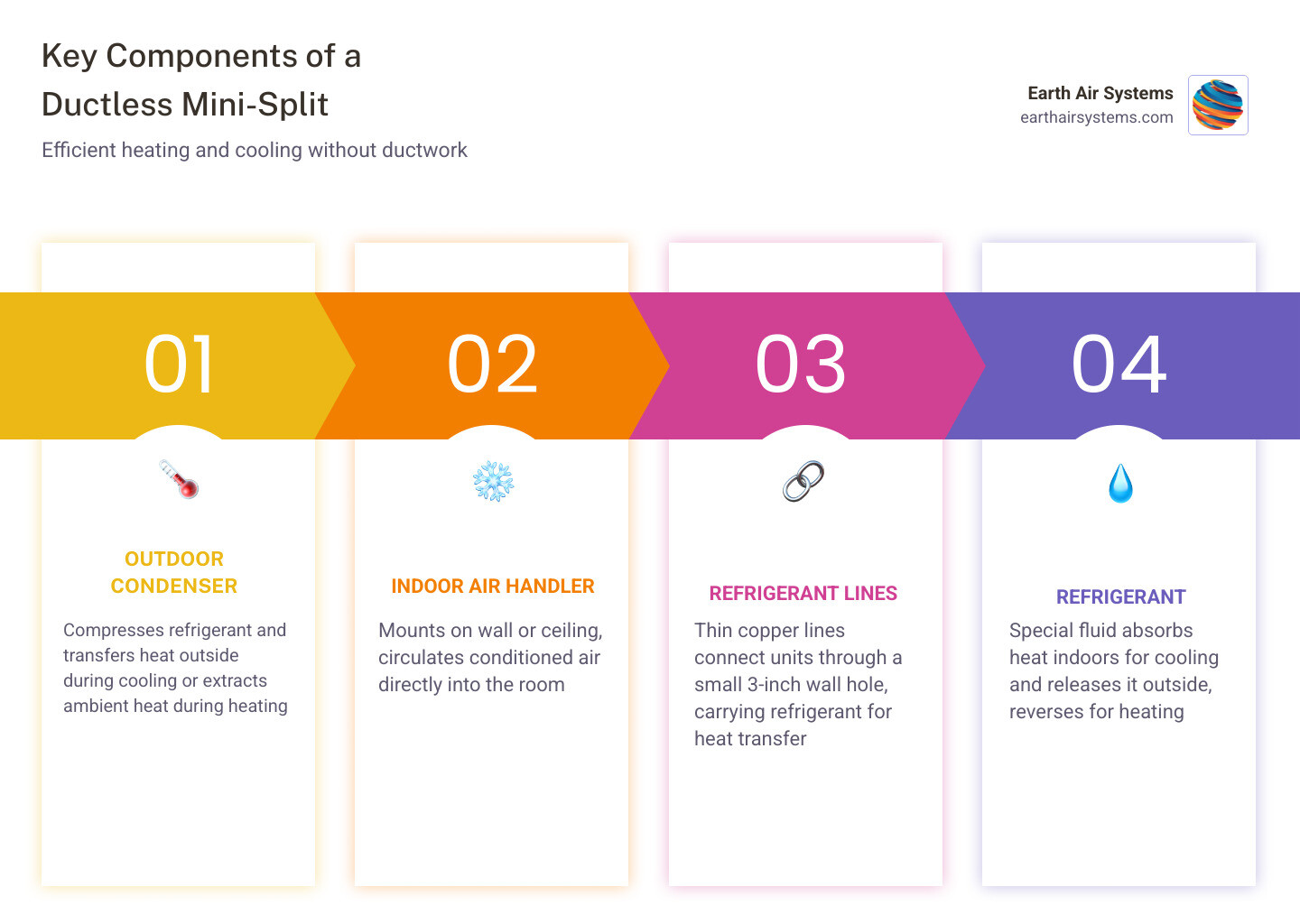
When we talk about a ductless mini-split, we are describing a heating and cooling system that bypasses the need for the bulky, dusty metal “veins” (ductwork) found in traditional homes. Instead of one giant furnace or air conditioner in the attic or garage pushing air through the whole house, a ductless system uses small, independent indoor units to deliver comfort directly to specific rooms.
At its core, a mini-split consists of two main parts. First, there is the outdoor condenser, which sits quietly outside your home (some operate as quietly as 46 decibels—about the volume of a normal conversation). Second, there is the indoor air handler, which is the sleek unit you see mounted on your wall or ceiling.
These two halves are joined by a refrigerant conduit. This bundle houses the power cable, refrigerant tubing, and a condensate drain line. Because there is no ductwork, we don’t have to tear apart your beautiful San Diego ceilings or walls. This makes it a perfect solution for Air Conditioning Services In San Diego when you’re looking to upgrade an older home or add climate control to a new sunroom. It is equally effective for Heating Services In San Diego, providing a cozy warmth that traditional electric baseboard heaters just can’t match.
How Ductless Systems Work for Cooling and Heating
The magic behind how ductless systems work for cooling and heating is a scientific process called “heat transfer.” Most people think an air conditioner “creates” cold air, but it actually just removes heat.
Modern ductless systems utilize inverter technology and variable speed motors. Think of a traditional AC like a light switch—it’s either 100% on or 100% off. An inverter-driven system is more like a dimmer switch. It ramps up or down to meet the exact needs of the room, which prevents the “stop-and-start” cycle that wastes so much energy.
By running at lower speeds for longer periods, the system maintains a rock-steady temperature. If you’re curious about how your current system stacks up, you can check out our Seer Calculator to see the efficiency gains. Ductless systems often boast SEER2 ratings between 15.2 and 35, whereas traditional ducted heat pumps usually top out much lower.
The Cooling Cycle: How Ductless Systems Work for Cooling
In the summer, your indoor unit acts as a heat magnet. Here is the step-by-step breakdown:
- Absorption: The indoor unit contains an evaporator coil filled with cold refrigerant. A fan pulls the warm air from your room across this coil.
- Phase Change: The refrigerant absorbs the heat from the air and turns from a liquid into a gas.
- Moisture Removal: As the air cools, it loses its ability to hold moisture. This condensation collects on the coil and is safely drained outside, acting as a powerful dehumidifier.
- Transfer: The now-warm gaseous refrigerant travels through the conduit to the outdoor unit.
- Release: The outdoor compressor squeezes the gas (raising its temperature even higher) and blows outdoor air across the coils to release that heat into the San Diego sunshine.
If your old central unit is struggling to keep up with the coastal humidity, it might be time for an Ac Installation In San Diego or a full Ac Replacement In San Diego to regain your indoor sanctuary.
The Heating Cycle: How Ductless Systems Work for Heating
Wait, how can a system “cool” your house in the winter? It can’t—but it can act as a heat pump. A ductless heat pump is essentially an air conditioner that can run in reverse.
Inside the outdoor unit is a clever component called a reversing valve. When you switch to heat mode, this valve flips the flow of the refrigerant. Even when it feels chilly outside in Vista or Oceanside, there is still ambient heat in the air. The outdoor unit extracts this heat, the compressor concentrates it to make it much hotter, and the refrigerant carries that heat into the house. The indoor unit then releases that warmth into your living room.
Because they move heat rather than creating it (like an electric furnace does), these systems are incredibly efficient. For homeowners looking at a Heating Installation In San Diego or a Heat Pump Replacement In San Diego, ductless technology offers a way to stay warm without the sky-high utility bills of a traditional furnace.
Key Components and Configuration Options
One of the best things about ductless technology is its flexibility. You aren’t limited to a “one size fits all” setup.
- Single-Zone Systems: These consist of one outdoor unit and one indoor unit. They are perfect for a garage workshop, a master bedroom, or a new home addition.
- Multi-Zone Systems: One outdoor unit can power up to eight indoor units. This allows you to set the kitchen to 72 degrees while the guest room stays at a crisp 68.
- Indoor Unit Styles: You aren’t stuck with just wall-mounted units. We can install ceiling cassettes that sit flush with the ceiling, floor-standing models for rooms with limited wall space, or even slim ducted units that hide behind a small vent.
| Feature | Single-Zone System | Multi-Zone System |
|---|---|---|
| Best For | Individual rooms or additions | Whole-home comfort |
| Outdoor Units | 1 | 1 |
| Indoor Units | 1 | Up to 8 |
| Installation Time | Very Fast (approx. 5 hours) | Moderate (depends on unit count) |
| Zoning | Single Temperature | Independent Room Control |
Professional Installation and Maintenance
While some “DIY” kits exist, we strongly recommend professional installation to ensure your system lasts its full 20-year lifespan. A professional install involves drilling a single 3-inch wall hole for the conduit and setting up a dedicated electrical circuit. If the refrigerant lines aren’t charged perfectly, the system will “short cycle,” which wears out the compressor and kills your energy savings.
Once installed, maintenance is a breeze. You should perform basic filter cleaning every month—just pop the front cover, rinse the screen, and let it dry. For the technical side, we recommend annual tune-ups. Our team provides comprehensive Ac Maintenance In San Diego and Heating Maintenance In San Diego to check refrigerant levels and clean the outdoor coils, ensuring you stay comfortable year-round.
Why Ductless is the Superior Choice for San Diego Homes
In San Diego, our homes are as diverse as our landscape. From historic cottages in North Park to modern estates in La Jolla, ductless systems fit where traditional HVAC can’t.
Energy Savings & Duct Loss Prevention Did you know that traditional ducted systems can waste up to 30% of the energy they consume through leaks in the ductwork? If your ducts run through a hot attic, you’re paying to cool your roof! Ductless systems eliminate this loss entirely, often saving homeowners up to 40% on energy consumption compared to conventional setups.
Quiet Operation & Zoned Control If you value serenity, ductless is the way to go. Because the noisy compressor is located outside, the indoor experience is “whisper-quiet.” Plus, with zoned control, you can stop paying to cool the guest room that nobody uses. This “spot conditioning” is the ultimate way to lower your carbon footprint and your bills.
Coastal Home Applications For our neighbors in Coronado or Solana Beach, salt air can be tough on equipment. Ductless units are compact and easy to protect, and the lack of ductwork means you won’t have salt-laden air or humidity trapped in hidden vents where mold can grow.
Whether you are in Downtown San Diego or the hills of Escondido, our Service Areas cover the entire region with expert ductless solutions.
Frequently Asked Questions about Ductless HVAC
Can ductless systems work in very cold climates?
Yes! While San Diego doesn’t usually see “arctic” temperatures, many of our customers in the higher elevations of North County do experience frosty mornings. Modern ductless units feature low-ambient heating and flash injection technology that allows them to extract heat even when it’s 15°F outside. If you ever run into trouble during a cold snap, we offer expert Heat Pump Repair In San Diego to get things running again.
How do I determine the right BTU capacity for my room?
Sizing is critical. If a unit is too small, it will run constantly and never get the room comfortable. If it’s too large, it will “short cycle,” turning on and off so fast that it fails to remove humidity. We look at square footage, ceiling height, insulation quality, and solar gain (how much sun hits your windows). Generally, a 12,000 BTU unit is great for about 500 square feet, but a professional assessment is always best. If your current unit is struggling, it might be a sizing issue rather than a mechanical one—something we can diagnose during an Ac Repair In San Diego visit.
Are ductless systems more efficient than central AC?
Almost always. Between the SEER2 ratings (which can reach up to 35), Energy Star certification, and the use of inverter compressors, ductless systems are designed for the modern, energy-conscious world. By providing targeted conditioning, you aren’t wasting power on the 70% of the house you aren’t currently using. This is a much more efficient approach than a traditional Furnace Replacement In San Diego if your goal is purely energy reduction.
Conclusion
At Earth Air Systems, we believe every San Diego homeowner deserves a home free of “hot spots” and “cold zones.” With over 40 years of experience serving our local community—from Chula Vista to San Marcos—we have seen how ductless technology transforms home comfort.
By understanding how ductless systems work for cooling and heating, you can take control of your indoor environment, slash your energy bills, and enjoy the whisper-quiet operation that only a mini-split can provide. Whether you need a simple repair or a full-home zoned upgrade, our commitment to 100% customer satisfaction ensures your project is handled with care.
Ready to say goodbye to hot spots for good? Explore our full range of Air Conditioning Services In San Diego and let us help you design the perfect system for your lifestyle.
