
Why Most San Diego Homeowners Regret Waiting Until Summer to Think About Their AC
Spring AC preparation for Southern California is the single most effective thing you can do to avoid a sweaty, stressful summer breakdown — and the best time to act is right now, in April 2026, before the heat arrives.
Here’s a quick summary of what spring AC prep involves in Southern California:
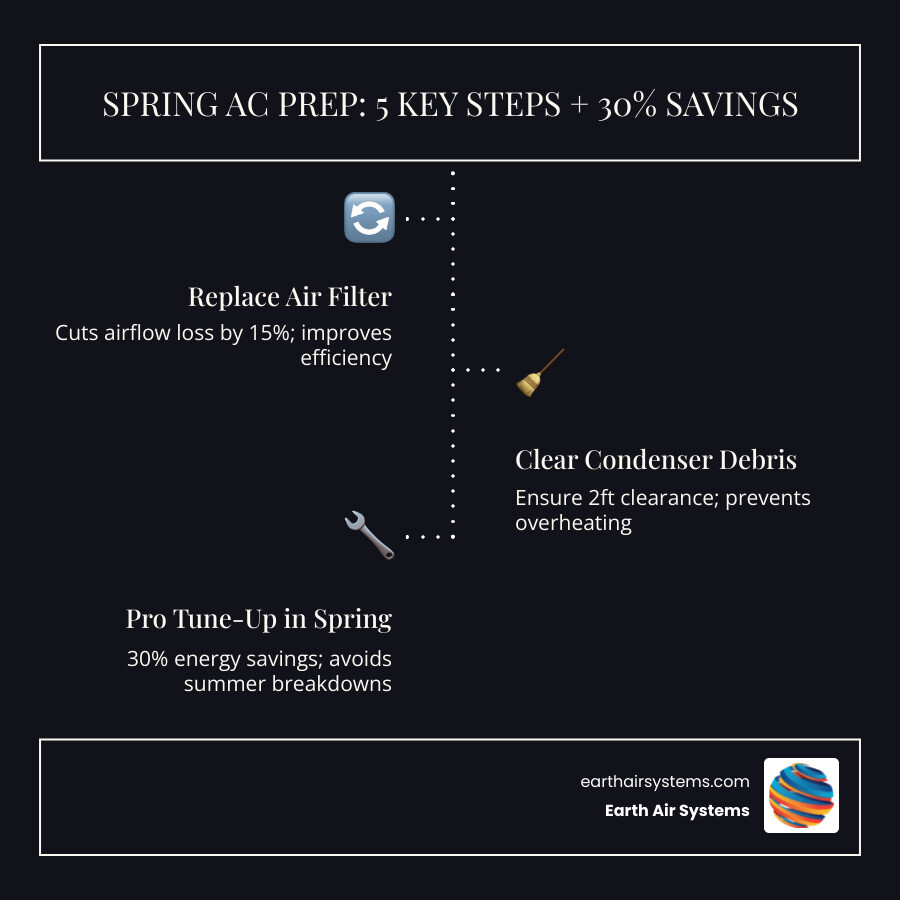
- Replace your air filter — a clogged filter cuts airflow by up to 15%
- Clear debris from your outdoor condenser unit — leave at least 2 feet of clearance
- Test your thermostat in cooling mode before temperatures climb
- Inspect visible ductwork for leaks (leaky ducts waste 20-30% of cooled air)
- Schedule a professional tune-up — ideally between February and April, before peak-season demand
- Upgrade to a MERV 11+ filter if wildfire smoke or heavy pollen is a concern
Southern California’s AC season runs roughly eight to nine months a year. That’s a long time to rely on a system you haven’t checked since last fall. Most failures don’t happen in the middle of August — they happen during the first real heat wave, when every HVAC company in the region is already booked out for weeks. By then, you’re stuck waiting in the heat.
The good news? A little preparation in spring changes everything. It keeps your system running efficiently, lowers your energy bills, and protects the lifespan of your equipment.
Why Spring AC Preparation for Southern California is Essential
Living in San Diego or Chula Vista means enjoying a Mediterranean climate that most of the world envies. However, that same climate presents unique challenges for your air conditioning system. Unlike other parts of the country where an AC might only run for three months, our systems are the workhorses of the home, often running from April through late October.
The primary reason spring ac preparation for southern california is so critical is the sheer volume of work the system performs. When a machine runs for 75% of the year, wear and tear accumulate quickly. Without a dedicated spring check-up, you are essentially asking your AC to run a marathon without any training.
One of our biggest local hurdles is the Santa Ana winds. These hot, dry winds carry massive amounts of dust and debris from the inland deserts toward the coast. This dust settles deep within your outdoor condenser coils, acting like a blanket that traps heat. When your coils can’t release heat, your system has to work twice as hard to cool your home, leading to higher bills and eventual component failure.
Furthermore, if you live in coastal areas like La Jolla, Del Mar, or Coronado, you have to contend with salt air. Salt is incredibly corrosive to the aluminum fins and copper tubing inside your outdoor unit. Regular AC Maintenance in San Diego is the only way to rinse away these corrosive deposits and inspect for early signs of “pitting” or damage.
Lastly, we cannot ignore the impact of wildfire smoke. Even if a fire isn’t in your immediate backyard, the fine particulate matter travels for miles and can completely clog a standard air filter in a matter of days. Preparing your system in the spring ensures you are starting the peak heat season with a clean slate and the right filtration to keep your indoor air breathable. For more details on how to handle these local challenges, check out The Ultimate Guide to AC Maintenance Services in San Diego.
The Smartest Window for Spring AC Preparation: February to April
Timing is everything. In the HVAC world, there is a phenomenon known as “The Rush.” This usually happens during the first week of June or the first time the thermometer hits 90 degrees. During this week, every dormant, dust-caked AC unit in San Diego County is switched on simultaneously. Predictably, many of them fail.
By scheduling your spring ac preparation for southern california between February and April, you are beating the rush. During this window, technician availability is much higher. This means we can offer more flexible scheduling that fits your busy life in Downtown San Diego or North County.
Early preparation also gives you a “buffer zone.” If a technician discovers a part that is on the verge of failing—like a weak capacitor or a fraying belt—we have plenty of time to order the component and install it before you actually need the cooling. If you wait until July and a major part fails, you might find yourself waiting days or even weeks for a replacement while the rest of the region is also clamoring for repairs.
Testing your system in March or April also allows you to plan your household budget. It’s much easier to handle a minor repair in the spring than it is to face an emergency replacement in the middle of a record-breaking heatwave. If you’re in the South Bay area, you can learn more about staying ahead of the heat with our guide on how to Stay Frosty: The Best AC Repair Services in Chula Vista, CA.
Improving Indoor Air Quality During Spring AC Preparation for Southern California
We often think of AC as just “cold air,” but the “V” in HVAC stands for ventilation. Your system is responsible for the air you breathe every single minute you are indoors. In Southern California, spring is prime time for allergens. Pollen from local flora, combined with the dust kicked up by spring winds, can make life miserable for allergy sufferers.
During your spring preparation, we focus heavily on filtration. While basic fiberglass filters are cheap, they do very little to protect your health; they are mostly designed to keep large dust bunnies out of the machinery. We recommend upgrading to a MERV 11 or MERV 13 pleated filter. These are dense enough to trap microscopic allergens, mold spores, and even some bacteria.
Indoor air quality is also impacted by the “dormancy effect.” If your system has been off or running in heating mode all winter, dust has likely settled in the supply registers and return grilles. When you first kick on the AC, that dust is recirculated throughout your home. Part of a thorough spring prep involves vacuuming these areas and ensuring the air is being cleaned, not just cooled. This is also a great time to think about your overall home health, including Heating Maintenance in San Diego to ensure your furnace isn’t harboring dust for the next winter cycle.
Maximizing Efficiency and Lifespan with Seasonal Maintenance
The numbers don’t lie: a well-maintained AC system is a financial asset. Statistics show that annual maintenance can lead to up to 15% lower summer energy costs. When you consider that air conditioning accounts for about 18% of the total energy consumed in a typical home, those savings add up quickly over a long San Diego summer.
Regular maintenance also acts as an “insurance policy” for your equipment. Systems that receive seasonal care typically last 15 years, whereas neglected units often fail between year 8 and year 10. By investing in spring ac preparation for southern california, you are potentially adding five extra years of life to your system.
| Feature | Maintained AC System | Neglected AC System |
|---|---|---|
| Average Lifespan | 15+ Years | 8–10 Years |
| Energy Efficiency | Peak performance (Lower bills) | 15–30% Efficiency loss (Higher bills) |
| Breakdown Risk | 30% Reduced risk of emergency | High risk during first heatwave |
| Air Quality | High (Filtered allergens/dust) | Poor (Recirculated dust/mold) |
| Warranty Status | Valid (with proof of service) | Often voided by manufacturers |
Beyond the lifespan, there is the immediate benefit of reliability. There is a 30% reduced risk of emergency breakdowns when a professional has inspected the system in the spring. We look for the “hidden” issues that homeowners can’t see, such as low refrigerant levels which cause the compressor to overheat, or loose electrical connections that could lead to a fire hazard. If you do run into trouble, AC Repair in San Diego is always available to get you back up and running.
Avoiding Common Mistakes During Spring AC Preparation for Southern California
The biggest mistake we see homeowners make is the “out of sight, out of mind” approach. Just because the air coming out of the vents feels cool doesn’t mean the system is healthy.
Another common error is ignoring unusual noises. That slight squealing or clicking you hear in April will likely turn into a full-system seizure by August. These sounds are your system’s way of telling you that a bearing is dry or a contactor is failing.
Perhaps the most dangerous mistake is attempting DIY refrigerant handling. Not only is it illegal to vent refrigerant into the atmosphere, but the “recharge kits” sold at hardware stores can actually damage modern high-efficiency systems if used incorrectly. Refrigerant doesn’t “wear out” like oil in a car; if it’s low, you have a leak that needs to be sealed by a pro. For more answers to common homeowner blunders, visit our HVAC FAQs.
Homeowner Checklist: Safe DIY Maintenance Tasks
While many parts of an AC system require a professional touch, there are several things you can—and should—do yourself to keep things running smoothly. Taking these steps as part of your spring ac preparation for southern california can improve your system’s airflow by as much as 15%.
- Change the Air Filter: This is the #1 most important DIY task. In San Diego’s dusty environment, check your filter every 30 days. If it looks grey or fuzzy, swap it out.
- Clear the Area Around the Condenser: Your outdoor unit needs to “breathe” to release heat. Ensure there is at least 2 feet of clear space around the unit. Remove any weeds, tall grass, or stored items like garden hoses or chairs that might be blocking airflow.
- Gently Clean the Exterior: Use a soft brush or a vacuum with a brush attachment to remove cobwebs and leaves from the exterior fins. You can gently rinse the unit with a garden hose (don’t use a pressure washer, as it can bend the delicate aluminum fins).
- Inspect Your Vents: Walk through your home and ensure that no furniture, rugs, or curtains are blocking the supply or return vents. Blocked vents cause pressure imbalances that strain the blower motor.
- Test the Thermostat: Turn your system to “Cool” and set the temperature a few degrees below the current room temp. Listen for the system to kick on and feel for cool air within a few minutes. If it doesn’t start, check the batteries in your thermostat first!
- Check the Condensate Line: Look at the white PVC pipe that exits your home (usually near the outdoor unit). If you see water dripping while the AC is running, that’s a good sign—it means the system is successfully removing humidity. If you see water pooling in an emergency drain pan under your indoor unit, call us immediately.
If you’re located in the South Bay, these simple steps are the foundation of good AC Repair in Chula Vista prevention.
When to Call the Pros: The Professional Tune-Up Difference
While DIY tasks are great for maintenance, a professional tune-up is a deep-dive into the “health” of your machine. There are things a licensed technician can do that are simply impossible for a homeowner.
For example, professional coil cleaning can improve system efficiency by 15% or more. We use specialized, non-corrosive chemical cleaners that penetrate deep into the coils to dissolve the “baked-on” grime that a garden hose can’t touch.
During a professional visit, we also perform:
- Refrigerant Level Checks: We use precision gauges to ensure your system has the exact “charge” required by the manufacturer. Too much or too little refrigerant can destroy a compressor.
- Electrical Inspection: We tighten all connections and measure the “amp draw” of your motors. High amperage is a sign that a motor is working too hard and is nearing the end of its life.
- Capacitor Testing: The capacitor is the most common part to fail. We test its “microfarads” to see if it’s still within safety specs.
- Drain Line Flushing: We use pressurized air or specialized brushes to clear the “sludge” out of your drain lines, preventing the water leaks that cause thousands of dollars in ceiling damage.
- Duct Inspection: We look for disconnected or crushed ducts in your attic or crawlspace. Leaky ducts waste 20–30% of cooled air into spaces you don’t even live in!
Our team serves a wide variety of Service Areas across San Diego County, ensuring that whether you’re in Escondido or San Marcos, your system gets the expert care it deserves.
Signs Your System Needs More Than a Routine Tune-Up
Sometimes, a simple tune-up isn’t enough. If your system is showing any of the following symptoms during your spring ac preparation for southern california, it’s time to schedule a diagnostic repair:
- Short Cycling: If your AC turns on and off every few minutes without ever really cooling the house, it’s likely “short cycling.” This is often caused by an oversized unit, a failing thermostat, or a refrigerant leak.
- Grinding or Banging Noises: These are mechanical red flags. A grinding sound usually points to a motor bearing failure, while banging might mean a part has come loose inside the blower.
- Burning Smells: An electrical “ozone” smell or a burning plastic odor is an emergency. Turn off the system at the breaker and call us immediately.
- Weak Airflow: If you can barely feel air coming out of the vents, you might have a failing blower motor or a major duct collapse.
- Uneven Cooling: If the living room is a freezer but the bedrooms are sweltering, you may have ducting issues or a system that is no longer capable of reaching its full cooling capacity.
If you notice any of these, don’t wait for the heat to intensify. Contact Us today for a comprehensive inspection.
Frequently Asked Questions about SoCal AC Prep
Why does salt air matter for my air conditioner?
If you live within 5 miles of the Pacific Ocean—places like Carlsbad, Oceanside, or Solana Beach—salt air is your AC’s worst enemy. Salt particles settle on the aluminum fins of your outdoor unit and cause “galvanic corrosion.” This eats away at the metal, reducing the unit’s ability to transfer heat and eventually causing refrigerant leaks. Regular spring rinsing and professional protective coatings are essential for coastal homes to prevent premature system failure.
How often should I change my filters in San Diego?
While the standard advice is “every three months,” San Diego’s dry, dusty climate often requires a more frequent schedule. If you have pets, live near a busy road (like the I-5 or I-15), or if it’s wildfire season, you should check your filter every 30 days. A clogged filter reduces airflow by up to 15%, forcing your system to run longer and hotter than necessary.
Can a tune-up really lower my summer utility bills?
Absolutely. A system that is dirty or low on refrigerant has to run for much longer cycles to reach your desired temperature. By cleaning the coils, calibrating the thermostat, and ensuring proper airflow, we can often see a 15% efficiency boost. Over the course of a four-month heatwave, that’s a significant amount of money back in your pocket.
Conclusion
Preparing your home for the summer doesn’t have to be a source of anxiety. By taking a proactive approach to spring ac preparation for southern california, you are choosing comfort, savings, and peace of mind.
At Earth Air Systems, we bring over 40 years of experience to every home we visit. Whether you are in North Park, Hillcrest, or National City, our commitment to 100% customer satisfaction and flat-rate pricing means you’ll never be surprised by a bill or disappointed by our work. We know San Diego’s unique climate challenges because we live here too.
Don’t wait until the first 90-degree day to find out your AC isn’t up to the task. Let us help you keep your cool all summer long. Explore our full range of Air Conditioning Services in San Diego and schedule your spring tune-up today!
