
Why San Diego Homeowners Need to Know How to Prepare Your HVAC for Santa Ana Conditions
Knowing how to prepare your HVAC for Santa Ana conditions can be the difference between staying comfortable indoors and watching your system struggle — or fail — during one of Southern California’s most punishing weather events. If you live in San Diego, you already know the feeling: the air turns hot and bone-dry, gusts pick up, and suddenly your home feels like it’s fighting back against everything your AC is trying to do.
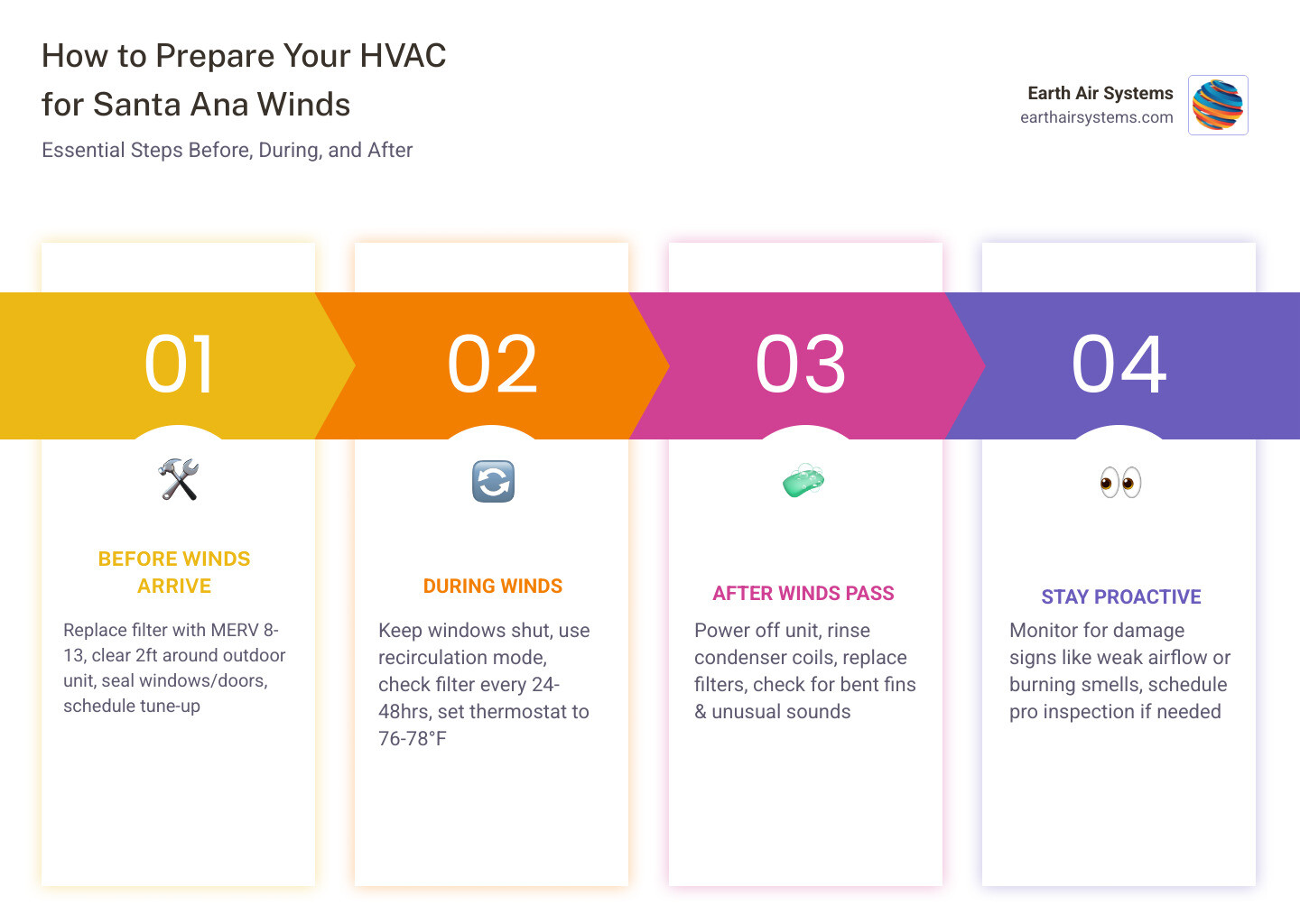
Here’s a quick overview of the essential steps to protect your HVAC before, during, and after a Santa Ana event:
- Before winds arrive – Replace your air filter with a MERV 8-13 pleated filter, clear a 2-foot zone around your outdoor unit, tighten loose panels, seal window and door gaps, and schedule a professional tune-up
- During winds – Keep windows and doors shut, switch to recirculation mode, inspect your filter every 24-48 hours, reduce indoor heat sources, and set your thermostat to a realistic 76-78°F
- After winds pass – Turn off power to the outdoor unit, rinse condenser coils with a low-pressure hose, replace filters, check for bent fins, clear condensate drain lines, and listen for any unusual sounds on restart
Southern California sees between 10 and 25 Santa Ana events every year, each lasting an average of three days. During those events, outdoor temperatures can push past 100°F, humidity can drop into the single digits, and airborne dust, sand, and wildfire smoke can clog a brand-new air filter in as little as 24 to 48 hours. Your HVAC system — designed for normal Southern California heat — suddenly finds itself working at or beyond its physical limits.
This guide walks San Diego homeowners through every phase of Santa Ana preparation: what these winds actually do to your equipment, what you can do yourself, and when it’s time to call in a professional.
What Santa Ana Winds Do to Your System
To understand how to prepare your HVAC for Santa Ana conditions, you first have to understand the science behind these “Devil Winds.” Santa Ana winds are katabatic winds, meaning they are caused by high pressure in the Great Basin pushing air toward the coast. As that air descends through the mountain passes, it undergoes “adiabatic heating”—compressing and warming by roughly 5°F for every 1,000 feet of descent.
By the time the air reaches North County or Downtown San Diego, it is incredibly hot and shockingly dry. Relative humidity regularly drops into the single digits—drier than the Sahara Desert, which typically sits around 20-25% humidity. This combination of heat, dryness, and high-velocity wind creates a “perfect storm” of mechanical stress for your air conditioner.
Why Santa Ana conditions are harder on HVAC than normal heat
Most residential AC systems in San Diego are engineered for a “design limit” of roughly 95-100°F. When Santa Anas push temperatures past 100°F, your system is already being asked to do more than it was technically built for.
Furthermore, the extreme dryness tricks your body, but it doesn’t help your AC. While dry air allows sweat to evaporate faster (making you feel cooler), it doesn’t change the fact that your attic is likely exceeding 150°F (sometimes hitting 160°F). This radiant heat from the attic, combined with hot air infiltration through small gaps in your home’s envelope, forces your system into continuous runtime. When an AC runs 24/7 without a break, components get hot, and the risk of a mechanical meltdown skyrockets.
Which HVAC parts are most vulnerable in Santa Ana conditions
Santa Ana winds carry a cocktail of particulates: fine desert dust, abrasive sand, leaves, pollen, and often sticky soot or ash from nearby wildfires. Each of these attacks your system differently:
- Coils and Fins: Fine dust coats the outdoor condenser coils, acting as an insulating blanket that prevents heat from escaping. High-speed sand can also “sandblast” the delicate aluminum fins, bending them and restricting airflow.
- Filters: These are your first line of defense, but they can become completely “impacted” (clogged) within 48 hours during heavy wind.
- Motors and Bearings: Abrasive sand can work its way into fan motors and bearings, causing premature wear like sandpaper on metal.
- Capacitors and Contactors: These electrical components are already under high stress from the heat. Voltage fluctuations or “brownouts” common during wind events can cause them to pop or fry.
- Drain Lines: Organic debris like leaves can get sucked into the unit, where they decompose and create a “slime” that clogs condensate drain lines.
Learn more about why hot dry gusts are your AC’s worst enemy
How to Prepare Your HVAC for Santa Ana Conditions Before the Winds Arrive
Preparation is the best way to avoid a mid-August or late-September emergency call. If the forecast calls for high winds and low humidity, use this checklist to get ahead of the weather.
Filter, airflow, and thermostat prep for how to prepare your HVAC for Santa Ana conditions
The single most important DIY step is managing your airflow. During a Santa Ana event, standard one-inch fiberglass filters are often insufficient. We recommend upgrading to pleated filters with a MERV (Minimum Efficiency Reporting Value) rating between 8 and 13.
| Filter Type | MERV Rating | Best For… |
|---|---|---|
| Basic Fiberglass | 1-4 | Large debris only; provides minimal protection. |
| Standard Pleated | 8-10 | Dust, pollen, and dust mites; good for general wind. |
| High-Efficiency | 11-13 | Fine desert silt, smoke particles, and allergens. |
Pro Tip: Keep a multi-pack of filters on hand. You might need to change them every few days during a prolonged wind event.
Additionally, adjust your thermostat expectations. During extreme heat, setting your thermostat to 72°F when it’s 105°F outside is a recipe for a frozen coil or a dead compressor. Aim for a realistic 76-78°F. Every degree you raise your thermostat reduces your AC’s workload by roughly 3%.
Seal the house so hot dusty air stays outside
Your HVAC system can only cool the air inside your home if the hot air stays outside. During Santa Anas, hot air is literally forced into your home through every tiny crack.
- Windows and Doors: Use weatherstripping or caulk to seal gaps. A simple rolled-up towel at the base of a drafty door can prevent a significant amount of dust and heat from entering.
- Solar Heat Gain: Closing blinds on sun-facing windows can reduce solar heat gain by 33% to 45%. If you have blackout curtains, you can reduce heat gain by up to 60%.
- The Attic: Ensure your attic hatch is sealed. If your attic is 150°F, you don’t want that air leaking into your hallway.
Prepare the outdoor unit without choking it off
Your outdoor condenser needs to “breathe” to release the heat it pulled from your house.
- Clear a 2-foot Zone: Trim back bougainvillea, coastal sage, or shrubs. Remove any loose leaves or trash that could get sucked against the coils.
- Tighten Panels: High winds can rattle loose cabinet panels. A quick check with a screwdriver can prevent panels from blowing off or vibrating loudly.
- Windbreaks: If your unit is in a particularly wind-whipped area (like a canyon-facing yard in Escondido), a breathable barrier like a lattice fence can help. Never wrap your unit in a tarp or plastic while it is running; this will cause it to overheat and fail almost instantly.
Discover if your AC is ready to survive the Southern California sun
What to Do During a Santa Ana Wind Event
Once the winds are howling, your goal shifts from preparation to protection.
How to prepare your HVAC for Santa Ana conditions while winds and smoke are active
If you smell smoke or see a haze of dust, switch your HVAC system to Recirculation Mode. Most modern thermostats have a setting that stops the system from pulling in “fresh” (but smoky) outdoor air.
Check your air filter daily. In May 2026, we’ve seen filters go from white to charcoal grey in just 24 hours. If you see dust accumulating around your supply vents, it’s a sign that your filter is overwhelmed or there is a leak in your return ductwork.
Avoid using heat-generating appliances during the peak of the day. Using your oven, clothes dryer, or even running the dishwasher can add enough internal heat to push an already struggling AC over the edge. Instead, use ceiling fans in a counterclockwise direction to create a “wind-chill” effect that makes you feel 4-6 degrees cooler.
Why your AC may struggle even when nothing is broken
It is common for homeowners in La Jolla or Chula Vista to call us saying their AC is “broken” because it won’t get below 78°F. However, if the air coming out of your vents is 15-20 degrees cooler than the air going into the return vent (the “temperature split”), your system is likely working perfectly.
It’s simply a matter of physics. If it’s 105°F outside and your attic is 155°F, your AC is fighting a losing battle to maintain 72°F. Think of it like a small car being asked to drive 110 mph uphill while towing a trailer—it’s doing its best, but it has hit its physical limit.
Tips on how to keep your cool when San Diego heats up
Power shutoffs, voltage fluctuations, and safe restart steps
High winds often lead to Public Safety Power Shutoffs (PSPS) or brownouts. Voltage fluctuations are incredibly hard on HVAC motors. If you notice your lights flickering or dimming, it is safest to turn your HVAC system off at the thermostat.
If the power goes out, turn the system off. When power is restored, wait about 10 to 15 minutes before turning the AC back on. This allows the electrical grid to stabilize and prevents a “hard start” that could damage your compressor. If your breaker trips, only reset it once. If it trips again, you likely have a wind-related electrical short and need professional service.
How to Clean and Inspect Your HVAC After Santa Ana Conditions
The wind has died down, and the sky is blue again—but your HVAC system is likely wearing a thick coat of desert grit.
Safe DIY cleaning steps after dust, sand, ash, and debris
- Shut off Power: Safety first. Turn off the AC at the thermostat and pull the “disconnect” or flip the breaker for the outdoor unit.
- Rinse the Coils: Use a standard garden hose with a gentle spray. Do not use a pressure washer, as the high pressure will flatten the aluminum fins and ruin the unit. Spray the coils from the top down to wash away dust, salt spray (if you’re near Coronado or Solana Beach), and ash.
- Check the Fins: If you see bent areas, you can use a “fin comb” (available at hardware stores) to gently straighten them.
- Clear the Drains: Pour a cup of distilled white vinegar down the T-shaped vent in your indoor condensate line to kill any “slime” or algae triggered by the heat and debris.
Warning signs Santa Ana winds caused HVAC damage
Keep an eye (and ear) out for these red flags after a wind event:
- Unusual Sounds: Squealing, rattling, or buzzing can indicate sand in the bearings or a loose component.
- Weak Airflow: Even with a new filter, weak air could mean the indoor evaporator coil is clogged with fine silt.
- Burning Smells: This could indicate a motor is overheating or an electrical component is failing.
- Short Cycling: If the unit turns on and off every few minutes, it may be overheating or have a refrigerant leak caused by vibration.
- Reduced Efficiency: If your system seems to be running longer than usual to reach the same temperature, it may be struggling with debris buildup.
The ultimate guide to AC maintenance services in San Diego
Long-Term Upgrades That Help HVAC Systems Handle Santa Ana Conditions Better
If you find yourself dreading every Santa Ana forecast, it might be time to look at long-term solutions that take the “stress” out of the season.
Best filtration and indoor air quality upgrades for dust and wildfire smoke
If you suffer from allergies, standard filters aren’t enough. Upgrading to a whole-home air purifier or an “Air Scrubber” that uses UV light can neutralize smoke odors and capture microscopic dust that bypasses traditional filters.
For the best results, ensure your system can handle a MERV 13 filter. These are much thicker and require more powerful blower motors. If your system wasn’t designed for them, we can often modify your ductwork to accommodate a high-efficiency media cabinet.
Home improvements that reduce HVAC strain season after season
- Insulation: Upgrading your attic insulation from R-19 to R-38 (the California Title 24 standard) can improve cooling efficiency by 15-25%. It keeps that 150°F attic heat from radiating into your bedrooms.
- Duct Sealing: Leaky ducts can lose 20-30% of your cooled air. In a hot attic, those leaks also suck in dusty, superheated air and blow it directly into your living room.
- Smart Thermostats: These can be programmed to “pre-cool” your home in the early morning hours when it’s still cool outside, allowing the system to work less during the heat of the afternoon.
A practical Santa Ana season maintenance schedule
We recommend a “twice-yearly” maintenance cadence for San Diego homes.
- Spring Tune-Up: Prepares the system for the initial “thermal shock” of the first heatwave.
- Early Fall Tune-Up: Specifically targets the Santa Ana season (September–November). This is when we check electrical connections, clear out summer dust, and ensure the system is ready for the high-wind “pop quiz.”
How often should you service your system in mild climates?
Frequently Asked Questions about How to Prepare Your HVAC for Santa Ana Conditions
Should you cover your outdoor condenser during Santa Ana winds?
No. You should never cover your unit with a tarp or plastic while it is in use. This blocks airflow and will burn out your compressor. If you want to protect it from wind, install a permanent, breathable windbreak like a lattice fence at least two feet away from the unit.
How often should you change your filter during dusty or smoky Santa Ana weather?
During an active event, you should check the filter every 24 to 48 hours. If it looks grey or dusty, replace it immediately. In normal conditions, every 30-90 days is fine, but Santa Anas change the rules.
When should you call for professional HVAC service after a wind event?
If you’ve changed the filter and rinsed the coils but the system still isn’t cooling, or if you hear loud mechanical noises, call a professional. Electrical issues (like a bad capacitor) or refrigerant leaks are not DIY fixes and can be dangerous to handle without proper training.
Learn more about our air conditioning services in San Diego
Conclusion
Santa Ana winds are a fact of life for San Diego homeowners, but they don’t have to result in a broken AC and unnecessary stress. By knowing how to prepare your HVAC for Santa Ana conditions—from the simple act of sealing window gaps to the technical necessity of coil cleaning—you can protect your investment and keep your family comfortable.
At Earth Air Heating & Cooling, we’ve spent over 40 years helping our neighbors in Carlsbad, Oceanside, Chula Vista, and across San Diego County navigate these extreme conditions. Whether you need a pre-season tune-up to ensure your electrical components can handle the heat, or a post-wind cleaning to get the desert grit out of your system, we’re here to help.
Don’t wait for the next Red Flag Warning. Schedule your maintenance service online today to make sure your system is ready for whatever the winds blow in.
